Event submissions
Published
This submission belongs to the session F. Biomass Catalysis of the event The 3rd International Electronic Conference on Catalysis Sciences
Published date
21 Apr, 2025
Academic Editor
'%3e%3cpath%20d='M12.6657%2010.9104C12.4185%2010.325%2012.0599%209.79327%2011.6097%209.34482C11.1609%208.89508%2010.6293%208.5365%2010.0442%208.28888C10.0389%208.28626%2010.0337%208.28495%2010.0285%208.28233C10.8446%207.69279%2011.3752%206.73249%2011.3752%205.64904C11.3752%203.8542%209.92103%202.39999%208.1262%202.39999C6.33136%202.39999%204.87715%203.8542%204.87715%205.64904C4.87715%206.73249%205.40774%207.69279%206.22393%208.28364C6.21869%208.28626%206.21345%208.28757%206.20821%208.29019C5.62129%208.5378%205.09463%208.89284%204.64265%209.34613C4.1929%209.79493%203.83432%2010.3266%203.58671%2010.9117C3.34345%2011.4845%203.21226%2012.0987%203.20023%2012.7209C3.19988%2012.7349%203.20233%2012.7488%203.20744%2012.7619C3.21255%2012.7749%203.22022%2012.7867%203.22998%2012.7968C3.23975%2012.8068%203.25142%2012.8147%203.26431%2012.8202C3.2772%2012.8256%203.29105%2012.8284%203.30504%2012.8284H4.09109C4.14874%2012.8284%204.19459%2012.7825%204.1959%2012.7262C4.2221%2011.7148%204.62823%2010.7676%205.34617%2010.0497C6.08899%209.30683%207.0755%208.89808%208.1262%208.89808C9.17689%208.89808%2010.1634%209.30683%2010.9062%2010.0497C11.6242%2010.7676%2012.0303%2011.7148%2012.0565%2012.7262C12.0578%2012.7838%2012.1037%2012.8284%2012.1613%2012.8284H12.9474C12.9613%2012.8284%2012.9752%2012.8256%2012.9881%2012.8202C13.001%2012.8147%2013.0126%2012.8068%2013.0224%2012.7968C13.0322%2012.7867%2013.0398%2012.7749%2013.0449%2012.7619C13.0501%2012.7488%2013.0525%2012.7349%2013.0522%2012.7209C13.0391%2012.0947%2012.9094%2011.4855%2012.6657%2010.9104ZM8.1262%207.9024C7.52486%207.9024%206.9589%207.6679%206.53312%207.24211C6.10733%206.81633%205.87283%206.25037%205.87283%205.64904C5.87283%205.0477%206.10733%204.48174%206.53312%204.05596C6.9589%203.63018%207.52486%203.39567%208.1262%203.39567C8.72753%203.39567%209.29349%203.63018%209.71927%204.05596C10.1451%204.48174%2010.3796%205.0477%2010.3796%205.64904C10.3796%206.25037%2010.1451%206.81633%209.71927%207.24211C9.29349%207.6679%208.72753%207.9024%208.1262%207.9024Z'%20fill='%235D1EE1'/%3e%3c/g%3e%3c/svg%3e) Francesco Mauriello
Francesco MaurielloCitation
Asimina Marianou, Angela Liatsou, Stelios Stefanidis, Stamatia Karakoulia, Angelos Lappas, Glucose oxidation to High-Value Products Using Heterogeneous Catalysts, in Proceedings of The 3rd International Electronic Conference on Catalysis Sciences, 23 April–25 April 2025, MDPI: Basel, Switzerland
Share
Email
Facebook
Twitter
LinkedIn
Glucose oxidation to High-Value Products Using Heterogeneous Catalysts
'%3e%3cpath%20d='M12.6647%2010.9104C12.4176%2010.325%2012.0589%209.7933%2011.6088%209.34485C11.16%208.89511%2010.6283%208.53653%2010.0432%208.28891C10.038%208.28629%2010.0327%208.28498%2010.0275%208.28236C10.8437%207.69282%2011.3743%206.73252%2011.3743%205.64907C11.3743%203.85423%209.92005%202.40002%208.12522%202.40002C6.33038%202.40002%204.87618%203.85423%204.87618%205.64907C4.87618%206.73252%205.40677%207.69282%206.22296%208.28367C6.21772%208.28629%206.21248%208.2876%206.20724%208.29022C5.62031%208.53783%205.09365%208.89287%204.64167%209.34616C4.19192%209.79496%203.83334%2010.3266%203.58573%2010.9117C3.34247%2011.4846%203.21128%2012.0987%203.19925%2012.721C3.1989%2012.735%203.20135%2012.7489%203.20646%2012.7619C3.21157%2012.7749%203.21924%2012.7868%203.22901%2012.7968C3.23877%2012.8068%203.25045%2012.8148%203.26334%2012.8202C3.27623%2012.8256%203.29007%2012.8284%203.30406%2012.8284H4.09012C4.14776%2012.8284%204.19362%2012.7825%204.19493%2012.7262C4.22113%2011.7148%204.62726%2010.7676%205.34519%2010.0497C6.08802%209.30686%207.07452%208.89811%208.12522%208.89811C9.17592%208.89811%2010.1624%209.30686%2010.9052%2010.0497C11.6232%2010.7676%2012.0293%2011.7148%2012.0555%2012.7262C12.0568%2012.7839%2012.1027%2012.8284%2012.1603%2012.8284H12.9464C12.9604%2012.8284%2012.9742%2012.8256%2012.9871%2012.8202C13%2012.8148%2013.0117%2012.8068%2013.0214%2012.7968C13.0312%2012.7868%2013.0389%2012.7749%2013.044%2012.7619C13.0491%2012.7489%2013.0515%2012.735%2013.0512%2012.721C13.0381%2012.0947%2012.9084%2011.4856%2012.6647%2010.9104ZM8.12522%207.90243C7.52388%207.90243%206.95792%207.66793%206.53214%207.24215C6.10636%206.81636%205.87185%206.2504%205.87185%205.64907C5.87185%205.04773%206.10636%204.48177%206.53214%204.05599C6.95792%203.63021%207.52388%203.3957%208.12522%203.3957C8.72655%203.3957%209.29252%203.63021%209.7183%204.05599C10.1441%204.48177%2010.3786%205.04773%2010.3786%205.64907C10.3786%206.2504%2010.1441%206.81636%209.7183%207.24215C9.29252%207.66793%208.72655%207.90243%208.12522%207.90243Z'%20fill='%235D1EE1'/%3e%3c/g%3e%3c/svg%3e)
Asimina Marianou 1
Angela Liatsou 2
Stelios Stefanidis 2
Stamatia Karakoulia 2

Angelos Lappas 2
1. Chemical Process and Energy Resources Institute, 6th km Harilaou-Thermi Road, 57001, Thessaloniki, Greece
2. Chemical Process & Energy Resources Institute, 6th km Harilaou-Thermi Road, 57001, Thessaloniki, Greece
Abstract
Introduction
Developing new chemical processes based on sustainable feedstocks is essential for reducing the dependence on fossil resources, lowering greenhouse gas emissions, and fostering a more sustainable chemical industry [1]. Among these chemicals, gluconic acid is one of the most important products derived from glucose, due to its biodegradability, biocompatibility, and widespread applications in the pharmaceutical, food, construction, and cleaning industries [2]. The oxidation of glucose to gluconic acid has been extensively investigated using biochemical processes, as well as homogeneous and heterogeneous catalysis. Among these methods, heterogeneous catalysis offers significant advantages in terms of recyclability and process integration [3].
In the present work, the synthesis of gluconic acid from glucose is investigated, using hydrogen peroxide as the oxidant and gold-supported catalysts. An initial catalyst screening was conducted under standard reaction conditions (80 °C, 30 min), followed by an optimization study to evaluate the influence of key reaction parameters.
Experimental
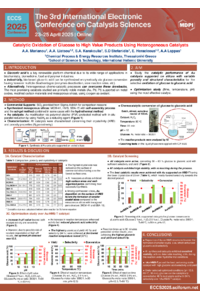
The method followed for the synthesis of all mesoporous silicas (SBA-15, MCM-41, HMS-2, HMS-3, HMS-5) was based on self-assembly processes and the sol-gel method. Au modification was achieved via a polyvinyl alcohol (PVA)-protected method with in situ parallel reduction by using NaBH4 as a reducing agent. All synthesized catalysts were fully characterized regarding their physicochemical properties. Glucose oxidation reaction was carried out in a batch, stirred, autoclave reactor (C-276 Parr Inst., USA). The reaction products were analyzed by ion chromatography (ICS-5000, Dionex, USA). The stability of the materials after the reaction was evaluated using ICP-AES analysis of the liquid phase.
Results and Discussion
Τhe results indicated that all synthesized catalysts exhibited excellent stability, with no detectable leaching of Au. Notably, the 1Au/TiO2 and 1Au/SBA-15 catalysts demonstrated the most promising performance, achieving glucose conversions of 69% and 67%, respectively, along with a gluconic acid selectivity exceeding 22 %.
Keywords
biomass valorization
glucose oxidation
gluconic acid
Au-based catalysts
Poster
Sciforum-112711_Poster ECCS2025_Marianou, Liatsou.pdf
Production of xylo-oligosaccharides from banana peel and corn husk by xylanase treatment
Exploring the Catalytic Potential of Oxide Glasses (Ceramics) in the Thermal Decomposition of Fatty Acids