Event submissions
Published
This submission belongs to the session F. Biomass Catalysis of the event The 3rd International Electronic Conference on Catalysis Sciences
Published date
21 Apr, 2025
Academic Editor
'%3e%3cpath%20d='M12.6657%2010.9104C12.4185%2010.325%2012.0599%209.79327%2011.6097%209.34482C11.1609%208.89508%2010.6293%208.5365%2010.0442%208.28888C10.0389%208.28626%2010.0337%208.28495%2010.0285%208.28233C10.8446%207.69279%2011.3752%206.73249%2011.3752%205.64904C11.3752%203.8542%209.92103%202.39999%208.1262%202.39999C6.33136%202.39999%204.87715%203.8542%204.87715%205.64904C4.87715%206.73249%205.40774%207.69279%206.22393%208.28364C6.21869%208.28626%206.21345%208.28757%206.20821%208.29019C5.62129%208.5378%205.09463%208.89284%204.64265%209.34613C4.1929%209.79493%203.83432%2010.3266%203.58671%2010.9117C3.34345%2011.4845%203.21226%2012.0987%203.20023%2012.7209C3.19988%2012.7349%203.20233%2012.7488%203.20744%2012.7619C3.21255%2012.7749%203.22022%2012.7867%203.22998%2012.7968C3.23975%2012.8068%203.25142%2012.8147%203.26431%2012.8202C3.2772%2012.8256%203.29105%2012.8284%203.30504%2012.8284H4.09109C4.14874%2012.8284%204.19459%2012.7825%204.1959%2012.7262C4.2221%2011.7148%204.62823%2010.7676%205.34617%2010.0497C6.08899%209.30683%207.0755%208.89808%208.1262%208.89808C9.17689%208.89808%2010.1634%209.30683%2010.9062%2010.0497C11.6242%2010.7676%2012.0303%2011.7148%2012.0565%2012.7262C12.0578%2012.7838%2012.1037%2012.8284%2012.1613%2012.8284H12.9474C12.9613%2012.8284%2012.9752%2012.8256%2012.9881%2012.8202C13.001%2012.8147%2013.0126%2012.8068%2013.0224%2012.7968C13.0322%2012.7867%2013.0398%2012.7749%2013.0449%2012.7619C13.0501%2012.7488%2013.0525%2012.7349%2013.0522%2012.7209C13.0391%2012.0947%2012.9094%2011.4855%2012.6657%2010.9104ZM8.1262%207.9024C7.52486%207.9024%206.9589%207.6679%206.53312%207.24211C6.10733%206.81633%205.87283%206.25037%205.87283%205.64904C5.87283%205.0477%206.10733%204.48174%206.53312%204.05596C6.9589%203.63018%207.52486%203.39567%208.1262%203.39567C8.72753%203.39567%209.29349%203.63018%209.71927%204.05596C10.1451%204.48174%2010.3796%205.0477%2010.3796%205.64904C10.3796%206.25037%2010.1451%206.81633%209.71927%207.24211C9.29349%207.6679%208.72753%207.9024%208.1262%207.9024Z'%20fill='%235D1EE1'/%3e%3c/g%3e%3c/svg%3e) Francesco Mauriello
Francesco MaurielloCitation
Sara Marijan, Petr Mošner, Ladislav Koudelka, Željko Skoko, Luka Pavić, Jana Pisk, Exploring the Catalytic Potential of Oxide Glasses (Ceramics) in the Thermal Decomposition of Fatty Acids, in Proceedings of The 3rd International Electronic Conference on Catalysis Sciences, 23 April–25 April 2025, MDPI: Basel, Switzerland
Share
Email
Facebook
Twitter
LinkedIn
Exploring the Catalytic Potential of Oxide Glasses (Ceramics) in the Thermal Decomposition of Fatty Acids
'%3e%3cpath%20d='M12.6647%2010.9104C12.4176%2010.325%2012.0589%209.7933%2011.6088%209.34485C11.16%208.89511%2010.6283%208.53653%2010.0432%208.28891C10.038%208.28629%2010.0327%208.28498%2010.0275%208.28236C10.8437%207.69282%2011.3743%206.73252%2011.3743%205.64907C11.3743%203.85423%209.92005%202.40002%208.12522%202.40002C6.33038%202.40002%204.87618%203.85423%204.87618%205.64907C4.87618%206.73252%205.40677%207.69282%206.22296%208.28367C6.21772%208.28629%206.21248%208.2876%206.20724%208.29022C5.62031%208.53783%205.09365%208.89287%204.64167%209.34616C4.19192%209.79496%203.83334%2010.3266%203.58573%2010.9117C3.34247%2011.4846%203.21128%2012.0987%203.19925%2012.721C3.1989%2012.735%203.20135%2012.7489%203.20646%2012.7619C3.21157%2012.7749%203.21924%2012.7868%203.22901%2012.7968C3.23877%2012.8068%203.25045%2012.8148%203.26334%2012.8202C3.27623%2012.8256%203.29007%2012.8284%203.30406%2012.8284H4.09012C4.14776%2012.8284%204.19362%2012.7825%204.19493%2012.7262C4.22113%2011.7148%204.62726%2010.7676%205.34519%2010.0497C6.08802%209.30686%207.07452%208.89811%208.12522%208.89811C9.17592%208.89811%2010.1624%209.30686%2010.9052%2010.0497C11.6232%2010.7676%2012.0293%2011.7148%2012.0555%2012.7262C12.0568%2012.7839%2012.1027%2012.8284%2012.1603%2012.8284H12.9464C12.9604%2012.8284%2012.9742%2012.8256%2012.9871%2012.8202C13%2012.8148%2013.0117%2012.8068%2013.0214%2012.7968C13.0312%2012.7868%2013.0389%2012.7749%2013.044%2012.7619C13.0491%2012.7489%2013.0515%2012.735%2013.0512%2012.721C13.0381%2012.0947%2012.9084%2011.4856%2012.6647%2010.9104ZM8.12522%207.90243C7.52388%207.90243%206.95792%207.66793%206.53214%207.24215C6.10636%206.81636%205.87185%206.2504%205.87185%205.64907C5.87185%205.04773%206.10636%204.48177%206.53214%204.05599C6.95792%203.63021%207.52388%203.3957%208.12522%203.3957C8.72655%203.3957%209.29252%203.63021%209.7183%204.05599C10.1441%204.48177%2010.3786%205.04773%2010.3786%205.64907C10.3786%206.2504%2010.1441%206.81636%209.7183%207.24215C9.29252%207.66793%208.72655%207.90243%208.12522%207.90243Z'%20fill='%235D1EE1'/%3e%3c/g%3e%3c/svg%3e)
Sara Marijan 1
Petr Mošner 2
Ladislav Koudelka 2

Željko Skoko 3

Luka Pavić 4

Jana Pisk 5
1. Ruđer Bošković Institute, Bijenička cesta 54, 10000 Zagreb
2. Department of General and Inorganic Chemistry, Faculty of Chemical Technology, University of Pardubice, Pardubice, Czech Republic
3. Department of Physics, Faculty of Science, University of Zagreb, Bijenička cesta 32, Zagreb, Croatia
4. Division of Materials Chemistry, Ruđer Bošković Institute, Bijenička cesta 54, Zagreb, Croatia
5. Department of Chemistry, Faculty of Science, University of Zagreb, Horvatovac 102a, Zagreb, Croatia
Abstract
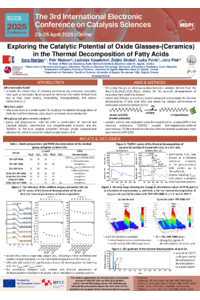
To tackle the critical issue of reducing greenhouse gas emissions, renewable fuels such as biofuels present an attractive alternative to fossil fuels due to their lower toxicity, renewability, biodegradability, and cleaner combustion [1,2]. This study focuses on developing cost-effective and innovative catalysts, specifically glasses (ceramics) derived from the Na2O-V2O5-(Al2O3)-P2O5-Nb2O5 system [3], for the pyrolytic deoxygenation of long-chain fatty acids into alkanes. Stearic acid was selected as a model compound to investigate the thermal decomposition of fatty acids and assess the catalytic performance of oxide glass (ceramic) catalysts, with additional experiments conducted on oleic acid and palmitic acid to extend the study. The tested catalysts varied in V2O5 content, ranging up to 70 mol% V2O5, with commercially available V2O5 used as a standard reference material. Catalytic activity was evaluated using thermogravimetric analysis/differential scanning calorimetry (TG/DSC), while coupled thermogravimetry–infrared spectroscopy (TG-IR) and simultaneous thermal analysis–quadrupole mass spectrometry (STA-QMS) provided comprehensive insights into the decomposition mechanisms. The results indicated that catalysts with a higher V2O5 content (≥ 55 mol%) significantly enhanced the thermal decomposition of fatty acids. This study highlights that oxide glasses (ceramics) are efficient catalysts for fatty acid decarboxylation, offering a combination of thermal and chemical stability, cost-effective and straightforward synthesis, and the flexibility to fine-tune catalyst properties through simple compositional adjustments, which is crucial for industrial applications.
This work is supported by the Croatian Science Foundation under projects IP-2018–01–5425 and DOK-2021–02–9665 and partially funded by the European Union – NextGenerationEU.
[1] Mulyatun, M. et al. Catal. Lett. 154, 4837–4855 (2024).
[2] Chen, B., et al., Appl. Catal. B: Environ. 338, 123067 (2023).
[3] Pisk, J. et al. J. Non-Cryst. Solids 626, 122780 (2024).
Keywords
oxide glasses
glass-ceramics
catalytic properties
fatty acid decarboxylation
coupled TG-IR system
coupled STA-QMS system
Poster
ECCS2025_Sara_Marijan_poster_v2.pdf
Glucose oxidation to High-Value Products Using Heterogeneous Catalysts
Strategic Design of Copper Nanoparticles on Modified Clay as Catalyst for Efficient Domino Synthesis of γ-Valerolactone from Furfural via Transfer Hydrogenation