Event submissions
Published
This submission belongs to the session H. Computational Catalysis of the event The 3rd International Electronic Conference on Catalysis Sciences
Published date
21 Apr, 2025
Academic Editor
'%3e%3cpath%20d='M12.6657%2010.9104C12.4185%2010.325%2012.0599%209.79327%2011.6097%209.34482C11.1609%208.89508%2010.6293%208.5365%2010.0442%208.28888C10.0389%208.28626%2010.0337%208.28495%2010.0285%208.28233C10.8446%207.69279%2011.3752%206.73249%2011.3752%205.64904C11.3752%203.8542%209.92103%202.39999%208.1262%202.39999C6.33136%202.39999%204.87715%203.8542%204.87715%205.64904C4.87715%206.73249%205.40774%207.69279%206.22393%208.28364C6.21869%208.28626%206.21345%208.28757%206.20821%208.29019C5.62129%208.5378%205.09463%208.89284%204.64265%209.34613C4.1929%209.79493%203.83432%2010.3266%203.58671%2010.9117C3.34345%2011.4845%203.21226%2012.0987%203.20023%2012.7209C3.19988%2012.7349%203.20233%2012.7488%203.20744%2012.7619C3.21255%2012.7749%203.22022%2012.7867%203.22998%2012.7968C3.23975%2012.8068%203.25142%2012.8147%203.26431%2012.8202C3.2772%2012.8256%203.29105%2012.8284%203.30504%2012.8284H4.09109C4.14874%2012.8284%204.19459%2012.7825%204.1959%2012.7262C4.2221%2011.7148%204.62823%2010.7676%205.34617%2010.0497C6.08899%209.30683%207.0755%208.89808%208.1262%208.89808C9.17689%208.89808%2010.1634%209.30683%2010.9062%2010.0497C11.6242%2010.7676%2012.0303%2011.7148%2012.0565%2012.7262C12.0578%2012.7838%2012.1037%2012.8284%2012.1613%2012.8284H12.9474C12.9613%2012.8284%2012.9752%2012.8256%2012.9881%2012.8202C13.001%2012.8147%2013.0126%2012.8068%2013.0224%2012.7968C13.0322%2012.7867%2013.0398%2012.7749%2013.0449%2012.7619C13.0501%2012.7488%2013.0525%2012.7349%2013.0522%2012.7209C13.0391%2012.0947%2012.9094%2011.4855%2012.6657%2010.9104ZM8.1262%207.9024C7.52486%207.9024%206.9589%207.6679%206.53312%207.24211C6.10733%206.81633%205.87283%206.25037%205.87283%205.64904C5.87283%205.0477%206.10733%204.48174%206.53312%204.05596C6.9589%203.63018%207.52486%203.39567%208.1262%203.39567C8.72753%203.39567%209.29349%203.63018%209.71927%204.05596C10.1451%204.48174%2010.3796%205.0477%2010.3796%205.64904C10.3796%206.25037%2010.1451%206.81633%209.71927%207.24211C9.29349%207.6679%208.72753%207.9024%208.1262%207.9024Z'%20fill='%235D1EE1'/%3e%3c/g%3e%3c/svg%3e) José R. B. Gomes
José R. B. GomesCitation
Ferran Acuña-Parés, The Role of Electronic and Geometric Factors in Rhodium-Catalyzed Selective Hydrogenation of Enones, in Proceedings of The 3rd International Electronic Conference on Catalysis Sciences, 23 April–25 April 2025, MDPI: Basel, Switzerland
Share
Email
Facebook
Twitter
LinkedIn
The Role of Electronic and Geometric Factors in Rhodium-Catalyzed Selective Hydrogenation of Enones

Ferran Acuña-Parés 1
1. Universidad Internacional de la Rioja (UNIR), Avda. de la Paz, 137. 26006. Logroño (La Rioja), Spain.
Abstract
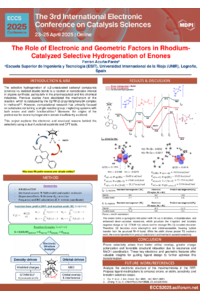
The selective hydrogenation of α,β-unsaturated carbonyl compounds (enones) versus isolated double bonds is a reaction of considerable interest in organic synthesis, particularly in the pharmaceutical and fine chemical industries. Previous studies have elucidated the mechanism of this reaction, which is catalyzed by the Cp*Rh(2-(2-pyridyl)phenyl)H complex1,2. However, computational research has primarily focused on substrates containing a single reactive group, neglecting systems with both enone and olefin functionalities2. Moreover, the origins of the preference for enone hydrogenation remain insufficiently explored.
In this study, DFT calculations were employed to investigate the key electronic and geometric features enabling the selective hydrogenation of a dual-functionality substrate, catalyzed by the Cp*Rh(2-(2-pyridyl)phenyl)H complex. The analysis integrated two complementary approaches: (1) an electron density-focused framework, including charge transfer and QTAIM/ELF analyses at critical points along the reaction force profile, and (2) quantum mechanical methods such as NBO analysis of donor–acceptor interactions and interference energy evaluations of the complex–substrate system. Additionally, coordination and deformation energies of the catalyst–substrate complex were compared for dual substrates and for substrates containing only one functionality.
The results reveal that the selective hydrogenation of enones over olefins is governed by distinct substrate–catalyst interactions, influenced by both steric and electronic factors. The interplay between electrostatic and quantum phenomena elucidates the preference for enone hydrogenation and provides insights into the coupling between electron and proton transfers along the reaction pathway. These findings suggest modifications to the ligand structure to further enhance the selective hydrogenation of enones, expanding the versatility of Rh-catalyzed transformations in synthetic chemistry.
- Gu, Y., Norton, J. R., Salahi, F., Lisnyak, V. G., Zhou, Z., & Snyder, S. A. (2021). Highly selective hydrogenation of C═C bonds catalyzed by a rhodium hydride. Journal of the American Chemical Society, 143(25), 9657-9663.
- Zhang, Y., & Li, X. (2022). Computational Mechanism Investigation of C=C Bond Hydrogenation Catalyzed by Rhodium Hydride. ChemPhysChem, 23(18), e202200562.
Keywords
Computational Catalysis
Hydrogenation reaction
Electronic structure analysis
Poster
Poster_Ferran_Acuña_final.pdf
Conversion of Carbon dioxide to hydrocarbons over hybrid catalysts containing methanol synthesis catalyst and zeolite
First-principles calculations of structural and electronic properties of FeSb2O6