Event submissions
Published
This submission belongs to the session H. Computational Catalysis of the event The 3rd International Electronic Conference on Catalysis Sciences
Published date
21 Apr, 2025
Academic Editor
'%3e%3cpath%20d='M12.6657%2010.9104C12.4185%2010.325%2012.0599%209.79327%2011.6097%209.34482C11.1609%208.89508%2010.6293%208.5365%2010.0442%208.28888C10.0389%208.28626%2010.0337%208.28495%2010.0285%208.28233C10.8446%207.69279%2011.3752%206.73249%2011.3752%205.64904C11.3752%203.8542%209.92103%202.39999%208.1262%202.39999C6.33136%202.39999%204.87715%203.8542%204.87715%205.64904C4.87715%206.73249%205.40774%207.69279%206.22393%208.28364C6.21869%208.28626%206.21345%208.28757%206.20821%208.29019C5.62129%208.5378%205.09463%208.89284%204.64265%209.34613C4.1929%209.79493%203.83432%2010.3266%203.58671%2010.9117C3.34345%2011.4845%203.21226%2012.0987%203.20023%2012.7209C3.19988%2012.7349%203.20233%2012.7488%203.20744%2012.7619C3.21255%2012.7749%203.22022%2012.7867%203.22998%2012.7968C3.23975%2012.8068%203.25142%2012.8147%203.26431%2012.8202C3.2772%2012.8256%203.29105%2012.8284%203.30504%2012.8284H4.09109C4.14874%2012.8284%204.19459%2012.7825%204.1959%2012.7262C4.2221%2011.7148%204.62823%2010.7676%205.34617%2010.0497C6.08899%209.30683%207.0755%208.89808%208.1262%208.89808C9.17689%208.89808%2010.1634%209.30683%2010.9062%2010.0497C11.6242%2010.7676%2012.0303%2011.7148%2012.0565%2012.7262C12.0578%2012.7838%2012.1037%2012.8284%2012.1613%2012.8284H12.9474C12.9613%2012.8284%2012.9752%2012.8256%2012.9881%2012.8202C13.001%2012.8147%2013.0126%2012.8068%2013.0224%2012.7968C13.0322%2012.7867%2013.0398%2012.7749%2013.0449%2012.7619C13.0501%2012.7488%2013.0525%2012.7349%2013.0522%2012.7209C13.0391%2012.0947%2012.9094%2011.4855%2012.6657%2010.9104ZM8.1262%207.9024C7.52486%207.9024%206.9589%207.6679%206.53312%207.24211C6.10733%206.81633%205.87283%206.25037%205.87283%205.64904C5.87283%205.0477%206.10733%204.48174%206.53312%204.05596C6.9589%203.63018%207.52486%203.39567%208.1262%203.39567C8.72753%203.39567%209.29349%203.63018%209.71927%204.05596C10.1451%204.48174%2010.3796%205.0477%2010.3796%205.64904C10.3796%206.25037%2010.1451%206.81633%209.71927%207.24211C9.29349%207.6679%208.72753%207.9024%208.1262%207.9024Z'%20fill='%235D1EE1'/%3e%3c/g%3e%3c/svg%3e) José R. B. Gomes
José R. B. GomesCitation
Mohammed Sakib Musa, Mst. Farhana Afrin, Monir Uzzaman, Structural Modification of Graphitic Carbon Nitride to Enhance Photocatalytic Efficiency: DFT-based Physicochemical and Spectral Study, in Proceedings of The 3rd International Electronic Conference on Catalysis Sciences, 23 April–25 April 2025, MDPI: Basel, Switzerland
Share
Email
Facebook
Twitter
LinkedIn
Structural Modification of Graphitic Carbon Nitride to Enhance Photocatalytic Efficiency: DFT-based Physicochemical and Spectral Study
'%3e%3cpath%20d='M12.6647%2010.9104C12.4176%2010.325%2012.0589%209.7933%2011.6088%209.34485C11.16%208.89511%2010.6283%208.53653%2010.0432%208.28891C10.038%208.28629%2010.0327%208.28498%2010.0275%208.28236C10.8437%207.69282%2011.3743%206.73252%2011.3743%205.64907C11.3743%203.85423%209.92005%202.40002%208.12522%202.40002C6.33038%202.40002%204.87618%203.85423%204.87618%205.64907C4.87618%206.73252%205.40677%207.69282%206.22296%208.28367C6.21772%208.28629%206.21248%208.2876%206.20724%208.29022C5.62031%208.53783%205.09365%208.89287%204.64167%209.34616C4.19192%209.79496%203.83334%2010.3266%203.58573%2010.9117C3.34247%2011.4846%203.21128%2012.0987%203.19925%2012.721C3.1989%2012.735%203.20135%2012.7489%203.20646%2012.7619C3.21157%2012.7749%203.21924%2012.7868%203.22901%2012.7968C3.23877%2012.8068%203.25045%2012.8148%203.26334%2012.8202C3.27623%2012.8256%203.29007%2012.8284%203.30406%2012.8284H4.09012C4.14776%2012.8284%204.19362%2012.7825%204.19493%2012.7262C4.22113%2011.7148%204.62726%2010.7676%205.34519%2010.0497C6.08802%209.30686%207.07452%208.89811%208.12522%208.89811C9.17592%208.89811%2010.1624%209.30686%2010.9052%2010.0497C11.6232%2010.7676%2012.0293%2011.7148%2012.0555%2012.7262C12.0568%2012.7839%2012.1027%2012.8284%2012.1603%2012.8284H12.9464C12.9604%2012.8284%2012.9742%2012.8256%2012.9871%2012.8202C13%2012.8148%2013.0117%2012.8068%2013.0214%2012.7968C13.0312%2012.7868%2013.0389%2012.7749%2013.044%2012.7619C13.0491%2012.7489%2013.0515%2012.735%2013.0512%2012.721C13.0381%2012.0947%2012.9084%2011.4856%2012.6647%2010.9104ZM8.12522%207.90243C7.52388%207.90243%206.95792%207.66793%206.53214%207.24215C6.10636%206.81636%205.87185%206.2504%205.87185%205.64907C5.87185%205.04773%206.10636%204.48177%206.53214%204.05599C6.95792%203.63021%207.52388%203.3957%208.12522%203.3957C8.72655%203.3957%209.29252%203.63021%209.7183%204.05599C10.1441%204.48177%2010.3786%205.04773%2010.3786%205.64907C10.3786%206.2504%2010.1441%206.81636%209.7183%207.24215C9.29252%207.66793%208.72655%207.90243%208.12522%207.90243Z'%20fill='%235D1EE1'/%3e%3c/g%3e%3c/svg%3e)
Mohammed Sakib Musa 1
Mst. Farhana Afrin 2
Monir Uzzaman 2
1. Department of Applied Chemistry and Chemical Engineering, University of Chittagong, 4331, Bangladesh
2. Department of Applied Chemistry, Mie University, Tsu, Mie 514-8507, Japan
Abstract
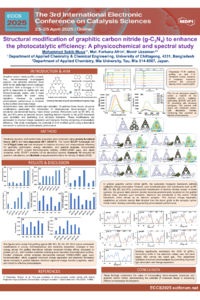
Semiconductor-based photocatalysis presents a promising solution to the global energy crisis and environmental pollution challenges. Since the groundbreaking discovery of graphitic carbon nitride (g-C₃N₄) in 2009 for visible light-driven photocatalytic water splitting, g-C₃N₄-based photocatalysis has emerged as a highly active area of research. Herein, the structural modification of pristine g-C₃N₄ isexplored to enhance its photocatalytic efficiency, employing density functional theory (DFT) with the widely adopted B3LYP/6-31g(d) theory. Furthermore, the band structure for the periodic system was determined using GGA-PBE functionals. This study investigated the effects of functionalizing g-C₃N₄ with different grafting agents, including benzofuran (BF), benzoxazole (BFz), indole (ID), and benzimidazole (IDz). Thermodynamic analyses revealed notable changes in free energy, indicating the improved binding possibility of the modified materials. Frontier molecular orbital analyses showed reduced HOMO-LUMO gaps, correlated with enhanced reactivity and improved charge transfer properties. Dipole moment analyses confirmed increased polarity, promoting higher photocatalytic activity. Band structure and density of states (DOS) analyses demonstrated shifts in energy levels conducive to visible light absorption. Theoretical FT-IR and Raman spectra confirmed successful functionalization by identifying characteristic bonds and vibrational modes. In contrast, UV-vis absorption spectra revealed a redshift absorption of modified g-C₃N₄, indicating improved light absorption. These findings highlight the potential of grafted g-C₃N₄ materials for efficient photocatalytic applications, offering a promising approach to address energy and environmental challenges.
Keywords
g-C₃N₄
DFT
Spectrochemical analyses
DOS
Band structure
Poster
ECCS2025 sciforum-115373.pdf
Structural modification of porphyrin to accelerate its electron donor nature: a physicochemical and spectral study
Exploring the Catalytic Potential of Noble and Non-Noble Metals for Carbon Monoxide Oxidation: A Computational Study