Event submissions
Published

This submission belongs to the session S1. Chemo- and Biosensors of the event The 11th International Electronic Conference on Sensors and Applications
Published date
23 Apr, 2025
Academic Editor
'%3e%3cpath%20d='M12.6657%2010.9104C12.4185%2010.325%2012.0599%209.79327%2011.6097%209.34482C11.1609%208.89508%2010.6293%208.5365%2010.0442%208.28888C10.0389%208.28626%2010.0337%208.28495%2010.0285%208.28233C10.8446%207.69279%2011.3752%206.73249%2011.3752%205.64904C11.3752%203.8542%209.92103%202.39999%208.1262%202.39999C6.33136%202.39999%204.87715%203.8542%204.87715%205.64904C4.87715%206.73249%205.40774%207.69279%206.22393%208.28364C6.21869%208.28626%206.21345%208.28757%206.20821%208.29019C5.62129%208.5378%205.09463%208.89284%204.64265%209.34613C4.1929%209.79493%203.83432%2010.3266%203.58671%2010.9117C3.34345%2011.4845%203.21226%2012.0987%203.20023%2012.7209C3.19988%2012.7349%203.20233%2012.7488%203.20744%2012.7619C3.21255%2012.7749%203.22022%2012.7867%203.22998%2012.7968C3.23975%2012.8068%203.25142%2012.8147%203.26431%2012.8202C3.2772%2012.8256%203.29105%2012.8284%203.30504%2012.8284H4.09109C4.14874%2012.8284%204.19459%2012.7825%204.1959%2012.7262C4.2221%2011.7148%204.62823%2010.7676%205.34617%2010.0497C6.08899%209.30683%207.0755%208.89808%208.1262%208.89808C9.17689%208.89808%2010.1634%209.30683%2010.9062%2010.0497C11.6242%2010.7676%2012.0303%2011.7148%2012.0565%2012.7262C12.0578%2012.7838%2012.1037%2012.8284%2012.1613%2012.8284H12.9474C12.9613%2012.8284%2012.9752%2012.8256%2012.9881%2012.8202C13.001%2012.8147%2013.0126%2012.8068%2013.0224%2012.7968C13.0322%2012.7867%2013.0398%2012.7749%2013.0449%2012.7619C13.0501%2012.7488%2013.0525%2012.7349%2013.0522%2012.7209C13.0391%2012.0947%2012.9094%2011.4855%2012.6657%2010.9104ZM8.1262%207.9024C7.52486%207.9024%206.9589%207.6679%206.53312%207.24211C6.10733%206.81633%205.87283%206.25037%205.87283%205.64904C5.87283%205.0477%206.10733%204.48174%206.53312%204.05596C6.9589%203.63018%207.52486%203.39567%208.1262%203.39567C8.72753%203.39567%209.29349%203.63018%209.71927%204.05596C10.1451%204.48174%2010.3796%205.0477%2010.3796%205.64904C10.3796%206.25037%2010.1451%206.81633%209.71927%207.24211C9.29349%207.6679%208.72753%207.9024%208.1262%207.9024Z'%20fill='%235D1EE1'/%3e%3c/g%3e%3c/svg%3e) Francisco Falcone
Francisco FalconeCitation
Irina O. Ignatieva, Victor V. Petrov, Ekaterina M. Bayan, Synthesis of nanocrystalline composite CuO-ZnO thin films for photovoltaic sensors, in Proceedings of The 11th International Electronic Conference on Sensors and Applications, 26 November–28 November 2024, MDPI: Basel, Switzerland, doi: 10.3390/ecsa-11-22210
Share
Email
Facebook
Twitter
LinkedIn
Synthesis of nanocrystalline composite CuO-ZnO thin films for photovoltaic sensors
'%3e%3cpath%20d='M12.6647%2010.9104C12.4176%2010.325%2012.0589%209.7933%2011.6088%209.34485C11.16%208.89511%2010.6283%208.53653%2010.0432%208.28891C10.038%208.28629%2010.0327%208.28498%2010.0275%208.28236C10.8437%207.69282%2011.3743%206.73252%2011.3743%205.64907C11.3743%203.85423%209.92005%202.40002%208.12522%202.40002C6.33038%202.40002%204.87618%203.85423%204.87618%205.64907C4.87618%206.73252%205.40677%207.69282%206.22296%208.28367C6.21772%208.28629%206.21248%208.2876%206.20724%208.29022C5.62031%208.53783%205.09365%208.89287%204.64167%209.34616C4.19192%209.79496%203.83334%2010.3266%203.58573%2010.9117C3.34247%2011.4846%203.21128%2012.0987%203.19925%2012.721C3.1989%2012.735%203.20135%2012.7489%203.20646%2012.7619C3.21157%2012.7749%203.21924%2012.7868%203.22901%2012.7968C3.23877%2012.8068%203.25045%2012.8148%203.26334%2012.8202C3.27623%2012.8256%203.29007%2012.8284%203.30406%2012.8284H4.09012C4.14776%2012.8284%204.19362%2012.7825%204.19493%2012.7262C4.22113%2011.7148%204.62726%2010.7676%205.34519%2010.0497C6.08802%209.30686%207.07452%208.89811%208.12522%208.89811C9.17592%208.89811%2010.1624%209.30686%2010.9052%2010.0497C11.6232%2010.7676%2012.0293%2011.7148%2012.0555%2012.7262C12.0568%2012.7839%2012.1027%2012.8284%2012.1603%2012.8284H12.9464C12.9604%2012.8284%2012.9742%2012.8256%2012.9871%2012.8202C13%2012.8148%2013.0117%2012.8068%2013.0214%2012.7968C13.0312%2012.7868%2013.0389%2012.7749%2013.044%2012.7619C13.0491%2012.7489%2013.0515%2012.735%2013.0512%2012.721C13.0381%2012.0947%2012.9084%2011.4856%2012.6647%2010.9104ZM8.12522%207.90243C7.52388%207.90243%206.95792%207.66793%206.53214%207.24215C6.10636%206.81636%205.87185%206.2504%205.87185%205.64907C5.87185%205.04773%206.10636%204.48177%206.53214%204.05599C6.95792%203.63021%207.52388%203.3957%208.12522%203.3957C8.72655%203.3957%209.29252%203.63021%209.7183%204.05599C10.1441%204.48177%2010.3786%205.04773%2010.3786%205.64907C10.3786%206.2504%2010.1441%206.81636%209.7183%207.24215C9.29252%207.66793%208.72655%207.90243%208.12522%207.90243Z'%20fill='%235D1EE1'/%3e%3c/g%3e%3c/svg%3e)
Irina O. Ignatieva 1
Victor V. Petrov 2
Ekaterina M. Bayan 1
1. Faculty of Chemistry, Southern Federal University, Rostov-on-Don, 344090, Russia
2. Southern Federal University, Taganrog, Russia
Abstract
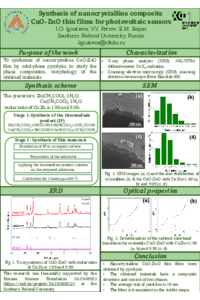
Zinc oxide is a multifunctional material, and composite nanomaterials based on it are used in optoelectronic devices and solar cells. P-type oxides CuO is added to the n-type semiconductor ZnO to create photosensitive resistors. In this work, nanocrystalline composite CuO-ZnO thin films were synthesized using solid-phase pyrolysis by the two-step method. Zn(CH3COO)2∙2H2O, Cu(CH3COO)2∙2H2O and C19H29COOH were used as the precursors. At the first stage, an intermediate product was obtained, which is a mixture of zinc and copper salts. Then, a solution of this intermediate product in an organic solvent was applied to pre-prepared substrates. After calcination for 2 hours at 600 °C, a film coating was formed. The molar ratio of Cu:Zn is 1:99 and 5:99. By XRD, the obtained materials are polycrystalline and two-phase. The peak intensity of ZnO is significantly more pronounced compared to CuO, which appears as the additive content increases. No other phases were detected. SEM studies have revealed that the films are homogeneous. The average size of spherical particles is 18 nm. n-p heterojunction formed between ZnO and CuO nanocrystallites in contact with each other. Optical measurements made it possible to determine the energy level of the band gap in the obtained composites. This energy level was found to be lower than that of ZnO, which explains why the composites are sensitive not only to UV light but also to visible light. The resulting materials are sensitive not only to UV light, but also to visible radiation, suggesting that they can be used to create photosensitive resistive sensors.
This research was financially supported by the Russian Science Foundation 24-29-00203 (https://rscf.ru/project/24-29-00203/) at the Southern Federal University.
Keywords
zinc oxide
copper oxide
composite
thin films
Manuscript
engproc-ssciforum-105898_original_Ignatieva-done.pdf
Poster
MDPI. Ignatieva.pdf
Time-dependent modelling of an electrochemical impedance spectroscopy based sensor
Performance Comparison of Parallel and 3 Finger Gripper Using Human Hand Grasping Taxonomies