Event submissions
Published
This submission belongs to the session E. Nanomaterials and Smart Surfaces in Biosensors of the event The 5th International Electronic Conference on Biosensors
Published date
02 May, 2025
Academic Editor
'%3e%3cpath%20d='M12.6657%2010.9104C12.4185%2010.325%2012.0599%209.79327%2011.6097%209.34482C11.1609%208.89508%2010.6293%208.5365%2010.0442%208.28888C10.0389%208.28626%2010.0337%208.28495%2010.0285%208.28233C10.8446%207.69279%2011.3752%206.73249%2011.3752%205.64904C11.3752%203.8542%209.92103%202.39999%208.1262%202.39999C6.33136%202.39999%204.87715%203.8542%204.87715%205.64904C4.87715%206.73249%205.40774%207.69279%206.22393%208.28364C6.21869%208.28626%206.21345%208.28757%206.20821%208.29019C5.62129%208.5378%205.09463%208.89284%204.64265%209.34613C4.1929%209.79493%203.83432%2010.3266%203.58671%2010.9117C3.34345%2011.4845%203.21226%2012.0987%203.20023%2012.7209C3.19988%2012.7349%203.20233%2012.7488%203.20744%2012.7619C3.21255%2012.7749%203.22022%2012.7867%203.22998%2012.7968C3.23975%2012.8068%203.25142%2012.8147%203.26431%2012.8202C3.2772%2012.8256%203.29105%2012.8284%203.30504%2012.8284H4.09109C4.14874%2012.8284%204.19459%2012.7825%204.1959%2012.7262C4.2221%2011.7148%204.62823%2010.7676%205.34617%2010.0497C6.08899%209.30683%207.0755%208.89808%208.1262%208.89808C9.17689%208.89808%2010.1634%209.30683%2010.9062%2010.0497C11.6242%2010.7676%2012.0303%2011.7148%2012.0565%2012.7262C12.0578%2012.7838%2012.1037%2012.8284%2012.1613%2012.8284H12.9474C12.9613%2012.8284%2012.9752%2012.8256%2012.9881%2012.8202C13.001%2012.8147%2013.0126%2012.8068%2013.0224%2012.7968C13.0322%2012.7867%2013.0398%2012.7749%2013.0449%2012.7619C13.0501%2012.7488%2013.0525%2012.7349%2013.0522%2012.7209C13.0391%2012.0947%2012.9094%2011.4855%2012.6657%2010.9104ZM8.1262%207.9024C7.52486%207.9024%206.9589%207.6679%206.53312%207.24211C6.10733%206.81633%205.87283%206.25037%205.87283%205.64904C5.87283%205.0477%206.10733%204.48174%206.53312%204.05596C6.9589%203.63018%207.52486%203.39567%208.1262%203.39567C8.72753%203.39567%209.29349%203.63018%209.71927%204.05596C10.1451%204.48174%2010.3796%205.0477%2010.3796%205.64904C10.3796%206.25037%2010.1451%206.81633%209.71927%207.24211C9.29349%207.6679%208.72753%207.9024%208.1262%207.9024Z'%20fill='%235D1EE1'/%3e%3c/g%3e%3c/svg%3e) Michael Thompson
Michael ThompsonCitation
Sorina-Alexandra Leau, Cecilia Lete, Mariana Marin, Cristian Matei, Stelian Lupu, Polydopamine-PEDOT-based composite material for electrochemical sensing applications, in Proceedings of The 5th International Electronic Conference on Biosensors, 26 May–28 May 2025, MDPI: Basel, Switzerland
Share
Email
Facebook
Twitter
LinkedIn
Polydopamine-PEDOT-based composite material for electrochemical sensing applications
'%3e%3cpath%20d='M12.6647%2010.9104C12.4176%2010.325%2012.0589%209.7933%2011.6088%209.34485C11.16%208.89511%2010.6283%208.53653%2010.0432%208.28891C10.038%208.28629%2010.0327%208.28498%2010.0275%208.28236C10.8437%207.69282%2011.3743%206.73252%2011.3743%205.64907C11.3743%203.85423%209.92005%202.40002%208.12522%202.40002C6.33038%202.40002%204.87618%203.85423%204.87618%205.64907C4.87618%206.73252%205.40677%207.69282%206.22296%208.28367C6.21772%208.28629%206.21248%208.2876%206.20724%208.29022C5.62031%208.53783%205.09365%208.89287%204.64167%209.34616C4.19192%209.79496%203.83334%2010.3266%203.58573%2010.9117C3.34247%2011.4846%203.21128%2012.0987%203.19925%2012.721C3.1989%2012.735%203.20135%2012.7489%203.20646%2012.7619C3.21157%2012.7749%203.21924%2012.7868%203.22901%2012.7968C3.23877%2012.8068%203.25045%2012.8148%203.26334%2012.8202C3.27623%2012.8256%203.29007%2012.8284%203.30406%2012.8284H4.09012C4.14776%2012.8284%204.19362%2012.7825%204.19493%2012.7262C4.22113%2011.7148%204.62726%2010.7676%205.34519%2010.0497C6.08802%209.30686%207.07452%208.89811%208.12522%208.89811C9.17592%208.89811%2010.1624%209.30686%2010.9052%2010.0497C11.6232%2010.7676%2012.0293%2011.7148%2012.0555%2012.7262C12.0568%2012.7839%2012.1027%2012.8284%2012.1603%2012.8284H12.9464C12.9604%2012.8284%2012.9742%2012.8256%2012.9871%2012.8202C13%2012.8148%2013.0117%2012.8068%2013.0214%2012.7968C13.0312%2012.7868%2013.0389%2012.7749%2013.044%2012.7619C13.0491%2012.7489%2013.0515%2012.735%2013.0512%2012.721C13.0381%2012.0947%2012.9084%2011.4856%2012.6647%2010.9104ZM8.12522%207.90243C7.52388%207.90243%206.95792%207.66793%206.53214%207.24215C6.10636%206.81636%205.87185%206.2504%205.87185%205.64907C5.87185%205.04773%206.10636%204.48177%206.53214%204.05599C6.95792%203.63021%207.52388%203.3957%208.12522%203.3957C8.72655%203.3957%209.29252%203.63021%209.7183%204.05599C10.1441%204.48177%2010.3786%205.04773%2010.3786%205.64907C10.3786%206.2504%2010.1441%206.81636%209.7183%207.24215C9.29252%207.66793%208.72655%207.90243%208.12522%207.90243Z'%20fill='%235D1EE1'/%3e%3c/g%3e%3c/svg%3e)
Sorina-Alexandra Leau 1

Cecilia Lete 2
Mariana Marin 2

Cristian Matei 3

Stelian Lupu 4
1. National University of Science and Technology Politehnica of Bucharest, Doctoral School of Chemical Engineering and Biotechnologies, 1-7 Polizu Gheorghe, 011061 Bucharest, Romania
2. Institute of Physical Chemistry - Ilie Murgulescu of the Romanian Academy, 202 Splaiul Independentei, 060021 Bucharest, Romania
3. National University of Science and Technology Politehnica of Bucharest, Faculty of Chemical Engineering and Biotechnologies, Department of Inorganic Chemistry, Physical Chemistry and Electrochemistry, 1-7 Polizu Gheorghe, 011061 Bucharest, Romania
4. National University of Science and Technology Politehnica of Bucharest, Faculty of Chemical Engineering and Biotechnologies, Department of Analytical Chemistry and Environmental Engineering, 1-7 Polizu Gheorghe, 011061 Bucharest, Romania
Abstract
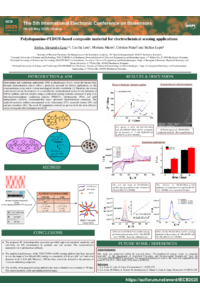
A novel sensing material has been synthesized for the design of an electrochemical sensor for epinephrine detection. The sensing material is composed of poly(3,4-ethylenedioxythiophene) polymer (PEDOT), polydopamine (PDA), and gold nanoparticles (AuNPs). The use of low-cost chemicals and the development of water-based preparation methods without the need for organic solvents were intended to comply with a sustainable development goal in the sensor’s preparation. The biocompatibility and adhesion properties of PDA were explored in the sensor’s design. The inclusion of AuNPs featuring pronounced electrocatalytic properties was aimed at improving the analytical sensitivity. The sensing material has been synthesized onto glassy carbon electrodes by using cyclic voltammetry and sinusoidal tension and current methods. The morphological analysis of the sensing material was carried out by scanning electron microscopy. The sinusoidal currents method [1] achieved the best analytical performance of the PEDOT-PDA-AuNP sensor toward epinephrine determination. A linear response in the range of 0.4 - 100 μM and a detection limit value of 0.11 μM epinephrine were obtained. The sensing material shows improved antifouling properties and stability in the detection of epinephrine in synthetic samples. The detection of epinephrine in spiked synthetic and urine samples was achieved with good accuracy and minor interferences from uric acid. The sensor is designed for reuse of the electrodic substrate, while the modifier can be eliminated by local procedures. The analytical performance of the sensor is comparable with that of other sensors prepared with conventional methods.
References:
[1]. S.A. Leau et. al. Biosensors 14 (2024) 320.
Keywords
electrochemical sensor
sinusoidal currents
gold nanoparticles
polydopamine
epinephrine.
Poster
sciforum-114727_Poster IECB 2025.pdf
Electrochemical/Optical detection of alpha synuclein biomarkers in clinical samples
Design of Pentagon-Shaped THz Photonic Crystal Fiber Biosensor for Early Detection of Crop Pathogens Using Rotation-Dilated Invariant Convolutional Cascaded Secretary-Bird Visual Attention Networks