Event submissions
Published
This submission belongs to the session C. Smartphone-based Biosensors of the event The 5th International Electronic Conference on Biosensors
Published date
02 May, 2025
Academic Editor
'%3e%3cpath%20d='M12.6657%2010.9104C12.4185%2010.325%2012.0599%209.79327%2011.6097%209.34482C11.1609%208.89508%2010.6293%208.5365%2010.0442%208.28888C10.0389%208.28626%2010.0337%208.28495%2010.0285%208.28233C10.8446%207.69279%2011.3752%206.73249%2011.3752%205.64904C11.3752%203.8542%209.92103%202.39999%208.1262%202.39999C6.33136%202.39999%204.87715%203.8542%204.87715%205.64904C4.87715%206.73249%205.40774%207.69279%206.22393%208.28364C6.21869%208.28626%206.21345%208.28757%206.20821%208.29019C5.62129%208.5378%205.09463%208.89284%204.64265%209.34613C4.1929%209.79493%203.83432%2010.3266%203.58671%2010.9117C3.34345%2011.4845%203.21226%2012.0987%203.20023%2012.7209C3.19988%2012.7349%203.20233%2012.7488%203.20744%2012.7619C3.21255%2012.7749%203.22022%2012.7867%203.22998%2012.7968C3.23975%2012.8068%203.25142%2012.8147%203.26431%2012.8202C3.2772%2012.8256%203.29105%2012.8284%203.30504%2012.8284H4.09109C4.14874%2012.8284%204.19459%2012.7825%204.1959%2012.7262C4.2221%2011.7148%204.62823%2010.7676%205.34617%2010.0497C6.08899%209.30683%207.0755%208.89808%208.1262%208.89808C9.17689%208.89808%2010.1634%209.30683%2010.9062%2010.0497C11.6242%2010.7676%2012.0303%2011.7148%2012.0565%2012.7262C12.0578%2012.7838%2012.1037%2012.8284%2012.1613%2012.8284H12.9474C12.9613%2012.8284%2012.9752%2012.8256%2012.9881%2012.8202C13.001%2012.8147%2013.0126%2012.8068%2013.0224%2012.7968C13.0322%2012.7867%2013.0398%2012.7749%2013.0449%2012.7619C13.0501%2012.7488%2013.0525%2012.7349%2013.0522%2012.7209C13.0391%2012.0947%2012.9094%2011.4855%2012.6657%2010.9104ZM8.1262%207.9024C7.52486%207.9024%206.9589%207.6679%206.53312%207.24211C6.10733%206.81633%205.87283%206.25037%205.87283%205.64904C5.87283%205.0477%206.10733%204.48174%206.53312%204.05596C6.9589%203.63018%207.52486%203.39567%208.1262%203.39567C8.72753%203.39567%209.29349%203.63018%209.71927%204.05596C10.1451%204.48174%2010.3796%205.0477%2010.3796%205.64904C10.3796%206.25037%2010.1451%206.81633%209.71927%207.24211C9.29349%207.6679%208.72753%207.9024%208.1262%207.9024Z'%20fill='%235D1EE1'/%3e%3c/g%3e%3c/svg%3e) Elisa Michelini
Elisa MicheliniCitation
Roshani Machhindranath Gadadare, Gripsa Prakashbhai Davariya, Abhi Piyushbhai Senjaliya, Mehul Dilipbhai Teraiya, Dr. Sheetal Sandeep Buddhadev, Smartphone-Integrated CRISPR Biosensors for Portable and High-Sensitivity Diagnostics, in Proceedings of The 5th International Electronic Conference on Biosensors, 26 May–28 May 2025, MDPI: Basel, Switzerland
Share
Email
Facebook
Twitter
LinkedIn
Smartphone-Integrated CRISPR Biosensors for Portable and High-Sensitivity Diagnostics
'%3e%3cpath%20d='M12.6647%2010.9104C12.4176%2010.325%2012.0589%209.7933%2011.6088%209.34485C11.16%208.89511%2010.6283%208.53653%2010.0432%208.28891C10.038%208.28629%2010.0327%208.28498%2010.0275%208.28236C10.8437%207.69282%2011.3743%206.73252%2011.3743%205.64907C11.3743%203.85423%209.92005%202.40002%208.12522%202.40002C6.33038%202.40002%204.87618%203.85423%204.87618%205.64907C4.87618%206.73252%205.40677%207.69282%206.22296%208.28367C6.21772%208.28629%206.21248%208.2876%206.20724%208.29022C5.62031%208.53783%205.09365%208.89287%204.64167%209.34616C4.19192%209.79496%203.83334%2010.3266%203.58573%2010.9117C3.34247%2011.4846%203.21128%2012.0987%203.19925%2012.721C3.1989%2012.735%203.20135%2012.7489%203.20646%2012.7619C3.21157%2012.7749%203.21924%2012.7868%203.22901%2012.7968C3.23877%2012.8068%203.25045%2012.8148%203.26334%2012.8202C3.27623%2012.8256%203.29007%2012.8284%203.30406%2012.8284H4.09012C4.14776%2012.8284%204.19362%2012.7825%204.19493%2012.7262C4.22113%2011.7148%204.62726%2010.7676%205.34519%2010.0497C6.08802%209.30686%207.07452%208.89811%208.12522%208.89811C9.17592%208.89811%2010.1624%209.30686%2010.9052%2010.0497C11.6232%2010.7676%2012.0293%2011.7148%2012.0555%2012.7262C12.0568%2012.7839%2012.1027%2012.8284%2012.1603%2012.8284H12.9464C12.9604%2012.8284%2012.9742%2012.8256%2012.9871%2012.8202C13%2012.8148%2013.0117%2012.8068%2013.0214%2012.7968C13.0312%2012.7868%2013.0389%2012.7749%2013.044%2012.7619C13.0491%2012.7489%2013.0515%2012.735%2013.0512%2012.721C13.0381%2012.0947%2012.9084%2011.4856%2012.6647%2010.9104ZM8.12522%207.90243C7.52388%207.90243%206.95792%207.66793%206.53214%207.24215C6.10636%206.81636%205.87185%206.2504%205.87185%205.64907C5.87185%205.04773%206.10636%204.48177%206.53214%204.05599C6.95792%203.63021%207.52388%203.3957%208.12522%203.3957C8.72655%203.3957%209.29252%203.63021%209.7183%204.05599C10.1441%204.48177%2010.3786%205.04773%2010.3786%205.64907C10.3786%206.2504%2010.1441%206.81636%209.7183%207.24215C9.29252%207.66793%208.72655%207.90243%208.12522%207.90243Z'%20fill='%235D1EE1'/%3e%3c/g%3e%3c/svg%3e)
Roshani Machhindranath Gadadare 1
Gripsa Prakashbhai Davariya 1
Abhi Piyushbhai Senjaliya 1
Mehul Dilipbhai Teraiya 1

Dr. Sheetal Sandeep Buddhadev 2
1. Student, Faculty of Pharmacy, Noble University, Junagadh, Gujarat 362001, India
2. Professor of Faculty of Pharmacy, Noble University, Junagadh 362001, Gujarat, India
Abstract
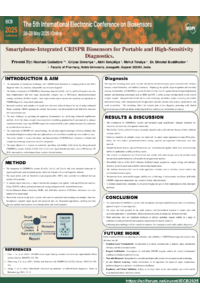
The combination of CRISPR-based biosensors with smartphone technology is changing point-of-care (PoC) diagnosis by offering fast, portable, and highly sensitive diagnosis of the disease. CRISPR/Cas biosensing has recently been further developed with Cas12a, Cas13a, and Cas14 proteins, and new signal transduction strategies, including DNAzymes, binary 3D DNA walkers, and photoelectrochemical sensing have been introduced to boost the sensitivity and specificity of CRISPR diagnostics for real-life use. Moreover, electrochemical and field-effect transistor (FET)-based biosensors, quantum dot-assisted fluorescence, and surface-enhanced Raman scattering (SERS) have also been used to enhance the sensitivity and accuracy of the signal.
Lab-on-a-Chip (LoC) microfluidic platforms have been integrated with diagnostic devices to achieve automated and multiplexed testing for high-throughput and low-cost testing strategies. AI-based smartphone applications now offer real-time data analysis, cloud-based result sharing, and machine learning-based interpretations of results to enhance diagnostic care and decision-making. In addition to nucleic acid detection, CRISPR systems engineered from bacteria and viruses have been deployed to recognize proteins, metabolites, and small molecules for their use in infectious disease surveillance, cancer screening, antimicrobial resistance detection, and environmental monitoring. However, there are several problems, including reagent stability, large scale clinical validation, and efficient signal amplification. A major concern with respect to CRISPR reagents is their robustness in different environmental conditions, and this remains an issue that requires urgent solutions.
The main challenges include developing isothermal amplification methods and obtaining regulatory signatures. In the future, research should be aimed at the application of graphene-based nanomaterials for the increase in the signal transfer rate, the optimization of the CRISPR reagents to have a long shelf life, and the creation of wearable biosensors for healthcare purposes. The combination of CRISPR technology, nanomaterials, artificial intelligence, and digital health solutions is likely to redefine decentralized diagnostics and extend globally to affordable and scalable healthcare solutions.
Keywords
SERS
LoC
FET
Cas12a
Cas13a
Cas14
PoC
Poster
Sciforum-116758.pdf
The Role of Artificial Intelligence and Biosensors in Crop Protection for Food Security: Smart Diagnostics in Precision Agriculture 4.0
Smartphone-Based Biosensors: Current Trends, Challenges, and Future Prospects