Event submissions
Published
This submission belongs to the session D. The Evolution of Biological Recognition Elements in Biosensors of the event The 5th International Electronic Conference on Biosensors
Published date
02 May, 2025
Academic Editor
'%3e%3cpath%20d='M12.6657%2010.9104C12.4185%2010.325%2012.0599%209.79327%2011.6097%209.34482C11.1609%208.89508%2010.6293%208.5365%2010.0442%208.28888C10.0389%208.28626%2010.0337%208.28495%2010.0285%208.28233C10.8446%207.69279%2011.3752%206.73249%2011.3752%205.64904C11.3752%203.8542%209.92103%202.39999%208.1262%202.39999C6.33136%202.39999%204.87715%203.8542%204.87715%205.64904C4.87715%206.73249%205.40774%207.69279%206.22393%208.28364C6.21869%208.28626%206.21345%208.28757%206.20821%208.29019C5.62129%208.5378%205.09463%208.89284%204.64265%209.34613C4.1929%209.79493%203.83432%2010.3266%203.58671%2010.9117C3.34345%2011.4845%203.21226%2012.0987%203.20023%2012.7209C3.19988%2012.7349%203.20233%2012.7488%203.20744%2012.7619C3.21255%2012.7749%203.22022%2012.7867%203.22998%2012.7968C3.23975%2012.8068%203.25142%2012.8147%203.26431%2012.8202C3.2772%2012.8256%203.29105%2012.8284%203.30504%2012.8284H4.09109C4.14874%2012.8284%204.19459%2012.7825%204.1959%2012.7262C4.2221%2011.7148%204.62823%2010.7676%205.34617%2010.0497C6.08899%209.30683%207.0755%208.89808%208.1262%208.89808C9.17689%208.89808%2010.1634%209.30683%2010.9062%2010.0497C11.6242%2010.7676%2012.0303%2011.7148%2012.0565%2012.7262C12.0578%2012.7838%2012.1037%2012.8284%2012.1613%2012.8284H12.9474C12.9613%2012.8284%2012.9752%2012.8256%2012.9881%2012.8202C13.001%2012.8147%2013.0126%2012.8068%2013.0224%2012.7968C13.0322%2012.7867%2013.0398%2012.7749%2013.0449%2012.7619C13.0501%2012.7488%2013.0525%2012.7349%2013.0522%2012.7209C13.0391%2012.0947%2012.9094%2011.4855%2012.6657%2010.9104ZM8.1262%207.9024C7.52486%207.9024%206.9589%207.6679%206.53312%207.24211C6.10733%206.81633%205.87283%206.25037%205.87283%205.64904C5.87283%205.0477%206.10733%204.48174%206.53312%204.05596C6.9589%203.63018%207.52486%203.39567%208.1262%203.39567C8.72753%203.39567%209.29349%203.63018%209.71927%204.05596C10.1451%204.48174%2010.3796%205.0477%2010.3796%205.64904C10.3796%206.25037%2010.1451%206.81633%209.71927%207.24211C9.29349%207.6679%208.72753%207.9024%208.1262%207.9024Z'%20fill='%235D1EE1'/%3e%3c/g%3e%3c/svg%3e) Cecilia Cristea
Cecilia CristeaCitation
Sai Deepika Reddy Yaram, Soumya K Srivastava, Dielectric Properties of Cells Under Simulated Microgravity Conditions, in Proceedings of The 5th International Electronic Conference on Biosensors, 26 May–28 May 2025, MDPI: Basel, Switzerland
Share
Email
Facebook
Twitter
LinkedIn
Dielectric Properties of Cells Under Simulated Microgravity Conditions

Sai Deepika Reddy Yaram 1

Soumya K Srivastava 1
1. Ph.D. Student in Chemical and Biomedical Engineering, West Virginia University, Morgantown, WV 26506, United States
Abstract
Introduction
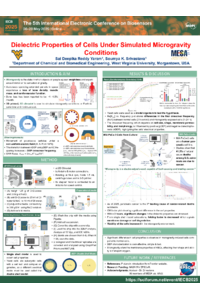
Human activities beyond Earth have steadily increased. During spaceflight, NASA observed that the lack of Earth's gravity causes a 1-1.5% monthly loss in the mineral density of weight-bearing bones. Even after returning, rehabilitation may be ineffective. The effects extend to muscles, the neuro-vestibular system, heart, eyes, and more. Understanding microgravity's effects on the human body is critical; however, sending samples to space is costly and time-consuming. Thus, technologies like the clinostat can simulate microgravity on Earth.
Methods
RBCs from cancer patients are used to investigate the impacts of microgravity. The link between microgravity-induced metabolic changes in their morphology and cytoplasm properties is poorly understood. To explore these changes, we will expose the RBCs to microgravity using a 3D clinostat, and using dielectrophoresis, an electrokinetic technique, we will analyze the dielectric profile related to morphological and cytoplasmic changes. The cells are suspended in media (8.6wt% sucrose + 0.3wt% dextrose in 100ml DI water), transferred into 1.5-ml centrifuge tubes, and exposed to microgravity for 1-24 hours at a specific conductivity (0.01 S/m), adjusted with 1xPBS.
Results
Cell behavior is quantified using the DEP crossover technique (when no DEP force occurs), where cells neither migrate toward nor away from the high electric field region at a specific AC frequency and peak-to-peak voltage. The results show statistically significant variations in membrane permittivity and conductivity between Earth and microgravity conditions. The folding factor of microgravity-induced cells decreased drastically. A decrease in the folding factor suggests altered cell structure and function, potentially affecting protein folding, morphology, and cellular processes.
Conclusions
These results help understand the effect of microgravity on changes in the morphology and cytoplasm of RBCs. The goal of this research is to enhance the understanding of the impacts of microgravity on the human body and advance space health studies.
Keywords
Dielectrophoresis
Microgravity
RBCs
Clinostats
Folding factor
Poster
MDPI_May26-28_SDRY.pdf
Wearable Biosensor Patch for Monitoring Air Toxicity in Occupational and Environmental Settings Over Time
Electrophysiological profiling of peripheral blood mononuclear cells (PBMCs) for early pancreatic ductal adenocarcinoma (PDAC) detection using dielectrophoresis