Event submissions
Published
This submission belongs to the session D. The Evolution of Biological Recognition Elements in Biosensors of the event The 5th International Electronic Conference on Biosensors
Published date
02 May, 2025
Academic Editor
'%3e%3cpath%20d='M12.6657%2010.9104C12.4185%2010.325%2012.0599%209.79327%2011.6097%209.34482C11.1609%208.89508%2010.6293%208.5365%2010.0442%208.28888C10.0389%208.28626%2010.0337%208.28495%2010.0285%208.28233C10.8446%207.69279%2011.3752%206.73249%2011.3752%205.64904C11.3752%203.8542%209.92103%202.39999%208.1262%202.39999C6.33136%202.39999%204.87715%203.8542%204.87715%205.64904C4.87715%206.73249%205.40774%207.69279%206.22393%208.28364C6.21869%208.28626%206.21345%208.28757%206.20821%208.29019C5.62129%208.5378%205.09463%208.89284%204.64265%209.34613C4.1929%209.79493%203.83432%2010.3266%203.58671%2010.9117C3.34345%2011.4845%203.21226%2012.0987%203.20023%2012.7209C3.19988%2012.7349%203.20233%2012.7488%203.20744%2012.7619C3.21255%2012.7749%203.22022%2012.7867%203.22998%2012.7968C3.23975%2012.8068%203.25142%2012.8147%203.26431%2012.8202C3.2772%2012.8256%203.29105%2012.8284%203.30504%2012.8284H4.09109C4.14874%2012.8284%204.19459%2012.7825%204.1959%2012.7262C4.2221%2011.7148%204.62823%2010.7676%205.34617%2010.0497C6.08899%209.30683%207.0755%208.89808%208.1262%208.89808C9.17689%208.89808%2010.1634%209.30683%2010.9062%2010.0497C11.6242%2010.7676%2012.0303%2011.7148%2012.0565%2012.7262C12.0578%2012.7838%2012.1037%2012.8284%2012.1613%2012.8284H12.9474C12.9613%2012.8284%2012.9752%2012.8256%2012.9881%2012.8202C13.001%2012.8147%2013.0126%2012.8068%2013.0224%2012.7968C13.0322%2012.7867%2013.0398%2012.7749%2013.0449%2012.7619C13.0501%2012.7488%2013.0525%2012.7349%2013.0522%2012.7209C13.0391%2012.0947%2012.9094%2011.4855%2012.6657%2010.9104ZM8.1262%207.9024C7.52486%207.9024%206.9589%207.6679%206.53312%207.24211C6.10733%206.81633%205.87283%206.25037%205.87283%205.64904C5.87283%205.0477%206.10733%204.48174%206.53312%204.05596C6.9589%203.63018%207.52486%203.39567%208.1262%203.39567C8.72753%203.39567%209.29349%203.63018%209.71927%204.05596C10.1451%204.48174%2010.3796%205.0477%2010.3796%205.64904C10.3796%206.25037%2010.1451%206.81633%209.71927%207.24211C9.29349%207.6679%208.72753%207.9024%208.1262%207.9024Z'%20fill='%235D1EE1'/%3e%3c/g%3e%3c/svg%3e) Cecilia Cristea
Cecilia CristeaCitation
Raphael Olumide Oladokun, Soumya Srivastava, Brian Boone, Kristen Ranson, Electrophysiological profiling of peripheral blood mononuclear cells (PBMCs) for early pancreatic ductal adenocarcinoma (PDAC) detection using dielectrophoresis, in Proceedings of The 5th International Electronic Conference on Biosensors, 26 May–28 May 2025, MDPI: Basel, Switzerland
Share
Email
Facebook
Twitter
LinkedIn
Electrophysiological profiling of peripheral blood mononuclear cells (PBMCs) for early pancreatic ductal adenocarcinoma (PDAC) detection using dielectrophoresis
'%3e%3cpath%20d='M12.6647%2010.9104C12.4176%2010.325%2012.0589%209.7933%2011.6088%209.34485C11.16%208.89511%2010.6283%208.53653%2010.0432%208.28891C10.038%208.28629%2010.0327%208.28498%2010.0275%208.28236C10.8437%207.69282%2011.3743%206.73252%2011.3743%205.64907C11.3743%203.85423%209.92005%202.40002%208.12522%202.40002C6.33038%202.40002%204.87618%203.85423%204.87618%205.64907C4.87618%206.73252%205.40677%207.69282%206.22296%208.28367C6.21772%208.28629%206.21248%208.2876%206.20724%208.29022C5.62031%208.53783%205.09365%208.89287%204.64167%209.34616C4.19192%209.79496%203.83334%2010.3266%203.58573%2010.9117C3.34247%2011.4846%203.21128%2012.0987%203.19925%2012.721C3.1989%2012.735%203.20135%2012.7489%203.20646%2012.7619C3.21157%2012.7749%203.21924%2012.7868%203.22901%2012.7968C3.23877%2012.8068%203.25045%2012.8148%203.26334%2012.8202C3.27623%2012.8256%203.29007%2012.8284%203.30406%2012.8284H4.09012C4.14776%2012.8284%204.19362%2012.7825%204.19493%2012.7262C4.22113%2011.7148%204.62726%2010.7676%205.34519%2010.0497C6.08802%209.30686%207.07452%208.89811%208.12522%208.89811C9.17592%208.89811%2010.1624%209.30686%2010.9052%2010.0497C11.6232%2010.7676%2012.0293%2011.7148%2012.0555%2012.7262C12.0568%2012.7839%2012.1027%2012.8284%2012.1603%2012.8284H12.9464C12.9604%2012.8284%2012.9742%2012.8256%2012.9871%2012.8202C13%2012.8148%2013.0117%2012.8068%2013.0214%2012.7968C13.0312%2012.7868%2013.0389%2012.7749%2013.044%2012.7619C13.0491%2012.7489%2013.0515%2012.735%2013.0512%2012.721C13.0381%2012.0947%2012.9084%2011.4856%2012.6647%2010.9104ZM8.12522%207.90243C7.52388%207.90243%206.95792%207.66793%206.53214%207.24215C6.10636%206.81636%205.87185%206.2504%205.87185%205.64907C5.87185%205.04773%206.10636%204.48177%206.53214%204.05599C6.95792%203.63021%207.52388%203.3957%208.12522%203.3957C8.72655%203.3957%209.29252%203.63021%209.7183%204.05599C10.1441%204.48177%2010.3786%205.04773%2010.3786%205.64907C10.3786%206.2504%2010.1441%206.81636%209.7183%207.24215C9.29252%207.66793%208.72655%207.90243%208.12522%207.90243Z'%20fill='%235D1EE1'/%3e%3c/g%3e%3c/svg%3e)
Raphael Olumide Oladokun 1

Soumya Srivastava 1

Brian Boone 2
Kristen Ranson 2
1. Department of Chemical and Biomedical Engineering, West Virginia University, Morgantown, WV 26506, USA
2. Department of Microbiology, Immunology & Cell Biology, West Virginia University, Morgantown, WV 26506, USA
Abstract
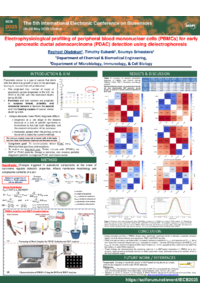
Pancreatic ductal adenocarcinoma (PDAC) is the most common form of pancreatic cancer, and is known to have an extremely low survival rate. The lack of early diagnostic techniques and tools, combined with non-specific symptoms, makes PDAC undetectable until it reaches advanced stages. PDAC is known to have resistance to treatment, largely due to the tumor's ability to suppress natural killer cells. Given the high mortality rate associated with this aggressive PDAC, there is an urgent need for innovative diagnostics to enable early detection, followed by an adequate and effective treatment procedure.
In this study, we used dielectrophoresis (DEP) to obtain dielectric profiles of peripheral blood mononuclear cells (PBMCs) isolated from PDAC patients under a non-uniform electric field gradient. Our hypothesis is based on cellular changes caused by PDAC interacting with the immune system, subsequently affecting the extracellular matrix (ECM) of the plasma membrane and the cell interior of PBMCs. These changes, resulting from the aggressive growth of dense fibrotic stroma, influence the cells' size, shape, permittivity, conductivity, and other dielectric properties, potentially serving as reliable biomarkers for early PDAC detection.
Using a single-shell model in 3DEP, we quantified the electrophysiological properties to discriminate PDAC PBMCs from non-cancerous pancreatic PBMCs in benign or pre-cancerous states by comparing their electrical biomarkers. Our preliminary results show significant differences in cytoplasm conductivity, membrane permittivity, conductance, and capacitance parameters of the PBMCs. These findings highlight the potential of dielectrophoresis as a technique for developing a diagnostic device for PDAC, providing relevant insight into cellular changes associated with the disease while enhancing our clinical understanding of its pathophysiology. This study has great potential for the development of accessible point-of-care devices for early PDAC diagnosis.
Keywords
Dielectrophoresis
crossover frequency
PDAC
extracellular matrix (ECM)
membrane capacitance
membrane conductance
cytoplasm conductivity
Poster
Poster IECB 2025_Raphael Oladokun.pdf
Dielectric Properties of Cells Under Simulated Microgravity Conditions
Freshwater Harmful Algal Bloom Detection Through Dieletrophoresis