Event submissions
Published
This submission belongs to the session D. The Evolution of Biological Recognition Elements in Biosensors of the event The 5th International Electronic Conference on Biosensors
Published date
02 May, 2025
Academic Editor
'%3e%3cpath%20d='M12.6657%2010.9104C12.4185%2010.325%2012.0599%209.79327%2011.6097%209.34482C11.1609%208.89508%2010.6293%208.5365%2010.0442%208.28888C10.0389%208.28626%2010.0337%208.28495%2010.0285%208.28233C10.8446%207.69279%2011.3752%206.73249%2011.3752%205.64904C11.3752%203.8542%209.92103%202.39999%208.1262%202.39999C6.33136%202.39999%204.87715%203.8542%204.87715%205.64904C4.87715%206.73249%205.40774%207.69279%206.22393%208.28364C6.21869%208.28626%206.21345%208.28757%206.20821%208.29019C5.62129%208.5378%205.09463%208.89284%204.64265%209.34613C4.1929%209.79493%203.83432%2010.3266%203.58671%2010.9117C3.34345%2011.4845%203.21226%2012.0987%203.20023%2012.7209C3.19988%2012.7349%203.20233%2012.7488%203.20744%2012.7619C3.21255%2012.7749%203.22022%2012.7867%203.22998%2012.7968C3.23975%2012.8068%203.25142%2012.8147%203.26431%2012.8202C3.2772%2012.8256%203.29105%2012.8284%203.30504%2012.8284H4.09109C4.14874%2012.8284%204.19459%2012.7825%204.1959%2012.7262C4.2221%2011.7148%204.62823%2010.7676%205.34617%2010.0497C6.08899%209.30683%207.0755%208.89808%208.1262%208.89808C9.17689%208.89808%2010.1634%209.30683%2010.9062%2010.0497C11.6242%2010.7676%2012.0303%2011.7148%2012.0565%2012.7262C12.0578%2012.7838%2012.1037%2012.8284%2012.1613%2012.8284H12.9474C12.9613%2012.8284%2012.9752%2012.8256%2012.9881%2012.8202C13.001%2012.8147%2013.0126%2012.8068%2013.0224%2012.7968C13.0322%2012.7867%2013.0398%2012.7749%2013.0449%2012.7619C13.0501%2012.7488%2013.0525%2012.7349%2013.0522%2012.7209C13.0391%2012.0947%2012.9094%2011.4855%2012.6657%2010.9104ZM8.1262%207.9024C7.52486%207.9024%206.9589%207.6679%206.53312%207.24211C6.10733%206.81633%205.87283%206.25037%205.87283%205.64904C5.87283%205.0477%206.10733%204.48174%206.53312%204.05596C6.9589%203.63018%207.52486%203.39567%208.1262%203.39567C8.72753%203.39567%209.29349%203.63018%209.71927%204.05596C10.1451%204.48174%2010.3796%205.0477%2010.3796%205.64904C10.3796%206.25037%2010.1451%206.81633%209.71927%207.24211C9.29349%207.6679%208.72753%207.9024%208.1262%207.9024Z'%20fill='%235D1EE1'/%3e%3c/g%3e%3c/svg%3e) Cecilia Cristea
Cecilia CristeaCitation
Mary Joy Rigor Ofiaza, Jonalhe Bautista, Anne Lorielle Lansangan Rivera, Molecularly Imprinted Polymers: Novel Affinity-Based Detection for Sensor Development of Fulvic Acid, in Proceedings of The 5th International Electronic Conference on Biosensors, 26 May–28 May 2025, MDPI: Basel, Switzerland
Share
Email
Facebook
Twitter
LinkedIn
Molecularly Imprinted Polymers: Novel Affinity-Based Detection for Sensor Development of Fulvic Acid
'%3e%3cpath%20d='M12.6647%2010.9104C12.4176%2010.325%2012.0589%209.7933%2011.6088%209.34485C11.16%208.89511%2010.6283%208.53653%2010.0432%208.28891C10.038%208.28629%2010.0327%208.28498%2010.0275%208.28236C10.8437%207.69282%2011.3743%206.73252%2011.3743%205.64907C11.3743%203.85423%209.92005%202.40002%208.12522%202.40002C6.33038%202.40002%204.87618%203.85423%204.87618%205.64907C4.87618%206.73252%205.40677%207.69282%206.22296%208.28367C6.21772%208.28629%206.21248%208.2876%206.20724%208.29022C5.62031%208.53783%205.09365%208.89287%204.64167%209.34616C4.19192%209.79496%203.83334%2010.3266%203.58573%2010.9117C3.34247%2011.4846%203.21128%2012.0987%203.19925%2012.721C3.1989%2012.735%203.20135%2012.7489%203.20646%2012.7619C3.21157%2012.7749%203.21924%2012.7868%203.22901%2012.7968C3.23877%2012.8068%203.25045%2012.8148%203.26334%2012.8202C3.27623%2012.8256%203.29007%2012.8284%203.30406%2012.8284H4.09012C4.14776%2012.8284%204.19362%2012.7825%204.19493%2012.7262C4.22113%2011.7148%204.62726%2010.7676%205.34519%2010.0497C6.08802%209.30686%207.07452%208.89811%208.12522%208.89811C9.17592%208.89811%2010.1624%209.30686%2010.9052%2010.0497C11.6232%2010.7676%2012.0293%2011.7148%2012.0555%2012.7262C12.0568%2012.7839%2012.1027%2012.8284%2012.1603%2012.8284H12.9464C12.9604%2012.8284%2012.9742%2012.8256%2012.9871%2012.8202C13%2012.8148%2013.0117%2012.8068%2013.0214%2012.7968C13.0312%2012.7868%2013.0389%2012.7749%2013.044%2012.7619C13.0491%2012.7489%2013.0515%2012.735%2013.0512%2012.721C13.0381%2012.0947%2012.9084%2011.4856%2012.6647%2010.9104ZM8.12522%207.90243C7.52388%207.90243%206.95792%207.66793%206.53214%207.24215C6.10636%206.81636%205.87185%206.2504%205.87185%205.64907C5.87185%205.04773%206.10636%204.48177%206.53214%204.05599C6.95792%203.63021%207.52388%203.3957%208.12522%203.3957C8.72655%203.3957%209.29252%203.63021%209.7183%204.05599C10.1441%204.48177%2010.3786%205.04773%2010.3786%205.64907C10.3786%206.2504%2010.1441%206.81636%209.7183%207.24215C9.29252%207.66793%208.72655%207.90243%208.12522%207.90243Z'%20fill='%235D1EE1'/%3e%3c/g%3e%3c/svg%3e)
Mary Joy Rigor Ofiaza 1
Jonalhe Bautista 1
Anne Lorielle Lansangan Rivera 1
1. Department of Chemistry, Tarlac State University, Tarlac City, 2300, Philippines
Abstract
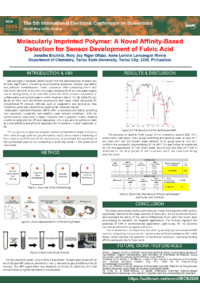
Fulvic acid (FA) is a water-soluble molecule belonging to the group of organic compounds called humic substances, which are derived from the decomposition of organic matter. Known for its significance in soil fertility and nutrient availability, it is considered a water pollutant due to its ability to become precursor for the formation of toxic halogenated disinfection by-products and complexes with heavy metals in soil. Several methods have been developed to remove this in water, such as coagulation and adsorption methods, but the efficiency is significantly affected by different factors such as the solubility, size, and concentration of the molecule.
Molecularly imprinted polymers (MIPs) are synthetic polymers that show promising properties to become an adsorbent for the removal of FA in water. MIPs exhibit robustness even in high pH and high temperature conditions and high selectivity for the target even in the presence of matrix interferers; they are also reusable, and their synthesis is simple and straightforward. This study explored the formulation of MIPs specific for FA using methacrylic acid, methacrylamide, and acrylamide as functional monomers.
Prior to MIP synthesis, this study employed the functionalization of silica gel with chitosan, followed by the immobilization of FA as the target and humic acid (HA) as the control molecule on the functionalized silica gel. Verification was performed through a series of FT-IR analyses conducted to ensure accuracy and consistency in the processes. The MIP’s selectivity was tested using HA, the control molecule. After the three-hour contact time with triplicate samples of FA and HA separately, the initial and final concentrations of MIP were analyzed using UV-Vis spectroscopy at a 190-400 nm range.
The 30 ppm MIP solution exhibited 65% FA recovery versus 1.69% HA recovery, proving the selectivity of the synthesized MIP towards the target. This paper could lay the groundwork for future researchers aiming to advance the development of a similar sensor or other innovations.
Keywords
(Adsorption)
(fulvic acid)
(humic acid)
(Molecularly imprinted polymers)
(synthetic polymer synthesis)
(monomers)
(target)
(FT-IR spectroscopy)
(UV-Vis spectroscopy)
Poster
Molecularly Imprinted Polymer A Novel Affinity-Based Detection for Sensor D_20250509_150329_0000.pdf
Advanced Micro-Electrochemical Biosensor for Acetylcholine Neurotransmitter Detection
Using the GOLD-SELEX approach to generate highly specific and sensitive DNA aptamers against carbendazim