Event submissions
Published
This submission belongs to the session G. Paper-based Biosensors of the event The 5th International Electronic Conference on Biosensors
Published date
02 May, 2025
Academic Editor
'%3e%3cpath%20d='M12.6657%2010.9104C12.4185%2010.325%2012.0599%209.79327%2011.6097%209.34482C11.1609%208.89508%2010.6293%208.5365%2010.0442%208.28888C10.0389%208.28626%2010.0337%208.28495%2010.0285%208.28233C10.8446%207.69279%2011.3752%206.73249%2011.3752%205.64904C11.3752%203.8542%209.92103%202.39999%208.1262%202.39999C6.33136%202.39999%204.87715%203.8542%204.87715%205.64904C4.87715%206.73249%205.40774%207.69279%206.22393%208.28364C6.21869%208.28626%206.21345%208.28757%206.20821%208.29019C5.62129%208.5378%205.09463%208.89284%204.64265%209.34613C4.1929%209.79493%203.83432%2010.3266%203.58671%2010.9117C3.34345%2011.4845%203.21226%2012.0987%203.20023%2012.7209C3.19988%2012.7349%203.20233%2012.7488%203.20744%2012.7619C3.21255%2012.7749%203.22022%2012.7867%203.22998%2012.7968C3.23975%2012.8068%203.25142%2012.8147%203.26431%2012.8202C3.2772%2012.8256%203.29105%2012.8284%203.30504%2012.8284H4.09109C4.14874%2012.8284%204.19459%2012.7825%204.1959%2012.7262C4.2221%2011.7148%204.62823%2010.7676%205.34617%2010.0497C6.08899%209.30683%207.0755%208.89808%208.1262%208.89808C9.17689%208.89808%2010.1634%209.30683%2010.9062%2010.0497C11.6242%2010.7676%2012.0303%2011.7148%2012.0565%2012.7262C12.0578%2012.7838%2012.1037%2012.8284%2012.1613%2012.8284H12.9474C12.9613%2012.8284%2012.9752%2012.8256%2012.9881%2012.8202C13.001%2012.8147%2013.0126%2012.8068%2013.0224%2012.7968C13.0322%2012.7867%2013.0398%2012.7749%2013.0449%2012.7619C13.0501%2012.7488%2013.0525%2012.7349%2013.0522%2012.7209C13.0391%2012.0947%2012.9094%2011.4855%2012.6657%2010.9104ZM8.1262%207.9024C7.52486%207.9024%206.9589%207.6679%206.53312%207.24211C6.10733%206.81633%205.87283%206.25037%205.87283%205.64904C5.87283%205.0477%206.10733%204.48174%206.53312%204.05596C6.9589%203.63018%207.52486%203.39567%208.1262%203.39567C8.72753%203.39567%209.29349%203.63018%209.71927%204.05596C10.1451%204.48174%2010.3796%205.0477%2010.3796%205.64904C10.3796%206.25037%2010.1451%206.81633%209.71927%207.24211C9.29349%207.6679%208.72753%207.9024%208.1262%207.9024Z'%20fill='%235D1EE1'/%3e%3c/g%3e%3c/svg%3e) Sara Tombelli
Sara TombelliCitation
Stephanie Lopes Morais, Michelle Castanheira, Isabel Seguro, Marlene Santos, João Pacheco, Valentina Domingues, Cristina Delerue-Matos, Maria Fátima Barroso, Electrochemical magnetic nanoparticles and paper-based biosensors for plant honey DNA origin detection and authentication, in Proceedings of The 5th International Electronic Conference on Biosensors, 26 May–28 May 2025, MDPI: Basel, Switzerland
Share
Email
Facebook
Twitter
LinkedIn
Electrochemical magnetic nanoparticles and paper-based biosensors for plant honey DNA origin detection and authentication
'%3e%3cpath%20d='M12.6647%2010.9104C12.4176%2010.325%2012.0589%209.7933%2011.6088%209.34485C11.16%208.89511%2010.6283%208.53653%2010.0432%208.28891C10.038%208.28629%2010.0327%208.28498%2010.0275%208.28236C10.8437%207.69282%2011.3743%206.73252%2011.3743%205.64907C11.3743%203.85423%209.92005%202.40002%208.12522%202.40002C6.33038%202.40002%204.87618%203.85423%204.87618%205.64907C4.87618%206.73252%205.40677%207.69282%206.22296%208.28367C6.21772%208.28629%206.21248%208.2876%206.20724%208.29022C5.62031%208.53783%205.09365%208.89287%204.64167%209.34616C4.19192%209.79496%203.83334%2010.3266%203.58573%2010.9117C3.34247%2011.4846%203.21128%2012.0987%203.19925%2012.721C3.1989%2012.735%203.20135%2012.7489%203.20646%2012.7619C3.21157%2012.7749%203.21924%2012.7868%203.22901%2012.7968C3.23877%2012.8068%203.25045%2012.8148%203.26334%2012.8202C3.27623%2012.8256%203.29007%2012.8284%203.30406%2012.8284H4.09012C4.14776%2012.8284%204.19362%2012.7825%204.19493%2012.7262C4.22113%2011.7148%204.62726%2010.7676%205.34519%2010.0497C6.08802%209.30686%207.07452%208.89811%208.12522%208.89811C9.17592%208.89811%2010.1624%209.30686%2010.9052%2010.0497C11.6232%2010.7676%2012.0293%2011.7148%2012.0555%2012.7262C12.0568%2012.7839%2012.1027%2012.8284%2012.1603%2012.8284H12.9464C12.9604%2012.8284%2012.9742%2012.8256%2012.9871%2012.8202C13%2012.8148%2013.0117%2012.8068%2013.0214%2012.7968C13.0312%2012.7868%2013.0389%2012.7749%2013.044%2012.7619C13.0491%2012.7489%2013.0515%2012.735%2013.0512%2012.721C13.0381%2012.0947%2012.9084%2011.4856%2012.6647%2010.9104ZM8.12522%207.90243C7.52388%207.90243%206.95792%207.66793%206.53214%207.24215C6.10636%206.81636%205.87185%206.2504%205.87185%205.64907C5.87185%205.04773%206.10636%204.48177%206.53214%204.05599C6.95792%203.63021%207.52388%203.3957%208.12522%203.3957C8.72655%203.3957%209.29252%203.63021%209.7183%204.05599C10.1441%204.48177%2010.3786%205.04773%2010.3786%205.64907C10.3786%206.2504%2010.1441%206.81636%209.7183%207.24215C9.29252%207.66793%208.72655%207.90243%208.12522%207.90243Z'%20fill='%235D1EE1'/%3e%3c/g%3e%3c/svg%3e)
Stephanie Lopes Morais 1,2
Michelle Castanheira 1,2
Isabel Seguro 1,2
Marlene Santos 3

João Pacheco 1
Valentina Domingues 1

Cristina Delerue-Matos 1

Maria Fátima Barroso 1
1. Instituto Superior de Engenharia do Porto, Instituto Politécnico do Porto, Porto, 4249-015, Portugal
2. Department of Chemistry, University of Porto - School of Science, Porto, 4169-007, Portugal
3. Escola Superior de Saúde, Instituto Politécnico do Porto, Porto, 4200-072, Portugal
Abstract
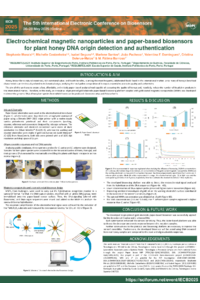
Food fraud remains an issue with significant environmental, health, and socio-economic impacts for consumers and the food industry alike. Honey, known for its natural sweetness, rich nutritional value, and numerous health benefits, is among the most adulterated foods found in the global market. Common fraudulent practices include mislabelling the honey’s botanical origin, blending it with lower-quality honeys, processed sugars, or other substances. Moreover, as most of their beneficial properties are linked to honey’s botanical origin, it is important to assure the safety and quality of the honey. Nonetheless, with the increasing number of reports on tampered or adulterated products appearing, there is a pressing need to develop an analytical tool that can quickly, affordably, and reliably ensure the quality and safety of honeys. In this study, an innovative inkjet-printed gold electrode paper-based biosensing platform coupled with gold-coated magnetic nanoparticles (MNPs) was developed to detect the genomic DNA of two plant species from which honey can be produced: Castanea sativa and Erica arborea. Analyzing public database platforms, a DNA-target probe for both C. sativa and E. arborea were selected and designed. These sensors resulted from the DNA hybridization reaction between the two complementary probes specific to both plant species in a sandwich format. Their complementary probes were modified with an amine (NH2) group and a fluorescein isothiocyanate and cut in two to generate the enzymatic amplification of the electrochemical signal. The hybridization reaction was labeled with enzymes, enabling chronoamperometric measurement of peroxidase activity associated with the MNPs on the gold electrode surface. The developed biosensor was then successfully applied to detect C. sativa and E. arborea present in real plant samples and, hence, determine the botanic origin of the honeys. Therefore, these MNPs and paper-based biosensors are a viable and rapid tool to help authenticate the origin of honeys.
Keywords
Castanea sativa
Erica arborea
Food fraud
Honey authentication
Magnetic nanoparticles
Paper-based biosensors
Poster
sciforum-115683.pdf
Paper-based device for monitoring the efficacy of anti-cancer therapy: detection of H2S in cells
A novel DNA-based electrochemical sensor for the detection of Candida species