Event submissions
Published
This submission belongs to the session G. Paper-based Biosensors of the event The 5th International Electronic Conference on Biosensors
Published date
02 May, 2025
Academic Editor
'%3e%3cpath%20d='M12.6657%2010.9104C12.4185%2010.325%2012.0599%209.79327%2011.6097%209.34482C11.1609%208.89508%2010.6293%208.5365%2010.0442%208.28888C10.0389%208.28626%2010.0337%208.28495%2010.0285%208.28233C10.8446%207.69279%2011.3752%206.73249%2011.3752%205.64904C11.3752%203.8542%209.92103%202.39999%208.1262%202.39999C6.33136%202.39999%204.87715%203.8542%204.87715%205.64904C4.87715%206.73249%205.40774%207.69279%206.22393%208.28364C6.21869%208.28626%206.21345%208.28757%206.20821%208.29019C5.62129%208.5378%205.09463%208.89284%204.64265%209.34613C4.1929%209.79493%203.83432%2010.3266%203.58671%2010.9117C3.34345%2011.4845%203.21226%2012.0987%203.20023%2012.7209C3.19988%2012.7349%203.20233%2012.7488%203.20744%2012.7619C3.21255%2012.7749%203.22022%2012.7867%203.22998%2012.7968C3.23975%2012.8068%203.25142%2012.8147%203.26431%2012.8202C3.2772%2012.8256%203.29105%2012.8284%203.30504%2012.8284H4.09109C4.14874%2012.8284%204.19459%2012.7825%204.1959%2012.7262C4.2221%2011.7148%204.62823%2010.7676%205.34617%2010.0497C6.08899%209.30683%207.0755%208.89808%208.1262%208.89808C9.17689%208.89808%2010.1634%209.30683%2010.9062%2010.0497C11.6242%2010.7676%2012.0303%2011.7148%2012.0565%2012.7262C12.0578%2012.7838%2012.1037%2012.8284%2012.1613%2012.8284H12.9474C12.9613%2012.8284%2012.9752%2012.8256%2012.9881%2012.8202C13.001%2012.8147%2013.0126%2012.8068%2013.0224%2012.7968C13.0322%2012.7867%2013.0398%2012.7749%2013.0449%2012.7619C13.0501%2012.7488%2013.0525%2012.7349%2013.0522%2012.7209C13.0391%2012.0947%2012.9094%2011.4855%2012.6657%2010.9104ZM8.1262%207.9024C7.52486%207.9024%206.9589%207.6679%206.53312%207.24211C6.10733%206.81633%205.87283%206.25037%205.87283%205.64904C5.87283%205.0477%206.10733%204.48174%206.53312%204.05596C6.9589%203.63018%207.52486%203.39567%208.1262%203.39567C8.72753%203.39567%209.29349%203.63018%209.71927%204.05596C10.1451%204.48174%2010.3796%205.0477%2010.3796%205.64904C10.3796%206.25037%2010.1451%206.81633%209.71927%207.24211C9.29349%207.6679%208.72753%207.9024%208.1262%207.9024Z'%20fill='%235D1EE1'/%3e%3c/g%3e%3c/svg%3e) Sara Tombelli
Sara TombelliCitation
Michelle Shereen Alves Castanheira, Stephanie Morais, Isabel Seguro, João Pacheco, Luís Lima, Marlene Santos, M. Fátima Barroso, A novel DNA-based electrochemical sensor for the detection of Candida species, in Proceedings of The 5th International Electronic Conference on Biosensors, 26 May–28 May 2025, MDPI: Basel, Switzerland
Share
Email
Facebook
Twitter
LinkedIn
A novel DNA-based electrochemical sensor for the detection of Candida species
'%3e%3cpath%20d='M12.6647%2010.9104C12.4176%2010.325%2012.0589%209.7933%2011.6088%209.34485C11.16%208.89511%2010.6283%208.53653%2010.0432%208.28891C10.038%208.28629%2010.0327%208.28498%2010.0275%208.28236C10.8437%207.69282%2011.3743%206.73252%2011.3743%205.64907C11.3743%203.85423%209.92005%202.40002%208.12522%202.40002C6.33038%202.40002%204.87618%203.85423%204.87618%205.64907C4.87618%206.73252%205.40677%207.69282%206.22296%208.28367C6.21772%208.28629%206.21248%208.2876%206.20724%208.29022C5.62031%208.53783%205.09365%208.89287%204.64167%209.34616C4.19192%209.79496%203.83334%2010.3266%203.58573%2010.9117C3.34247%2011.4846%203.21128%2012.0987%203.19925%2012.721C3.1989%2012.735%203.20135%2012.7489%203.20646%2012.7619C3.21157%2012.7749%203.21924%2012.7868%203.22901%2012.7968C3.23877%2012.8068%203.25045%2012.8148%203.26334%2012.8202C3.27623%2012.8256%203.29007%2012.8284%203.30406%2012.8284H4.09012C4.14776%2012.8284%204.19362%2012.7825%204.19493%2012.7262C4.22113%2011.7148%204.62726%2010.7676%205.34519%2010.0497C6.08802%209.30686%207.07452%208.89811%208.12522%208.89811C9.17592%208.89811%2010.1624%209.30686%2010.9052%2010.0497C11.6232%2010.7676%2012.0293%2011.7148%2012.0555%2012.7262C12.0568%2012.7839%2012.1027%2012.8284%2012.1603%2012.8284H12.9464C12.9604%2012.8284%2012.9742%2012.8256%2012.9871%2012.8202C13%2012.8148%2013.0117%2012.8068%2013.0214%2012.7968C13.0312%2012.7868%2013.0389%2012.7749%2013.044%2012.7619C13.0491%2012.7489%2013.0515%2012.735%2013.0512%2012.721C13.0381%2012.0947%2012.9084%2011.4856%2012.6647%2010.9104ZM8.12522%207.90243C7.52388%207.90243%206.95792%207.66793%206.53214%207.24215C6.10636%206.81636%205.87185%206.2504%205.87185%205.64907C5.87185%205.04773%206.10636%204.48177%206.53214%204.05599C6.95792%203.63021%207.52388%203.3957%208.12522%203.3957C8.72655%203.3957%209.29252%203.63021%209.7183%204.05599C10.1441%204.48177%2010.3786%205.04773%2010.3786%205.64907C10.3786%206.2504%2010.1441%206.81636%209.7183%207.24215C9.29252%207.66793%208.72655%207.90243%208.12522%207.90243Z'%20fill='%235D1EE1'/%3e%3c/g%3e%3c/svg%3e)
Michelle Shereen Alves Castanheira 1,2,3,4
Stephanie Morais 1
Isabel Seguro 1

João Pacheco 1

Luís Lima 3
Marlene Santos 2

M. Fátima Barroso 1
1. REQUIMTE/LAQV- Superior Institute of Engineering of Porto, Polytechnic Institute of Porto, Porto,4200-07, Portugal.
2. REQUIMTE|LAQV, Superior School of Health, Polytechnic Institute of Porto, Porto, 4200-072, Portugal.
3. Research Center, Portuguese Institute of Oncology of Porto Francisco Gentil, E.P.E., Porto, 4200-072, Portugal.
4. FCUP-Department of Chemistry, Faculty of Sciences, University of Porto, Porto, 4169– 007, Portugal.
Abstract
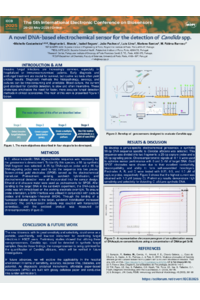
The frequency and prevalence of invasive fungal infections have increased, particularly among hospitalized patients with severe underlying illnesses and/or immunocompromised individuals [1,2]. The survival of these patients relies on the prompt identification of the infection and on the timely initiation of antifungal therapy, and yet standard laboratory testing may yield ambiguous results [3]. The diagnostic approaches for candidiasis include culture testing, serological assays, and histopathologic analysis of tissues; however, these methods may be time-consuming and can yield insensitivity or inaccuracies. The prevailing "gold standard" for identifying Candida spp. fungemia is blood culture. Nonetheless, this is considered insensitive, as it has been shown to be positive in fewer than half of individuals with chronic disseminated candidiasis [4]. Culture methods are time-intensive, with certain Candida species requiring up to a week for development, which is an intolerable delay before initiating fungemia treatment. The difficulties in diagnosing Candida infections highlight the necessity for efficient and rapid methods to detect and identify clinically relevant fungi in a microbiology laboratory. This work involves the development of an electrochemical DNA-based sensor for the rapid, simple, and precise detection of Candida spp. This sensor, self-assembled in an electronic paper device (ePAD), is based on the electrochemical detection of the hybridization reaction between two complementary single-stranded DNA sequences. Initial research indicated that this DNA-based sensor may identify Candida spp. in synthetic DNA samples. Notwithstanding these results, efforts are underway to enhance the sensor for measuring Candida albicans; this methodology will be corroborated by a further study. Future advancements will focus on application within a medical setting, encompassing sensitivity, accuracy, response time, challenges, and potential.
Keywords
Biosensors
DNA
genosensors
Fungal
Candida spp.
Poster
115632.pdf
Electrochemical magnetic nanoparticles and paper-based biosensors for plant honey DNA origin detection and authentication
Screening of magnetic nanoconjugates’ kinetic properties based on their magnetometric registration in LFA test strips