Event submissions
Published
This submission belongs to the session G. Paper-based Biosensors of the event The 5th International Electronic Conference on Biosensors
Published date
02 May, 2025
Academic Editor
'%3e%3cpath%20d='M12.6657%2010.9104C12.4185%2010.325%2012.0599%209.79327%2011.6097%209.34482C11.1609%208.89508%2010.6293%208.5365%2010.0442%208.28888C10.0389%208.28626%2010.0337%208.28495%2010.0285%208.28233C10.8446%207.69279%2011.3752%206.73249%2011.3752%205.64904C11.3752%203.8542%209.92103%202.39999%208.1262%202.39999C6.33136%202.39999%204.87715%203.8542%204.87715%205.64904C4.87715%206.73249%205.40774%207.69279%206.22393%208.28364C6.21869%208.28626%206.21345%208.28757%206.20821%208.29019C5.62129%208.5378%205.09463%208.89284%204.64265%209.34613C4.1929%209.79493%203.83432%2010.3266%203.58671%2010.9117C3.34345%2011.4845%203.21226%2012.0987%203.20023%2012.7209C3.19988%2012.7349%203.20233%2012.7488%203.20744%2012.7619C3.21255%2012.7749%203.22022%2012.7867%203.22998%2012.7968C3.23975%2012.8068%203.25142%2012.8147%203.26431%2012.8202C3.2772%2012.8256%203.29105%2012.8284%203.30504%2012.8284H4.09109C4.14874%2012.8284%204.19459%2012.7825%204.1959%2012.7262C4.2221%2011.7148%204.62823%2010.7676%205.34617%2010.0497C6.08899%209.30683%207.0755%208.89808%208.1262%208.89808C9.17689%208.89808%2010.1634%209.30683%2010.9062%2010.0497C11.6242%2010.7676%2012.0303%2011.7148%2012.0565%2012.7262C12.0578%2012.7838%2012.1037%2012.8284%2012.1613%2012.8284H12.9474C12.9613%2012.8284%2012.9752%2012.8256%2012.9881%2012.8202C13.001%2012.8147%2013.0126%2012.8068%2013.0224%2012.7968C13.0322%2012.7867%2013.0398%2012.7749%2013.0449%2012.7619C13.0501%2012.7488%2013.0525%2012.7349%2013.0522%2012.7209C13.0391%2012.0947%2012.9094%2011.4855%2012.6657%2010.9104ZM8.1262%207.9024C7.52486%207.9024%206.9589%207.6679%206.53312%207.24211C6.10733%206.81633%205.87283%206.25037%205.87283%205.64904C5.87283%205.0477%206.10733%204.48174%206.53312%204.05596C6.9589%203.63018%207.52486%203.39567%208.1262%203.39567C8.72753%203.39567%209.29349%203.63018%209.71927%204.05596C10.1451%204.48174%2010.3796%205.0477%2010.3796%205.64904C10.3796%206.25037%2010.1451%206.81633%209.71927%207.24211C9.29349%207.6679%208.72753%207.9024%208.1262%207.9024Z'%20fill='%235D1EE1'/%3e%3c/g%3e%3c/svg%3e) Sara Tombelli
Sara TombelliCitation
Aparoop Das, Partha Protim Borthakur, Dibyajyoti Das, Jon Jyoti Sahariah, Parimita kalita, Kalyani Pathak, Emerging Trends in Paper-Based Electrochemical Biosensors for Healthcare Applications, in Proceedings of The 5th International Electronic Conference on Biosensors, 26 May–28 May 2025, MDPI: Basel, Switzerland
Share
Email
Facebook
Twitter
LinkedIn
Emerging Trends in Paper-Based Electrochemical Biosensors for Healthcare Applications
'%3e%3cpath%20d='M12.6647%2010.9104C12.4176%2010.325%2012.0589%209.7933%2011.6088%209.34485C11.16%208.89511%2010.6283%208.53653%2010.0432%208.28891C10.038%208.28629%2010.0327%208.28498%2010.0275%208.28236C10.8437%207.69282%2011.3743%206.73252%2011.3743%205.64907C11.3743%203.85423%209.92005%202.40002%208.12522%202.40002C6.33038%202.40002%204.87618%203.85423%204.87618%205.64907C4.87618%206.73252%205.40677%207.69282%206.22296%208.28367C6.21772%208.28629%206.21248%208.2876%206.20724%208.29022C5.62031%208.53783%205.09365%208.89287%204.64167%209.34616C4.19192%209.79496%203.83334%2010.3266%203.58573%2010.9117C3.34247%2011.4846%203.21128%2012.0987%203.19925%2012.721C3.1989%2012.735%203.20135%2012.7489%203.20646%2012.7619C3.21157%2012.7749%203.21924%2012.7868%203.22901%2012.7968C3.23877%2012.8068%203.25045%2012.8148%203.26334%2012.8202C3.27623%2012.8256%203.29007%2012.8284%203.30406%2012.8284H4.09012C4.14776%2012.8284%204.19362%2012.7825%204.19493%2012.7262C4.22113%2011.7148%204.62726%2010.7676%205.34519%2010.0497C6.08802%209.30686%207.07452%208.89811%208.12522%208.89811C9.17592%208.89811%2010.1624%209.30686%2010.9052%2010.0497C11.6232%2010.7676%2012.0293%2011.7148%2012.0555%2012.7262C12.0568%2012.7839%2012.1027%2012.8284%2012.1603%2012.8284H12.9464C12.9604%2012.8284%2012.9742%2012.8256%2012.9871%2012.8202C13%2012.8148%2013.0117%2012.8068%2013.0214%2012.7968C13.0312%2012.7868%2013.0389%2012.7749%2013.044%2012.7619C13.0491%2012.7489%2013.0515%2012.735%2013.0512%2012.721C13.0381%2012.0947%2012.9084%2011.4856%2012.6647%2010.9104ZM8.12522%207.90243C7.52388%207.90243%206.95792%207.66793%206.53214%207.24215C6.10636%206.81636%205.87185%206.2504%205.87185%205.64907C5.87185%205.04773%206.10636%204.48177%206.53214%204.05599C6.95792%203.63021%207.52388%203.3957%208.12522%203.3957C8.72655%203.3957%209.29252%203.63021%209.7183%204.05599C10.1441%204.48177%2010.3786%205.04773%2010.3786%205.64907C10.3786%206.2504%2010.1441%206.81636%209.7183%207.24215C9.29252%207.66793%208.72655%207.90243%208.12522%207.90243Z'%20fill='%235D1EE1'/%3e%3c/g%3e%3c/svg%3e)
Aparoop Das 1

Partha Protim Borthakur 1
Dibyajyoti Das 2
Jon Jyoti Sahariah 1
Parimita kalita 3

Kalyani Pathak 1
1. Department of Pharmaceutical Sciences, Dibrugarh University, Dibrugarh, 786004, India
2. Pratiksha Institute of Pharmaceutical Science, Panikhaiti, Guwahati, Assam-781026, India
3. School of Pharmacy, Assam Kaziranga University, Jorhat, Assam, 785006
Abstract
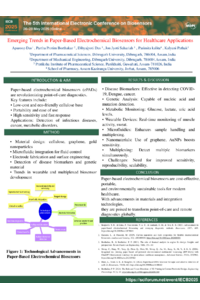
Paper-based electrochemical biosensors have emerged as a revolutionary technology in healthcare diagnostics due to their affordability, portability, ease of use, and environmental sustainability. These biosensors utilize paper as the primary material, capitalizing on its unique properties, such as high porosity, flexibility, and capillary action, which make it an ideal candidate for low-cost, functional, and reliable diagnostic devices. The simplicity and cost-effectiveness of paper-based biosensors make them especially suitable for point-of-care (POC) applications, particularly in resource-limited settings where traditional diagnostic tools may be inaccessible. Their lightweight nature and ease of operation allow non-specialized users to perform diagnostic tests without the need for complex laboratory equipment, making them suitable for emergency, field, and remote applications. Technological advancements in paper-based biosensors have significantly enhanced their capabilities. Integration with microfluidic systems has improved fluid handling and reagent storage, resulting in enhanced sensor performance, including greater sensitivity and specificity for target biomarkers. The use of nanomaterials in electrode fabrication, such as reduced graphene oxide and gold nanoparticles, has further elevated their sensitivity, allowing for precise detection of low-concentration biomarkers. Moreover, the development of multiplexed sensor arrays has enabled the simultaneous detection of multiple biomarkers from a single sample, facilitating comprehensive and rapid diagnostics in clinical settings. These biosensors have found applications in diagnosing a wide range of diseases, including infectious diseases, cancer, and metabolic disorders. They are also effective in genetic analysis and metabolic monitoring, such as tracking glucose, lactate, and uric acid levels, which are crucial for managing chronic conditions like diabetes and kidney diseases. In this review, the latest advancements in paper-based electrochemical biosensors are explored, with a focus on their applications, technological innovations, challenges, and future directions.
Keywords
Paper-based biosensors
Electrochemical detection
Microfluidics
Biomarker detection and Wearable sensors.
Poster
sciforum-114202.pdf
Optimization of Magnetic Immunochromatographic Assay Parameters for Effective Assessment of Mycotoxin Contamination of Cereal Products
Edge IoT-Enabled Cyber–Physical Systems with Paper-Based Biosensors and Temporal Convolutional Networks for Real-Time Water Contamination Monitoring