Event submissions
Published
This submission belongs to the session H. Optical and Photonic Biosensors of the event The 5th International Electronic Conference on Biosensors
Published date
02 May, 2025
Academic Editor
'%3e%3cpath%20d='M12.6657%2010.9104C12.4185%2010.325%2012.0599%209.79327%2011.6097%209.34482C11.1609%208.89508%2010.6293%208.5365%2010.0442%208.28888C10.0389%208.28626%2010.0337%208.28495%2010.0285%208.28233C10.8446%207.69279%2011.3752%206.73249%2011.3752%205.64904C11.3752%203.8542%209.92103%202.39999%208.1262%202.39999C6.33136%202.39999%204.87715%203.8542%204.87715%205.64904C4.87715%206.73249%205.40774%207.69279%206.22393%208.28364C6.21869%208.28626%206.21345%208.28757%206.20821%208.29019C5.62129%208.5378%205.09463%208.89284%204.64265%209.34613C4.1929%209.79493%203.83432%2010.3266%203.58671%2010.9117C3.34345%2011.4845%203.21226%2012.0987%203.20023%2012.7209C3.19988%2012.7349%203.20233%2012.7488%203.20744%2012.7619C3.21255%2012.7749%203.22022%2012.7867%203.22998%2012.7968C3.23975%2012.8068%203.25142%2012.8147%203.26431%2012.8202C3.2772%2012.8256%203.29105%2012.8284%203.30504%2012.8284H4.09109C4.14874%2012.8284%204.19459%2012.7825%204.1959%2012.7262C4.2221%2011.7148%204.62823%2010.7676%205.34617%2010.0497C6.08899%209.30683%207.0755%208.89808%208.1262%208.89808C9.17689%208.89808%2010.1634%209.30683%2010.9062%2010.0497C11.6242%2010.7676%2012.0303%2011.7148%2012.0565%2012.7262C12.0578%2012.7838%2012.1037%2012.8284%2012.1613%2012.8284H12.9474C12.9613%2012.8284%2012.9752%2012.8256%2012.9881%2012.8202C13.001%2012.8147%2013.0126%2012.8068%2013.0224%2012.7968C13.0322%2012.7867%2013.0398%2012.7749%2013.0449%2012.7619C13.0501%2012.7488%2013.0525%2012.7349%2013.0522%2012.7209C13.0391%2012.0947%2012.9094%2011.4855%2012.6657%2010.9104ZM8.1262%207.9024C7.52486%207.9024%206.9589%207.6679%206.53312%207.24211C6.10733%206.81633%205.87283%206.25037%205.87283%205.64904C5.87283%205.0477%206.10733%204.48174%206.53312%204.05596C6.9589%203.63018%207.52486%203.39567%208.1262%203.39567C8.72753%203.39567%209.29349%203.63018%209.71927%204.05596C10.1451%204.48174%2010.3796%205.0477%2010.3796%205.64904C10.3796%206.25037%2010.1451%206.81633%209.71927%207.24211C9.29349%207.6679%208.72753%207.9024%208.1262%207.9024Z'%20fill='%235D1EE1'/%3e%3c/g%3e%3c/svg%3e) Chun-yang Zhang
Chun-yang ZhangCitation
Leonardo Bottacin, Veronica Zani, Roberto Pilot, Francesca Taioli, Silvia Gross, Raffaella Signorini, Dual-core Ag/TiO₂ nanoparticles for photothermal therapy , in Proceedings of The 5th International Electronic Conference on Biosensors, 26 May–28 May 2025, MDPI: Basel, Switzerland
Share
Email
Facebook
Twitter
LinkedIn
Dual-core Ag/TiO2 nanoparticles for photothermal therapy
'%3e%3cpath%20d='M12.6647%2010.9104C12.4176%2010.325%2012.0589%209.7933%2011.6088%209.34485C11.16%208.89511%2010.6283%208.53653%2010.0432%208.28891C10.038%208.28629%2010.0327%208.28498%2010.0275%208.28236C10.8437%207.69282%2011.3743%206.73252%2011.3743%205.64907C11.3743%203.85423%209.92005%202.40002%208.12522%202.40002C6.33038%202.40002%204.87618%203.85423%204.87618%205.64907C4.87618%206.73252%205.40677%207.69282%206.22296%208.28367C6.21772%208.28629%206.21248%208.2876%206.20724%208.29022C5.62031%208.53783%205.09365%208.89287%204.64167%209.34616C4.19192%209.79496%203.83334%2010.3266%203.58573%2010.9117C3.34247%2011.4846%203.21128%2012.0987%203.19925%2012.721C3.1989%2012.735%203.20135%2012.7489%203.20646%2012.7619C3.21157%2012.7749%203.21924%2012.7868%203.22901%2012.7968C3.23877%2012.8068%203.25045%2012.8148%203.26334%2012.8202C3.27623%2012.8256%203.29007%2012.8284%203.30406%2012.8284H4.09012C4.14776%2012.8284%204.19362%2012.7825%204.19493%2012.7262C4.22113%2011.7148%204.62726%2010.7676%205.34519%2010.0497C6.08802%209.30686%207.07452%208.89811%208.12522%208.89811C9.17592%208.89811%2010.1624%209.30686%2010.9052%2010.0497C11.6232%2010.7676%2012.0293%2011.7148%2012.0555%2012.7262C12.0568%2012.7839%2012.1027%2012.8284%2012.1603%2012.8284H12.9464C12.9604%2012.8284%2012.9742%2012.8256%2012.9871%2012.8202C13%2012.8148%2013.0117%2012.8068%2013.0214%2012.7968C13.0312%2012.7868%2013.0389%2012.7749%2013.044%2012.7619C13.0491%2012.7489%2013.0515%2012.735%2013.0512%2012.721C13.0381%2012.0947%2012.9084%2011.4856%2012.6647%2010.9104ZM8.12522%207.90243C7.52388%207.90243%206.95792%207.66793%206.53214%207.24215C6.10636%206.81636%205.87185%206.2504%205.87185%205.64907C5.87185%205.04773%206.10636%204.48177%206.53214%204.05599C6.95792%203.63021%207.52388%203.3957%208.12522%203.3957C8.72655%203.3957%209.29252%203.63021%209.7183%204.05599C10.1441%204.48177%2010.3786%205.04773%2010.3786%205.64907C10.3786%206.2504%2010.1441%206.81636%209.7183%207.24215C9.29252%207.66793%208.72655%207.90243%208.12522%207.90243Z'%20fill='%235D1EE1'/%3e%3c/g%3e%3c/svg%3e)
Leonardo Bottacin 1
Veronica Zani 1,2

Roberto Pilot 1,2
Francesca Taioli 1

Silvia Gross 1,2,3

Raffaella Signorini 2,4
1. Department of Chemical Science, University of Padova, Via Marzolo 1, 35131 Padova, Italy
2. Consorzio Interuniversitario Nazionale per la Scienza e Tecnologia dei Materiali (Consorzio INSTM), Via Giuseppe Giusti 9, 50121 Florence, Italy
3. Institute for Chemical Technology and Polymer Chemistry (ITCP), 76131 Karlsruhe, Germany
4. Department of Chemical Science, University of Padova, Via Marzolo 1, I-35131 Padova, Italy
Abstract
In photothermal therapy, the controlled release of heat by properly synthesized nanomaterials can be assisted by local temperature detection, provided by so-called nanothermometers present near nanoheaters.
The current research study offers various methodologies for measuring local temperature based on the electrical, mechanical or optical properties of materials, like Scanning Thermal Microscopy, Atomic Force Microscopy, Infrared or Fluorescence Thermography and Raman Spectroscopy. In this context, Raman Spectroscopy is a non-contact technique offering high spatial and thermal resolution, which is extremely important for photothermal therapy. Raman signals can be enhanced by exploiting the vicinity of Raman-active materials/molecules to plasmonic nanosystems, which are also widely used to produce nanoheaters.
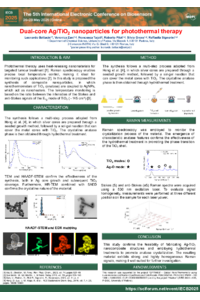
In this work, composite nanoparticles are specifically developed to provide close contact between plasmonic nanosystems, acting as nanoheaters, and local temperature sensors: silver nanoparticles (AgNP) are surrounded by a shell of anatase titanium dioxide (TiO2), which has already been tested as a Raman thermometer.
The synthesis is a multi-step process. Silver cores are prepared through a two-pot reaction. First, the silver precursor (AgNO₃) is reduced and stabilized to produce a seed suspension with an average particle size of 7 (± 2) nm. Then, a growth step is performed to reach nanoparticle sizes of 46 (± 8) nm. Dioxide shell formation is carried out using a sol–gel method starting from an ethanol solution of titanium tetrabutoxide (TTB) as a precursor. A final hydrothermal treatment induces the crystallization of TiO2 to the anatase form.
The resulting nanocomposites are characterized using various techniques, including Transmission Electron Microscopy (TEM), Scanning Electron Microscopy (SEM), energy-dispersive X-ray spectroscopy (EDX), X-ray diffraction (XRD), UV/Vis extinction and Raman Spectroscopy.
This work demonstrates the feasibility of fabricating nanocomposite structures with high potential as photothermal systems, providing a starting point for future improvements in this field.
Keywords
temperature sensor
heat release
nano thermometer
nano heater
Raman
silver
anatase
Poster
110459-Leonardo Bottacin.pdf
Optical Properties of Silver Nanoparticles Coated with Silica
Biosensors in Agriculture: Revolutionizing Sustainable Farming through Precision Technologies