Event submissions
Published
This submission belongs to the session H. Optical and Photonic Biosensors of the event The 5th International Electronic Conference on Biosensors
Published date
02 May, 2025
Academic Editor
'%3e%3cpath%20d='M12.6657%2010.9104C12.4185%2010.325%2012.0599%209.79327%2011.6097%209.34482C11.1609%208.89508%2010.6293%208.5365%2010.0442%208.28888C10.0389%208.28626%2010.0337%208.28495%2010.0285%208.28233C10.8446%207.69279%2011.3752%206.73249%2011.3752%205.64904C11.3752%203.8542%209.92103%202.39999%208.1262%202.39999C6.33136%202.39999%204.87715%203.8542%204.87715%205.64904C4.87715%206.73249%205.40774%207.69279%206.22393%208.28364C6.21869%208.28626%206.21345%208.28757%206.20821%208.29019C5.62129%208.5378%205.09463%208.89284%204.64265%209.34613C4.1929%209.79493%203.83432%2010.3266%203.58671%2010.9117C3.34345%2011.4845%203.21226%2012.0987%203.20023%2012.7209C3.19988%2012.7349%203.20233%2012.7488%203.20744%2012.7619C3.21255%2012.7749%203.22022%2012.7867%203.22998%2012.7968C3.23975%2012.8068%203.25142%2012.8147%203.26431%2012.8202C3.2772%2012.8256%203.29105%2012.8284%203.30504%2012.8284H4.09109C4.14874%2012.8284%204.19459%2012.7825%204.1959%2012.7262C4.2221%2011.7148%204.62823%2010.7676%205.34617%2010.0497C6.08899%209.30683%207.0755%208.89808%208.1262%208.89808C9.17689%208.89808%2010.1634%209.30683%2010.9062%2010.0497C11.6242%2010.7676%2012.0303%2011.7148%2012.0565%2012.7262C12.0578%2012.7838%2012.1037%2012.8284%2012.1613%2012.8284H12.9474C12.9613%2012.8284%2012.9752%2012.8256%2012.9881%2012.8202C13.001%2012.8147%2013.0126%2012.8068%2013.0224%2012.7968C13.0322%2012.7867%2013.0398%2012.7749%2013.0449%2012.7619C13.0501%2012.7488%2013.0525%2012.7349%2013.0522%2012.7209C13.0391%2012.0947%2012.9094%2011.4855%2012.6657%2010.9104ZM8.1262%207.9024C7.52486%207.9024%206.9589%207.6679%206.53312%207.24211C6.10733%206.81633%205.87283%206.25037%205.87283%205.64904C5.87283%205.0477%206.10733%204.48174%206.53312%204.05596C6.9589%203.63018%207.52486%203.39567%208.1262%203.39567C8.72753%203.39567%209.29349%203.63018%209.71927%204.05596C10.1451%204.48174%2010.3796%205.0477%2010.3796%205.64904C10.3796%206.25037%2010.1451%206.81633%209.71927%207.24211C9.29349%207.6679%208.72753%207.9024%208.1262%207.9024Z'%20fill='%235D1EE1'/%3e%3c/g%3e%3c/svg%3e) Chun-yang Zhang
Chun-yang ZhangCitation
Abraham Abbey Paul, Yael Schlichter Kadosh, Ariel Kushmaro, Robert S. Marks, Whole-Cell Fiber-Optical Biosensor for Detecting P. aeruginosa Via Secreted Quorum-Sensing Molecule Using Bioluminescent Bioreporters, in Proceedings of The 5th International Electronic Conference on Biosensors, 26 May–28 May 2025, MDPI: Basel, Switzerland
Share
Email
Facebook
Twitter
LinkedIn
Whole-Cell Fiber-Optical Biosensor for Detecting P. aeruginosa Via Secreted Quorum-Sensing Molecule Using Bioluminescent Bioreporters

Abraham Abbey Paul 1
'%3e%3cpath%20d='M12.6647%2010.9104C12.4176%2010.325%2012.0589%209.7933%2011.6088%209.34485C11.16%208.89511%2010.6283%208.53653%2010.0432%208.28891C10.038%208.28629%2010.0327%208.28498%2010.0275%208.28236C10.8437%207.69282%2011.3743%206.73252%2011.3743%205.64907C11.3743%203.85423%209.92005%202.40002%208.12522%202.40002C6.33038%202.40002%204.87618%203.85423%204.87618%205.64907C4.87618%206.73252%205.40677%207.69282%206.22296%208.28367C6.21772%208.28629%206.21248%208.2876%206.20724%208.29022C5.62031%208.53783%205.09365%208.89287%204.64167%209.34616C4.19192%209.79496%203.83334%2010.3266%203.58573%2010.9117C3.34247%2011.4846%203.21128%2012.0987%203.19925%2012.721C3.1989%2012.735%203.20135%2012.7489%203.20646%2012.7619C3.21157%2012.7749%203.21924%2012.7868%203.22901%2012.7968C3.23877%2012.8068%203.25045%2012.8148%203.26334%2012.8202C3.27623%2012.8256%203.29007%2012.8284%203.30406%2012.8284H4.09012C4.14776%2012.8284%204.19362%2012.7825%204.19493%2012.7262C4.22113%2011.7148%204.62726%2010.7676%205.34519%2010.0497C6.08802%209.30686%207.07452%208.89811%208.12522%208.89811C9.17592%208.89811%2010.1624%209.30686%2010.9052%2010.0497C11.6232%2010.7676%2012.0293%2011.7148%2012.0555%2012.7262C12.0568%2012.7839%2012.1027%2012.8284%2012.1603%2012.8284H12.9464C12.9604%2012.8284%2012.9742%2012.8256%2012.9871%2012.8202C13%2012.8148%2013.0117%2012.8068%2013.0214%2012.7968C13.0312%2012.7868%2013.0389%2012.7749%2013.044%2012.7619C13.0491%2012.7489%2013.0515%2012.735%2013.0512%2012.721C13.0381%2012.0947%2012.9084%2011.4856%2012.6647%2010.9104ZM8.12522%207.90243C7.52388%207.90243%206.95792%207.66793%206.53214%207.24215C6.10636%206.81636%205.87185%206.2504%205.87185%205.64907C5.87185%205.04773%206.10636%204.48177%206.53214%204.05599C6.95792%203.63021%207.52388%203.3957%208.12522%203.3957C8.72655%203.3957%209.29252%203.63021%209.7183%204.05599C10.1441%204.48177%2010.3786%205.04773%2010.3786%205.64907C10.3786%206.2504%2010.1441%206.81636%209.7183%207.24215C9.29252%207.66793%208.72655%207.90243%208.12522%207.90243Z'%20fill='%235D1EE1'/%3e%3c/g%3e%3c/svg%3e)
Yael Schlichter Kadosh 1
Ariel Kushmaro 1,2

Robert S. Marks 1,2
1. Avram and Stella Goldstein-Goren, Department of Biotechnology Engineering, Ben-Gurion University of the Negev, Be'er Sheva 84105, Israel
2. The Ilse Katz Center for Nanoscale Science and Technology, Ben-Gurion University of the Negev, Be'er Sheva 84105, Israel
Abstract
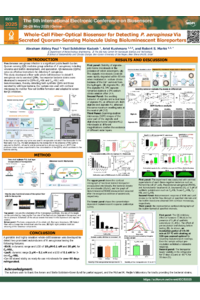
The opportunistic Gram-negative bacterium Pseudomonas aeruginosa poses significant challenges in both clinical and environmental settings due to its pathogenicity and resilience. Quorum-sensing (QS) molecules have emerged as promising biomarkers for the detection of P. aeruginosa. This study focused on the development of an alginate-based bioreporter encapsulation system designed for the identification of QS molecules, utilizing a custom-engineered coating formed through the assembly of poly-lysine (PLL). This PLL coating facilitates the passive diffusion of external QS molecules, resulting in a measurable, dose-dependent bioluminescent response. The microbeads reinforced with PLL exhibited substantial stability in the presence of cation scavengers, enabling prolonged shelf life and functionality. The encapsulated bacterial system demonstrated consistent, dose-dependent detection of QS molecules in media containing synthetic autoinducers and in cell-free supernatants derived from wild-type P. aeruginosa (PAO1) cultures. These bioreporter beads maintained their stability during extended storage at both 4 °C and -80 °C, allowing for immediate, on-site sensing without the need for recovery processes. The RhlR-based bioreporter displayed a dynamic detection range of 10 μM to 0.1 nM, with a sensitivity threshold of 50 pM for the designated QS molecules. The LasR-based bioreporter demonstrated a broader range of 5 μM to 0.2 nM and a lower detection threshold of 0.1 nM for 3-oxo-C12-HSL. Furthermore, the bioreporter beads effectively detected the presence of the synthetic QS inhibitor furanone C-30 in a dose-dependent manner. This proof-of-concept optical-fiber-based whole-cell biosensor illustrates the feasibility of employing an encapsulated bioreporter system for the detection of bacteria through specific QS molecules. The results of this study hold promise for potential applications in diagnostics, environmental monitoring, and screening for quorum-sensing inhibitors.
Keywords
alginate hydrogels
microbeads
optical biosensors
bioencapsulation
autoinducers
Pseudomonas aeruginosa
quorum sensing
C4-HSL
3-oxo-C12-HSL
Furanone C-30
QS inhibitor
whole-cell biosensors.
Poster
sciforum-116644_PosterPaul et al.pdf
A chemiluminescence immunosensor exploiting thin-film photosensors to detect C-reactive protein as a biomarker for astronaut health monitoring in long-term missions
Fiber gratings coupled with polymers for biosensing