Event submissions
Published
This submission belongs to the session H. Optical and Photonic Biosensors of the event The 5th International Electronic Conference on Biosensors
Published date
02 May, 2025
Academic Editor
'%3e%3cpath%20d='M12.6657%2010.9104C12.4185%2010.325%2012.0599%209.79327%2011.6097%209.34482C11.1609%208.89508%2010.6293%208.5365%2010.0442%208.28888C10.0389%208.28626%2010.0337%208.28495%2010.0285%208.28233C10.8446%207.69279%2011.3752%206.73249%2011.3752%205.64904C11.3752%203.8542%209.92103%202.39999%208.1262%202.39999C6.33136%202.39999%204.87715%203.8542%204.87715%205.64904C4.87715%206.73249%205.40774%207.69279%206.22393%208.28364C6.21869%208.28626%206.21345%208.28757%206.20821%208.29019C5.62129%208.5378%205.09463%208.89284%204.64265%209.34613C4.1929%209.79493%203.83432%2010.3266%203.58671%2010.9117C3.34345%2011.4845%203.21226%2012.0987%203.20023%2012.7209C3.19988%2012.7349%203.20233%2012.7488%203.20744%2012.7619C3.21255%2012.7749%203.22022%2012.7867%203.22998%2012.7968C3.23975%2012.8068%203.25142%2012.8147%203.26431%2012.8202C3.2772%2012.8256%203.29105%2012.8284%203.30504%2012.8284H4.09109C4.14874%2012.8284%204.19459%2012.7825%204.1959%2012.7262C4.2221%2011.7148%204.62823%2010.7676%205.34617%2010.0497C6.08899%209.30683%207.0755%208.89808%208.1262%208.89808C9.17689%208.89808%2010.1634%209.30683%2010.9062%2010.0497C11.6242%2010.7676%2012.0303%2011.7148%2012.0565%2012.7262C12.0578%2012.7838%2012.1037%2012.8284%2012.1613%2012.8284H12.9474C12.9613%2012.8284%2012.9752%2012.8256%2012.9881%2012.8202C13.001%2012.8147%2013.0126%2012.8068%2013.0224%2012.7968C13.0322%2012.7867%2013.0398%2012.7749%2013.0449%2012.7619C13.0501%2012.7488%2013.0525%2012.7349%2013.0522%2012.7209C13.0391%2012.0947%2012.9094%2011.4855%2012.6657%2010.9104ZM8.1262%207.9024C7.52486%207.9024%206.9589%207.6679%206.53312%207.24211C6.10733%206.81633%205.87283%206.25037%205.87283%205.64904C5.87283%205.0477%206.10733%204.48174%206.53312%204.05596C6.9589%203.63018%207.52486%203.39567%208.1262%203.39567C8.72753%203.39567%209.29349%203.63018%209.71927%204.05596C10.1451%204.48174%2010.3796%205.0477%2010.3796%205.64904C10.3796%206.25037%2010.1451%206.81633%209.71927%207.24211C9.29349%207.6679%208.72753%207.9024%208.1262%207.9024Z'%20fill='%235D1EE1'/%3e%3c/g%3e%3c/svg%3e) Chun-yang Zhang
Chun-yang ZhangCitation
Niccolò Marcucci, Gabriele Frigenti, Francesco Arcadio, Nunzio Cennamo, Mostafa Hussien Fytory Abdallah, Sara Tombelli, Francesco Baldini, Cosimo Trono, Biosensing and physical sensing methodologies based on optical fiber gratings, in Proceedings of The 5th International Electronic Conference on Biosensors, 26 May–28 May 2025, MDPI: Basel, Switzerland
Share
Email
Facebook
Twitter
LinkedIn
Biosensing and physical sensing methodologies based on optical fiber gratings
'%3e%3cpath%20d='M12.6647%2010.9104C12.4176%2010.325%2012.0589%209.7933%2011.6088%209.34485C11.16%208.89511%2010.6283%208.53653%2010.0432%208.28891C10.038%208.28629%2010.0327%208.28498%2010.0275%208.28236C10.8437%207.69282%2011.3743%206.73252%2011.3743%205.64907C11.3743%203.85423%209.92005%202.40002%208.12522%202.40002C6.33038%202.40002%204.87618%203.85423%204.87618%205.64907C4.87618%206.73252%205.40677%207.69282%206.22296%208.28367C6.21772%208.28629%206.21248%208.2876%206.20724%208.29022C5.62031%208.53783%205.09365%208.89287%204.64167%209.34616C4.19192%209.79496%203.83334%2010.3266%203.58573%2010.9117C3.34247%2011.4846%203.21128%2012.0987%203.19925%2012.721C3.1989%2012.735%203.20135%2012.7489%203.20646%2012.7619C3.21157%2012.7749%203.21924%2012.7868%203.22901%2012.7968C3.23877%2012.8068%203.25045%2012.8148%203.26334%2012.8202C3.27623%2012.8256%203.29007%2012.8284%203.30406%2012.8284H4.09012C4.14776%2012.8284%204.19362%2012.7825%204.19493%2012.7262C4.22113%2011.7148%204.62726%2010.7676%205.34519%2010.0497C6.08802%209.30686%207.07452%208.89811%208.12522%208.89811C9.17592%208.89811%2010.1624%209.30686%2010.9052%2010.0497C11.6232%2010.7676%2012.0293%2011.7148%2012.0555%2012.7262C12.0568%2012.7839%2012.1027%2012.8284%2012.1603%2012.8284H12.9464C12.9604%2012.8284%2012.9742%2012.8256%2012.9871%2012.8202C13%2012.8148%2013.0117%2012.8068%2013.0214%2012.7968C13.0312%2012.7868%2013.0389%2012.7749%2013.044%2012.7619C13.0491%2012.7489%2013.0515%2012.735%2013.0512%2012.721C13.0381%2012.0947%2012.9084%2011.4856%2012.6647%2010.9104ZM8.12522%207.90243C7.52388%207.90243%206.95792%207.66793%206.53214%207.24215C6.10636%206.81636%205.87185%206.2504%205.87185%205.64907C5.87185%205.04773%206.10636%204.48177%206.53214%204.05599C6.95792%203.63021%207.52388%203.3957%208.12522%203.3957C8.72655%203.3957%209.29252%203.63021%209.7183%204.05599C10.1441%204.48177%2010.3786%205.04773%2010.3786%205.64907C10.3786%206.2504%2010.1441%206.81636%209.7183%207.24215C9.29252%207.66793%208.72655%207.90243%208.12522%207.90243Z'%20fill='%235D1EE1'/%3e%3c/g%3e%3c/svg%3e)
Niccolò Marcucci 1
Gabriele Frigenti 1

Francesco Arcadio 2

Nunzio Cennamo 2
Mostafa Hussien Fytory Abdallah 1

Sara Tombelli 1

Francesco Baldini 1

Cosimo Trono 1
1. Institute of Applied Physics “Nello Carrara”, CNR-IFAC, Italy
2. Department of Engineering, University of Campania "Luigi Vanvitelli", Aversa - 81031; Italy
Abstract
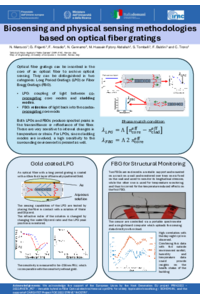
Fiber gratings have long been utilized as optical sensors, particularly for measuring chemical, biochemical, and physical parameters. These sensors typically operate by detecting changes in the external refractive index or by monitoring physical parameters such as strain, temperature, and pressure. Fiber gratings can be categorized into two main types based on the grating period and their distinct optical characteristics: (i) long-period gratings (LPGs), with grating periods of hundreds of micrometers, couple guided light from the fiber core to the cladding, facilitating interaction with the surrounding environment, and are primarily used for chemical and biochemical sensing; (ii) fiber Bragg gratings (FBGs), with grating periods of hundreds of nanometers, reflect light within the core's fundamental mode and are mainly employed for physical parameter sensing.
This work presents two practical applications of these methodologies. First, we characterize an LPG optical sensor inscribed in an optical fiber, enhanced with a 40 nm gold layer. The gold coating offers several benefits, such as ease of functionalization and the potential for multiphysics sensing, including its use as an electrode for electrical measurements. The fiber sensor is integrated into a thermostated microfluidic system. Our experimental results indicate that the sensor's sensitivity, with the gold coating, is comparable to a similar sensor without the coating. However, the gold layer introduces significant opportunities for integrating electrical and optical sensing capabilities.
The second application involves the design and implementation of a remote sensing apparatus for monitoring deformation and temperature in large structures, such as bridges. This system employs two FBGs: one for strain and one for tilt sensing. The FBG interrogation is managed by a single-board computer, and custom software is developed for data acquisition, analysis, and remote monitoring. The system is designed for low power consumption, with provisions for battery power and solar charging, ensuring energy efficiency and sustainability.
Acknowledgements:
We acknowledge the support of the European Union by the Next Generation EU project PRIN2022 – 2022JRKETK_PE7 - Versatile hybrid in-fiBer Optical-electrocHemical systEMs for wIdely Applicable bioseNsing – BOHEMIAN, and the support of CNR DIITET Project FOE 2022 STRIVE “INOSTRI”.
Keywords
long period gratings
fiber bragg gratings
optical fiber sensors
Poster
IECB25_Marcucci_poster.pdf
Recent advances in optical biosensors for the rapid detection of heavy metals
High-Performance Non-Isolated Boost DC-DC Converters with Voltage Multiplier Techniques for Solar Energy Harvesting Applications