Event submissions
Published
This submission belongs to the session E. Nanomaterials and Smart Surfaces in Biosensors of the event The 5th International Electronic Conference on Biosensors
Published date
02 May, 2025
Academic Editor
'%3e%3cpath%20d='M12.6657%2010.9104C12.4185%2010.325%2012.0599%209.79327%2011.6097%209.34482C11.1609%208.89508%2010.6293%208.5365%2010.0442%208.28888C10.0389%208.28626%2010.0337%208.28495%2010.0285%208.28233C10.8446%207.69279%2011.3752%206.73249%2011.3752%205.64904C11.3752%203.8542%209.92103%202.39999%208.1262%202.39999C6.33136%202.39999%204.87715%203.8542%204.87715%205.64904C4.87715%206.73249%205.40774%207.69279%206.22393%208.28364C6.21869%208.28626%206.21345%208.28757%206.20821%208.29019C5.62129%208.5378%205.09463%208.89284%204.64265%209.34613C4.1929%209.79493%203.83432%2010.3266%203.58671%2010.9117C3.34345%2011.4845%203.21226%2012.0987%203.20023%2012.7209C3.19988%2012.7349%203.20233%2012.7488%203.20744%2012.7619C3.21255%2012.7749%203.22022%2012.7867%203.22998%2012.7968C3.23975%2012.8068%203.25142%2012.8147%203.26431%2012.8202C3.2772%2012.8256%203.29105%2012.8284%203.30504%2012.8284H4.09109C4.14874%2012.8284%204.19459%2012.7825%204.1959%2012.7262C4.2221%2011.7148%204.62823%2010.7676%205.34617%2010.0497C6.08899%209.30683%207.0755%208.89808%208.1262%208.89808C9.17689%208.89808%2010.1634%209.30683%2010.9062%2010.0497C11.6242%2010.7676%2012.0303%2011.7148%2012.0565%2012.7262C12.0578%2012.7838%2012.1037%2012.8284%2012.1613%2012.8284H12.9474C12.9613%2012.8284%2012.9752%2012.8256%2012.9881%2012.8202C13.001%2012.8147%2013.0126%2012.8068%2013.0224%2012.7968C13.0322%2012.7867%2013.0398%2012.7749%2013.0449%2012.7619C13.0501%2012.7488%2013.0525%2012.7349%2013.0522%2012.7209C13.0391%2012.0947%2012.9094%2011.4855%2012.6657%2010.9104ZM8.1262%207.9024C7.52486%207.9024%206.9589%207.6679%206.53312%207.24211C6.10733%206.81633%205.87283%206.25037%205.87283%205.64904C5.87283%205.0477%206.10733%204.48174%206.53312%204.05596C6.9589%203.63018%207.52486%203.39567%208.1262%203.39567C8.72753%203.39567%209.29349%203.63018%209.71927%204.05596C10.1451%204.48174%2010.3796%205.0477%2010.3796%205.64904C10.3796%206.25037%2010.1451%206.81633%209.71927%207.24211C9.29349%207.6679%208.72753%207.9024%208.1262%207.9024Z'%20fill='%235D1EE1'/%3e%3c/g%3e%3c/svg%3e) Michael Thompson
Michael ThompsonCitation
Nouha Ghorbel, Ratiba Wali Elleuch, A High-Sensitivity Electrochemical Sensor Utilizing Polyaniline/Sodium Alginate Composite for Lead and Cadmium Detection, in Proceedings of The 5th International Electronic Conference on Biosensors, 26 May–28 May 2025, MDPI: Basel, Switzerland
Share
Email
Facebook
Twitter
LinkedIn
A High-Sensitivity Electrochemical Sensor Utilizing Polyaniline/Sodium Alginate Composite for Lead and Cadmium Detection
'%3e%3cpath%20d='M12.6647%2010.9104C12.4176%2010.325%2012.0589%209.7933%2011.6088%209.34485C11.16%208.89511%2010.6283%208.53653%2010.0432%208.28891C10.038%208.28629%2010.0327%208.28498%2010.0275%208.28236C10.8437%207.69282%2011.3743%206.73252%2011.3743%205.64907C11.3743%203.85423%209.92005%202.40002%208.12522%202.40002C6.33038%202.40002%204.87618%203.85423%204.87618%205.64907C4.87618%206.73252%205.40677%207.69282%206.22296%208.28367C6.21772%208.28629%206.21248%208.2876%206.20724%208.29022C5.62031%208.53783%205.09365%208.89287%204.64167%209.34616C4.19192%209.79496%203.83334%2010.3266%203.58573%2010.9117C3.34247%2011.4846%203.21128%2012.0987%203.19925%2012.721C3.1989%2012.735%203.20135%2012.7489%203.20646%2012.7619C3.21157%2012.7749%203.21924%2012.7868%203.22901%2012.7968C3.23877%2012.8068%203.25045%2012.8148%203.26334%2012.8202C3.27623%2012.8256%203.29007%2012.8284%203.30406%2012.8284H4.09012C4.14776%2012.8284%204.19362%2012.7825%204.19493%2012.7262C4.22113%2011.7148%204.62726%2010.7676%205.34519%2010.0497C6.08802%209.30686%207.07452%208.89811%208.12522%208.89811C9.17592%208.89811%2010.1624%209.30686%2010.9052%2010.0497C11.6232%2010.7676%2012.0293%2011.7148%2012.0555%2012.7262C12.0568%2012.7839%2012.1027%2012.8284%2012.1603%2012.8284H12.9464C12.9604%2012.8284%2012.9742%2012.8256%2012.9871%2012.8202C13%2012.8148%2013.0117%2012.8068%2013.0214%2012.7968C13.0312%2012.7868%2013.0389%2012.7749%2013.044%2012.7619C13.0491%2012.7489%2013.0515%2012.735%2013.0512%2012.721C13.0381%2012.0947%2012.9084%2011.4856%2012.6647%2010.9104ZM8.12522%207.90243C7.52388%207.90243%206.95792%207.66793%206.53214%207.24215C6.10636%206.81636%205.87185%206.2504%205.87185%205.64907C5.87185%205.04773%206.10636%204.48177%206.53214%204.05599C6.95792%203.63021%207.52388%203.3957%208.12522%203.3957C8.72655%203.3957%209.29252%203.63021%209.7183%204.05599C10.1441%204.48177%2010.3786%205.04773%2010.3786%205.64907C10.3786%206.2504%2010.1441%206.81636%209.7183%207.24215C9.29252%207.66793%208.72655%207.90243%208.12522%207.90243Z'%20fill='%235D1EE1'/%3e%3c/g%3e%3c/svg%3e)
Nouha Ghorbel 1
Ratiba Wali Elleuch 2
1. Laboratory of Polymer, Ceramic and Composites' Materials, University of Sfax, Tunisia
2. Department of Physics, University of Sfax, Tunisia
Abstract
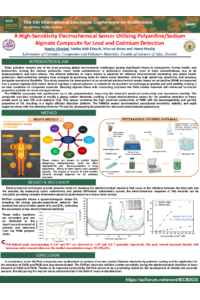
Water pollution remains one of the most pressing global environmental challenges, posing significant threats to ecosystems, human health, and biodiversity. Among the various pollutants, heavy metal contamination is particularly concerning, even at trace concentrations, due to its bioaccumulative and toxic effects. The efficient detection of heavy metals is essential for effective environmental monitoring and public health protection. Electrochemical sensors have emerged as promising tools for heavy metal detection, offering high sensitivity, selectivity, and accuracy alongside operational flexibility.
This study presents the development of an advanced electrochemical sensor based on polyaniline (PANI) incorporated into a sodium alginate (SA) matrix. Sodium alginate, a natural polymer, is notable for its excellent ion exchange properties and acid stability, making it an ideal candidate for composite materials. Blending alginate fibers with conducting polymers like PANI creates materials with enhanced functional properties suitable for advanced applications.
The PANI/SA composite was synthesized via in situ polymerization, improving the material's electrical conductivity and mechanical stability. The composite was then employed to modify a glassy carbon electrode, creating a robust electrochemical sensor for the sensitive detection of heavy metals such as lead (Pb) and cadmium (Cd). This sensor combines the high electrical conductivity of PANI with the biocompatibility and gel-like properties of SA, resulting in a highly efficient detection platform. The PANI/SA sensor demonstrated exceptional sensitivity, stability, and rapid response times, with low detection limits for Pb and Cd, showcasing its potential for real-world environmental applications.
Keywords
Biosensors
Heavy metals
Sodium alginate
Polyaniline
Electrochemical technique.
Poster
sciforum-115282 nouha ghorbel.pdf
Electrochemical immunoplatform for the quantification of epithelial extracellular vesicles applied to prostate cancer diagnosis
Nanobiosensors as trend-setting tools in agricultural engineering diagnostics