Event submissions
Published
This submission belongs to the session E. Nanomaterials and Smart Surfaces in Biosensors of the event The 5th International Electronic Conference on Biosensors
Published date
02 May, 2025
Academic Editor
'%3e%3cpath%20d='M12.6657%2010.9104C12.4185%2010.325%2012.0599%209.79327%2011.6097%209.34482C11.1609%208.89508%2010.6293%208.5365%2010.0442%208.28888C10.0389%208.28626%2010.0337%208.28495%2010.0285%208.28233C10.8446%207.69279%2011.3752%206.73249%2011.3752%205.64904C11.3752%203.8542%209.92103%202.39999%208.1262%202.39999C6.33136%202.39999%204.87715%203.8542%204.87715%205.64904C4.87715%206.73249%205.40774%207.69279%206.22393%208.28364C6.21869%208.28626%206.21345%208.28757%206.20821%208.29019C5.62129%208.5378%205.09463%208.89284%204.64265%209.34613C4.1929%209.79493%203.83432%2010.3266%203.58671%2010.9117C3.34345%2011.4845%203.21226%2012.0987%203.20023%2012.7209C3.19988%2012.7349%203.20233%2012.7488%203.20744%2012.7619C3.21255%2012.7749%203.22022%2012.7867%203.22998%2012.7968C3.23975%2012.8068%203.25142%2012.8147%203.26431%2012.8202C3.2772%2012.8256%203.29105%2012.8284%203.30504%2012.8284H4.09109C4.14874%2012.8284%204.19459%2012.7825%204.1959%2012.7262C4.2221%2011.7148%204.62823%2010.7676%205.34617%2010.0497C6.08899%209.30683%207.0755%208.89808%208.1262%208.89808C9.17689%208.89808%2010.1634%209.30683%2010.9062%2010.0497C11.6242%2010.7676%2012.0303%2011.7148%2012.0565%2012.7262C12.0578%2012.7838%2012.1037%2012.8284%2012.1613%2012.8284H12.9474C12.9613%2012.8284%2012.9752%2012.8256%2012.9881%2012.8202C13.001%2012.8147%2013.0126%2012.8068%2013.0224%2012.7968C13.0322%2012.7867%2013.0398%2012.7749%2013.0449%2012.7619C13.0501%2012.7488%2013.0525%2012.7349%2013.0522%2012.7209C13.0391%2012.0947%2012.9094%2011.4855%2012.6657%2010.9104ZM8.1262%207.9024C7.52486%207.9024%206.9589%207.6679%206.53312%207.24211C6.10733%206.81633%205.87283%206.25037%205.87283%205.64904C5.87283%205.0477%206.10733%204.48174%206.53312%204.05596C6.9589%203.63018%207.52486%203.39567%208.1262%203.39567C8.72753%203.39567%209.29349%203.63018%209.71927%204.05596C10.1451%204.48174%2010.3796%205.0477%2010.3796%205.64904C10.3796%206.25037%2010.1451%206.81633%209.71927%207.24211C9.29349%207.6679%208.72753%207.9024%208.1262%207.9024Z'%20fill='%235D1EE1'/%3e%3c/g%3e%3c/svg%3e) Michael Thompson
Michael ThompsonCitation
Guzel Ziyatdinova, Alena Kalmykova, Anastasiya Zhupanova, Selective voltammetric sensors based on carbon nanotubes and poly(triphenylmethane dyes) for quantification of phenolic antioxidants, in Proceedings of The 5th International Electronic Conference on Biosensors, 26 May–28 May 2025, MDPI: Basel, Switzerland
Share
Email
Facebook
Twitter
LinkedIn
Selective voltammetric sensors based on carbon nanotubes and poly(triphenylmethane dyes) for quantification of phenolic antioxidants

Guzel Ziyatdinova 1
'%3e%3cpath%20d='M12.6647%2010.9104C12.4176%2010.325%2012.0589%209.7933%2011.6088%209.34485C11.16%208.89511%2010.6283%208.53653%2010.0432%208.28891C10.038%208.28629%2010.0327%208.28498%2010.0275%208.28236C10.8437%207.69282%2011.3743%206.73252%2011.3743%205.64907C11.3743%203.85423%209.92005%202.40002%208.12522%202.40002C6.33038%202.40002%204.87618%203.85423%204.87618%205.64907C4.87618%206.73252%205.40677%207.69282%206.22296%208.28367C6.21772%208.28629%206.21248%208.2876%206.20724%208.29022C5.62031%208.53783%205.09365%208.89287%204.64167%209.34616C4.19192%209.79496%203.83334%2010.3266%203.58573%2010.9117C3.34247%2011.4846%203.21128%2012.0987%203.19925%2012.721C3.1989%2012.735%203.20135%2012.7489%203.20646%2012.7619C3.21157%2012.7749%203.21924%2012.7868%203.22901%2012.7968C3.23877%2012.8068%203.25045%2012.8148%203.26334%2012.8202C3.27623%2012.8256%203.29007%2012.8284%203.30406%2012.8284H4.09012C4.14776%2012.8284%204.19362%2012.7825%204.19493%2012.7262C4.22113%2011.7148%204.62726%2010.7676%205.34519%2010.0497C6.08802%209.30686%207.07452%208.89811%208.12522%208.89811C9.17592%208.89811%2010.1624%209.30686%2010.9052%2010.0497C11.6232%2010.7676%2012.0293%2011.7148%2012.0555%2012.7262C12.0568%2012.7839%2012.1027%2012.8284%2012.1603%2012.8284H12.9464C12.9604%2012.8284%2012.9742%2012.8256%2012.9871%2012.8202C13%2012.8148%2013.0117%2012.8068%2013.0214%2012.7968C13.0312%2012.7868%2013.0389%2012.7749%2013.044%2012.7619C13.0491%2012.7489%2013.0515%2012.735%2013.0512%2012.721C13.0381%2012.0947%2012.9084%2011.4856%2012.6647%2010.9104ZM8.12522%207.90243C7.52388%207.90243%206.95792%207.66793%206.53214%207.24215C6.10636%206.81636%205.87185%206.2504%205.87185%205.64907C5.87185%205.04773%206.10636%204.48177%206.53214%204.05599C6.95792%203.63021%207.52388%203.3957%208.12522%203.3957C8.72655%203.3957%209.29252%203.63021%209.7183%204.05599C10.1441%204.48177%2010.3786%205.04773%2010.3786%205.64907C10.3786%206.2504%2010.1441%206.81636%209.7183%207.24215C9.29252%207.66793%208.72655%207.90243%208.12522%207.90243Z'%20fill='%235D1EE1'/%3e%3c/g%3e%3c/svg%3e)
Alena Kalmykova 1
Anastasiya Zhupanova 1
1. Analytical Chemistry Department, Kazan Federal University, Kazan, 420008, Russia
Abstract
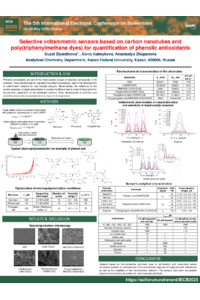
Phenolic antioxidants are one of the most studied groups of bioactive compounds in life sciences. Their electrooxidation capability has been successfully used in the development of voltammetric sensors for real sample analysis. Nevertheless, the selectivity of the sensor response to target antioxidants is usually insufficient and is a key limiting factor for the practical application of the developed sensors. In the current work, highly selective voltammetric sensors for natural phenolic antioxidants have been developed using glassy carbon electrodes and a layer-by-layer combination of carbon nanotubes and poly(triphenylmethane dyes) containing phenolic fragments in their structure. Carboxylated multi-walled and polyaminobenzene sulfonic acid-functionalized single-walled carbon nanotubes have been used as a substrate for the electrodeposition of polymeric coverages obtained by potentiodynamic electrolysis from triphenylmethane dyes (pyrogallol red, aluminon, phenol red, thymolphthalein). The optimal conditions of electropolymerization have been found on the basis of the voltammetric response of target phenolic antioxidants, i.e., eugenol, flavonoids (hesperidin and naringin, quercetin and rutin), and hydroxycinnamic acids (caffeic, ferulic, and p-coumaric acids). Electropolymerization proceeds via phenoxyl radical formation and its further dimerization and polymerization. A non-conductive polymeric layer in combination with conductive carbon nanotubes provides an improvement in the voltammetric response of target phenolic antioxidants as well as the possibility of their simultaneous detection. Sensors have shown significant increase in the electroactive surface and electron transfer rate compared to bare glassy carbon electrodes. Under conditions of differential pulse voltammetry, the sensors exhibit a sensitive response to phenolic antioxidants within the range from n×10-8 to n×10-5 M with the detection limits of 0.0047-730 μM. The sensor's high selectivity response to the target analyte in the presence of structurally related antioxidants is its main advantage over other electrochemical methods. The sensors have been successfully tested on real samples (essential oils, plant materials, and food).
Keywords
Voltammetric sensors
carbon nanomaterials
electropolymerization
triphenylmethane dyes
phenolic antioxidants
Poster
Poster_Ziyatdinova.pdf
Graphene-Based Platform for Electrochemical Profiling of Amino Acids
The microfluidic-based fluorescence enhancement of delayed fluorescence silica-embedded carbon dots for the detection and quantification of unamplified nucleic acid in clinical samples