Event submissions
Published
This submission belongs to the session E. Nanomaterials and Smart Surfaces in Biosensors of the event The 5th International Electronic Conference on Biosensors
Published date
02 May, 2025
Academic Editor
'%3e%3cpath%20d='M12.6657%2010.9104C12.4185%2010.325%2012.0599%209.79327%2011.6097%209.34482C11.1609%208.89508%2010.6293%208.5365%2010.0442%208.28888C10.0389%208.28626%2010.0337%208.28495%2010.0285%208.28233C10.8446%207.69279%2011.3752%206.73249%2011.3752%205.64904C11.3752%203.8542%209.92103%202.39999%208.1262%202.39999C6.33136%202.39999%204.87715%203.8542%204.87715%205.64904C4.87715%206.73249%205.40774%207.69279%206.22393%208.28364C6.21869%208.28626%206.21345%208.28757%206.20821%208.29019C5.62129%208.5378%205.09463%208.89284%204.64265%209.34613C4.1929%209.79493%203.83432%2010.3266%203.58671%2010.9117C3.34345%2011.4845%203.21226%2012.0987%203.20023%2012.7209C3.19988%2012.7349%203.20233%2012.7488%203.20744%2012.7619C3.21255%2012.7749%203.22022%2012.7867%203.22998%2012.7968C3.23975%2012.8068%203.25142%2012.8147%203.26431%2012.8202C3.2772%2012.8256%203.29105%2012.8284%203.30504%2012.8284H4.09109C4.14874%2012.8284%204.19459%2012.7825%204.1959%2012.7262C4.2221%2011.7148%204.62823%2010.7676%205.34617%2010.0497C6.08899%209.30683%207.0755%208.89808%208.1262%208.89808C9.17689%208.89808%2010.1634%209.30683%2010.9062%2010.0497C11.6242%2010.7676%2012.0303%2011.7148%2012.0565%2012.7262C12.0578%2012.7838%2012.1037%2012.8284%2012.1613%2012.8284H12.9474C12.9613%2012.8284%2012.9752%2012.8256%2012.9881%2012.8202C13.001%2012.8147%2013.0126%2012.8068%2013.0224%2012.7968C13.0322%2012.7867%2013.0398%2012.7749%2013.0449%2012.7619C13.0501%2012.7488%2013.0525%2012.7349%2013.0522%2012.7209C13.0391%2012.0947%2012.9094%2011.4855%2012.6657%2010.9104ZM8.1262%207.9024C7.52486%207.9024%206.9589%207.6679%206.53312%207.24211C6.10733%206.81633%205.87283%206.25037%205.87283%205.64904C5.87283%205.0477%206.10733%204.48174%206.53312%204.05596C6.9589%203.63018%207.52486%203.39567%208.1262%203.39567C8.72753%203.39567%209.29349%203.63018%209.71927%204.05596C10.1451%204.48174%2010.3796%205.0477%2010.3796%205.64904C10.3796%206.25037%2010.1451%206.81633%209.71927%207.24211C9.29349%207.6679%208.72753%207.9024%208.1262%207.9024Z'%20fill='%235D1EE1'/%3e%3c/g%3e%3c/svg%3e) Michael Thompson
Michael ThompsonCitation
Nikolai A. Belyakov, Zoia G. Zaitseva, Olga K. Deeva, Controllable Development of Dual-Modified Protein Molecules for Bio-Computational Tasks, in Proceedings of The 5th International Electronic Conference on Biosensors, 26 May–28 May 2025, MDPI: Basel, Switzerland
Share
Email
Facebook
Twitter
LinkedIn
Controllable Development of Dual-Modified Protein Molecules for Bio-Computational Tasks
'%3e%3cpath%20d='M12.6647%2010.9104C12.4176%2010.325%2012.0589%209.7933%2011.6088%209.34485C11.16%208.89511%2010.6283%208.53653%2010.0432%208.28891C10.038%208.28629%2010.0327%208.28498%2010.0275%208.28236C10.8437%207.69282%2011.3743%206.73252%2011.3743%205.64907C11.3743%203.85423%209.92005%202.40002%208.12522%202.40002C6.33038%202.40002%204.87618%203.85423%204.87618%205.64907C4.87618%206.73252%205.40677%207.69282%206.22296%208.28367C6.21772%208.28629%206.21248%208.2876%206.20724%208.29022C5.62031%208.53783%205.09365%208.89287%204.64167%209.34616C4.19192%209.79496%203.83334%2010.3266%203.58573%2010.9117C3.34247%2011.4846%203.21128%2012.0987%203.19925%2012.721C3.1989%2012.735%203.20135%2012.7489%203.20646%2012.7619C3.21157%2012.7749%203.21924%2012.7868%203.22901%2012.7968C3.23877%2012.8068%203.25045%2012.8148%203.26334%2012.8202C3.27623%2012.8256%203.29007%2012.8284%203.30406%2012.8284H4.09012C4.14776%2012.8284%204.19362%2012.7825%204.19493%2012.7262C4.22113%2011.7148%204.62726%2010.7676%205.34519%2010.0497C6.08802%209.30686%207.07452%208.89811%208.12522%208.89811C9.17592%208.89811%2010.1624%209.30686%2010.9052%2010.0497C11.6232%2010.7676%2012.0293%2011.7148%2012.0555%2012.7262C12.0568%2012.7839%2012.1027%2012.8284%2012.1603%2012.8284H12.9464C12.9604%2012.8284%2012.9742%2012.8256%2012.9871%2012.8202C13%2012.8148%2013.0117%2012.8068%2013.0214%2012.7968C13.0312%2012.7868%2013.0389%2012.7749%2013.044%2012.7619C13.0491%2012.7489%2013.0515%2012.735%2013.0512%2012.721C13.0381%2012.0947%2012.9084%2011.4856%2012.6647%2010.9104ZM8.12522%207.90243C7.52388%207.90243%206.95792%207.66793%206.53214%207.24215C6.10636%206.81636%205.87185%206.2504%205.87185%205.64907C5.87185%205.04773%206.10636%204.48177%206.53214%204.05599C6.95792%203.63021%207.52388%203.3957%208.12522%203.3957C8.72655%203.3957%209.29252%203.63021%209.7183%204.05599C10.1441%204.48177%2010.3786%205.04773%2010.3786%205.64907C10.3786%206.2504%2010.1441%206.81636%209.7183%207.24215C9.29252%207.66793%208.72655%207.90243%208.12522%207.90243Z'%20fill='%235D1EE1'/%3e%3c/g%3e%3c/svg%3e)
Nikolai A. Belyakov 1
Zoia G. Zaitseva 1
Olga K. Deeva 1
1. Prokhorov General Physics Institute of the Russian Academy of Sciences, Moscow Center for Advanced Studies, Russia
Abstract
Introduction
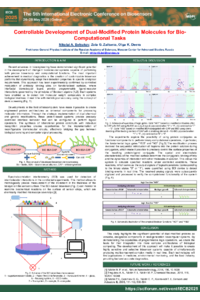
The development of biomolecular systems for computational tasks is a promising area in bioengineering and biosensor techniques. Using modified protein molecules as functional components of such systems enables the creation of next-generation devices based on the principles of biocomputing. In this study, we explored approaches to synthesizing dual-modified proteins with controlled surface characteristics and their potential application in implementing logical operations.
Materials and Methods
Dual-modified proteins were synthesized through the controlled sequential conjugation of test proteins, bovine serum albumin, and gelatin with low-molecular-weight compounds such as chloramphenicol and biotin, using carbodiimide chemistry. Low-molecular-weight substances were dissolved in a mixed buffer system with dimethyl sulfoxide, and their carboxyl groups were activated by a carbodiimide reagent. The activated compounds were then added to a protein solution in borate buffer, maintaining a precise molar ratio of 1:37:12 to ensure proper structural organization. This step allowed for an equilibrium distribution of surface charges, optimizing molecular interactions. The entire process was meticulously monitored using a label-free optical biosensor system based on spectral-phase interferometry (SPI). The final conjugates were diluted in a phosphate buffer and stored at 4 °C.
Results and Discussion
This study investigated the potential of using the obtained modified protein molecules to perform computational tasks, exemplified by the logical operations “YES” and “NOT.” By adding low-molecular-weight substances to the protein solution in a specific sequence during conjugation, the surface characteristics of the resulting product could be tailored. The steric properties of the surface determine the interaction pattern of the conjugate with other molecules in the solution, enabling it to reproduce specific reactions in a defined environment. These reactions, representing the output signals of a logical operator (logical “0” or “1”), were recorded using the SPI method and digitized.
Conclusions
This study demonstrates the potential of dual-modified proteins for use in biocomputing systems. Future work will focus on expanding the range of logical operations and optimizing the synthesis of dual-modified proteins to enhance their reproducibility and performance in biocomputing systems.
Keywords
Biocomputing
optical biosensors
molecular interactions
modified proteins
logical operations
surface characteristics
Poster
Poster_Controllable Development.pdf
In vitro Selection of ss DNA Aptamers and Their Role in the Fabrication of a Biosensing Platform for Gastric Cancer Diagnostics
Investigation of kinetic parameters of chloramphenicol and its conjugates’ interaction with monoclonal antibodies using label-free biosensors based on low-coherence interferometry