Event submissions
Published

This submission belongs to the session a. General Organic Synthesis of the event The 17th International Electronic Conference on Synthetic Organic Chemistry
Published date
31 Oct, 2013
Citation
Wolfgang STADLBAUER, Corinna V. MOSER, Synthesis of Heterocyclic Carbamates with Potential Activity in Plant Protection, in Proceedings of The 17th International Electronic Conference on Synthetic Organic Chemistry, 1 November–30 November 2013, MDPI: Basel, Switzerland, doi: 10.3390/ecsoc-17-a027
Share
Email
Facebook
Twitter
LinkedIn
Synthesis of Heterocyclic Carbamates with Potential Activity in Plant Protection
'%3e%3cpath%20d='M12.6647%2010.9104C12.4176%2010.325%2012.0589%209.7933%2011.6088%209.34485C11.16%208.89511%2010.6283%208.53653%2010.0432%208.28891C10.038%208.28629%2010.0327%208.28498%2010.0275%208.28236C10.8437%207.69282%2011.3743%206.73252%2011.3743%205.64907C11.3743%203.85423%209.92005%202.40002%208.12522%202.40002C6.33038%202.40002%204.87618%203.85423%204.87618%205.64907C4.87618%206.73252%205.40677%207.69282%206.22296%208.28367C6.21772%208.28629%206.21248%208.2876%206.20724%208.29022C5.62031%208.53783%205.09365%208.89287%204.64167%209.34616C4.19192%209.79496%203.83334%2010.3266%203.58573%2010.9117C3.34247%2011.4846%203.21128%2012.0987%203.19925%2012.721C3.1989%2012.735%203.20135%2012.7489%203.20646%2012.7619C3.21157%2012.7749%203.21924%2012.7868%203.22901%2012.7968C3.23877%2012.8068%203.25045%2012.8148%203.26334%2012.8202C3.27623%2012.8256%203.29007%2012.8284%203.30406%2012.8284H4.09012C4.14776%2012.8284%204.19362%2012.7825%204.19493%2012.7262C4.22113%2011.7148%204.62726%2010.7676%205.34519%2010.0497C6.08802%209.30686%207.07452%208.89811%208.12522%208.89811C9.17592%208.89811%2010.1624%209.30686%2010.9052%2010.0497C11.6232%2010.7676%2012.0293%2011.7148%2012.0555%2012.7262C12.0568%2012.7839%2012.1027%2012.8284%2012.1603%2012.8284H12.9464C12.9604%2012.8284%2012.9742%2012.8256%2012.9871%2012.8202C13%2012.8148%2013.0117%2012.8068%2013.0214%2012.7968C13.0312%2012.7868%2013.0389%2012.7749%2013.044%2012.7619C13.0491%2012.7489%2013.0515%2012.735%2013.0512%2012.721C13.0381%2012.0947%2012.9084%2011.4856%2012.6647%2010.9104ZM8.12522%207.90243C7.52388%207.90243%206.95792%207.66793%206.53214%207.24215C6.10636%206.81636%205.87185%206.2504%205.87185%205.64907C5.87185%205.04773%206.10636%204.48177%206.53214%204.05599C6.95792%203.63021%207.52388%203.3957%208.12522%203.3957C8.72655%203.3957%209.29252%203.63021%209.7183%204.05599C10.1441%204.48177%2010.3786%205.04773%2010.3786%205.64907C10.3786%206.2504%2010.1441%206.81636%209.7183%207.24215C9.29252%207.66793%208.72655%207.90243%208.12522%207.90243Z'%20fill='%235D1EE1'/%3e%3c/g%3e%3c/svg%3e)
Wolfgang STADLBAUER 1
Corinna V. MOSER 1
1. Institut für Chemie, University of Graz, Heinrichstrasse 28, A-8010 Graz
Abstract
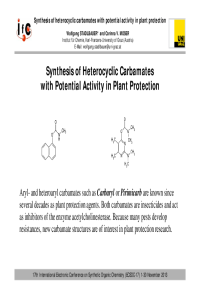
Aryl- and heteroaryl carbamates (e.g. Carbaryl and Pirimicarb) are known as plant protection agents. Because many pests develop resistances, new carbamate structures are of interest in plant protection research. Our synthetic approach started with the preparation of heterocyclic enoles such as pyrones 3, quinolones 6, and coumarins, quinolines, and pyridones of the general structure 12. They were obtained from 1,3-dinucleophiles such as anilines 1 and 10, phenols 10, and azomethines 10 by cyclocondensation with malonates. The pyrones 3 reacts with dialkylcarbamoylchlorides 4 in the presence of a base to carbamates 5. Degradation of 3 gave 4-hydroxyquinolones 6 which reacted with 4 to carbamates 9. Methylisocyanate 7 led to carbamates 8. Anilines 10 (X = NH, R3-R3 = -CH=CH-CH=CH-) cyclize with 2-substituted malonates 11 to quinolones 12. Similarly, phenols 10 (X = O, R3-R3 = -CH=CH-CH=CH-) react to coumarins 12. Azomethins 10 (X = N-alkyl, N-aryl, R4 either alkyl, aryl or 6- or 7-membered rings) give with reactive malonates pyridones, tetrahydroquinolines or cycloheptapyridones 12. Monocyclic pyridones 12 were also accessible from dehydracetic acid, followed by oxygen exchange with amines. The reaction of dialkylcarbamoylchlorides 4 with enols 12 in the presence of bases formed carbamates 13. With methylisocyanate 7, carbamates 14 were obtained. The evaluation of the biological activity shows, that 2 representatives from structures 6 and 12 exhibit strong plant protection properties.
Keywords
Heterocyclic carbamates
plant protection
dimethylaminocarbamoyl-pyrones
-pyridones
-quinolones
synthesis
Manuscript
ecsoc17_stadlbauer_manuscript.pdf
Poster
ecsoc17_stadlbauer_presentation.pdf
Semi-Synthetic Analogs of 17-Hydroxycativic Acid and their Biological Evaluation
From Suzuki-Miyaura Cross Coupling Reactions of 2-Bromo- and 4-Bromoestranes to Fluorinated Benzofuranoestranes