Event submissions
Published
This submission belongs to the session S7. Corrosion, Wear, and Protection of the event The 2nd International Electronic Conference on Metals
Published date
02 May, 2025
Academic Editor
'%3e%3cpath%20d='M12.6657%2010.9104C12.4185%2010.325%2012.0599%209.79327%2011.6097%209.34482C11.1609%208.89508%2010.6293%208.5365%2010.0442%208.28888C10.0389%208.28626%2010.0337%208.28495%2010.0285%208.28233C10.8446%207.69279%2011.3752%206.73249%2011.3752%205.64904C11.3752%203.8542%209.92103%202.39999%208.1262%202.39999C6.33136%202.39999%204.87715%203.8542%204.87715%205.64904C4.87715%206.73249%205.40774%207.69279%206.22393%208.28364C6.21869%208.28626%206.21345%208.28757%206.20821%208.29019C5.62129%208.5378%205.09463%208.89284%204.64265%209.34613C4.1929%209.79493%203.83432%2010.3266%203.58671%2010.9117C3.34345%2011.4845%203.21226%2012.0987%203.20023%2012.7209C3.19988%2012.7349%203.20233%2012.7488%203.20744%2012.7619C3.21255%2012.7749%203.22022%2012.7867%203.22998%2012.7968C3.23975%2012.8068%203.25142%2012.8147%203.26431%2012.8202C3.2772%2012.8256%203.29105%2012.8284%203.30504%2012.8284H4.09109C4.14874%2012.8284%204.19459%2012.7825%204.1959%2012.7262C4.2221%2011.7148%204.62823%2010.7676%205.34617%2010.0497C6.08899%209.30683%207.0755%208.89808%208.1262%208.89808C9.17689%208.89808%2010.1634%209.30683%2010.9062%2010.0497C11.6242%2010.7676%2012.0303%2011.7148%2012.0565%2012.7262C12.0578%2012.7838%2012.1037%2012.8284%2012.1613%2012.8284H12.9474C12.9613%2012.8284%2012.9752%2012.8256%2012.9881%2012.8202C13.001%2012.8147%2013.0126%2012.8068%2013.0224%2012.7968C13.0322%2012.7867%2013.0398%2012.7749%2013.0449%2012.7619C13.0501%2012.7488%2013.0525%2012.7349%2013.0522%2012.7209C13.0391%2012.0947%2012.9094%2011.4855%2012.6657%2010.9104ZM8.1262%207.9024C7.52486%207.9024%206.9589%207.6679%206.53312%207.24211C6.10733%206.81633%205.87283%206.25037%205.87283%205.64904C5.87283%205.0477%206.10733%204.48174%206.53312%204.05596C6.9589%203.63018%207.52486%203.39567%208.1262%203.39567C8.72753%203.39567%209.29349%203.63018%209.71927%204.05596C10.1451%204.48174%2010.3796%205.0477%2010.3796%205.64904C10.3796%206.25037%2010.1451%206.81633%209.71927%207.24211C9.29349%207.6679%208.72753%207.9024%208.1262%207.9024Z'%20fill='%235D1EE1'/%3e%3c/g%3e%3c/svg%3e) Branimir Grgur
Branimir GrgurCitation
Andrés Fernando Quintana Rondón, Jose Miguel Jiménez Martínez, Giovanni Juzga, Jorge Hernando Panqueva, Methodological Routes for Failure Analysis in Continuous Rods for Artificial Lift Systems: A Data-Driven and Damage Characteristic Approach, in Proceedings of The 2nd International Electronic Conference on Metals, 5 May–7 May 2025, MDPI: Basel, Switzerland
Share
Email
Facebook
Twitter
LinkedIn
Methodological Routes for Failure Analysis in Continuous Rods for Artificial Lift Systems: A Data-Driven and Damage Characteristic Approach
'%3e%3cpath%20d='M12.6647%2010.9104C12.4176%2010.325%2012.0589%209.7933%2011.6088%209.34485C11.16%208.89511%2010.6283%208.53653%2010.0432%208.28891C10.038%208.28629%2010.0327%208.28498%2010.0275%208.28236C10.8437%207.69282%2011.3743%206.73252%2011.3743%205.64907C11.3743%203.85423%209.92005%202.40002%208.12522%202.40002C6.33038%202.40002%204.87618%203.85423%204.87618%205.64907C4.87618%206.73252%205.40677%207.69282%206.22296%208.28367C6.21772%208.28629%206.21248%208.2876%206.20724%208.29022C5.62031%208.53783%205.09365%208.89287%204.64167%209.34616C4.19192%209.79496%203.83334%2010.3266%203.58573%2010.9117C3.34247%2011.4846%203.21128%2012.0987%203.19925%2012.721C3.1989%2012.735%203.20135%2012.7489%203.20646%2012.7619C3.21157%2012.7749%203.21924%2012.7868%203.22901%2012.7968C3.23877%2012.8068%203.25045%2012.8148%203.26334%2012.8202C3.27623%2012.8256%203.29007%2012.8284%203.30406%2012.8284H4.09012C4.14776%2012.8284%204.19362%2012.7825%204.19493%2012.7262C4.22113%2011.7148%204.62726%2010.7676%205.34519%2010.0497C6.08802%209.30686%207.07452%208.89811%208.12522%208.89811C9.17592%208.89811%2010.1624%209.30686%2010.9052%2010.0497C11.6232%2010.7676%2012.0293%2011.7148%2012.0555%2012.7262C12.0568%2012.7839%2012.1027%2012.8284%2012.1603%2012.8284H12.9464C12.9604%2012.8284%2012.9742%2012.8256%2012.9871%2012.8202C13%2012.8148%2013.0117%2012.8068%2013.0214%2012.7968C13.0312%2012.7868%2013.0389%2012.7749%2013.044%2012.7619C13.0491%2012.7489%2013.0515%2012.735%2013.0512%2012.721C13.0381%2012.0947%2012.9084%2011.4856%2012.6647%2010.9104ZM8.12522%207.90243C7.52388%207.90243%206.95792%207.66793%206.53214%207.24215C6.10636%206.81636%205.87185%206.2504%205.87185%205.64907C5.87185%205.04773%206.10636%204.48177%206.53214%204.05599C6.95792%203.63021%207.52388%203.3957%208.12522%203.3957C8.72655%203.3957%209.29252%203.63021%209.7183%204.05599C10.1441%204.48177%2010.3786%205.04773%2010.3786%205.64907C10.3786%206.2504%2010.1441%206.81636%209.7183%207.24215C9.29252%207.66793%208.72655%207.90243%208.12522%207.90243Z'%20fill='%235D1EE1'/%3e%3c/g%3e%3c/svg%3e)
Andrés Fernando Quintana Rondón 1
Jose Miguel Jiménez Martínez 1
Giovanni Juzga 1
Jorge Hernando Panqueva 1
1. Corporación para la Investigación de la Corrosión, Km 2 Vía Refugio Sede UIS Guatiguará, Piedecuesta, Santander - Colombia
Abstract
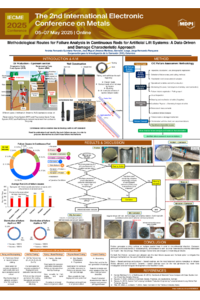
One of the key components in the reciprocating lift system and progressive cavity pump system is the steel rod string. This part is in charge of two main objectives in oil production. First, it allows the transmission of movement from surface to downhole, and secondly, it permits fluid lift. Nowadays, the use of continuous rods instead of conventional coupling rod systems has gained considerable attention due to its advantages like the higher amount of annular space available for production, less complex installation, and better distribution of contact loads with tubing. Understanding the reasons for continuous rod failure important to improve the performance and propose improvements in its design, use, and materials. Herein, an extensive data analysis of 51 failures in continuous rods has been performed, providing principal insights to identify the damage mechanisms, and, through fractography analysis, the principal service loads are identified. All the analyzed failures have occurred due to fatigue, implying that fatigue design and assessment are necessary for successful rod performance. Stress concentrators have been caused due to abrasion related to sand management, friction between the tubing and the rod, corrosion (CO2, microorganisms), issues with rod manufacture quality, operative conditions, installation, and synergies between them. Our results show that the three main reasons for failure are corrosion (31.4%), fretting corrosion (13.4%), and abrasion–corrosion (11.8%) which are related to service conditions, and their principal morphological features were identified. Also, manufacturing rod quality is the source of 9.8% of failures. This provides a useful guide for engineers to find an easy way to identify the reasons for failure in their oilfields. Finally, a comprehensive analysis of the principal used metallurgies is presented, presenting their main advantages, limitations, quality control benchmarks, and future perspectives for new materials in this component.
Keywords
Artificial Lift Systems
Continuous Rods
Corrosion
Data Analysis
Failure Analysis
Fatigue.
Poster
sciforum-119497 Andres Quintana.pdf
Microbial corrosion in oil transportation and storage systems: laboratory-scale study on biofilm and pitting formation
Cobalt-Based Electrocatalysts: A Pathway Toward Cost-Effective and High-Performance Energy Conversion