Event submissions
Published
This submission belongs to the session S5. Metallic Functional/ Electronics Materials of the event The 2nd International Electronic Conference on Metals
Published date
02 May, 2025
Academic Editor
'%3e%3cpath%20d='M12.6657%2010.9104C12.4185%2010.325%2012.0599%209.79327%2011.6097%209.34482C11.1609%208.89508%2010.6293%208.5365%2010.0442%208.28888C10.0389%208.28626%2010.0337%208.28495%2010.0285%208.28233C10.8446%207.69279%2011.3752%206.73249%2011.3752%205.64904C11.3752%203.8542%209.92103%202.39999%208.1262%202.39999C6.33136%202.39999%204.87715%203.8542%204.87715%205.64904C4.87715%206.73249%205.40774%207.69279%206.22393%208.28364C6.21869%208.28626%206.21345%208.28757%206.20821%208.29019C5.62129%208.5378%205.09463%208.89284%204.64265%209.34613C4.1929%209.79493%203.83432%2010.3266%203.58671%2010.9117C3.34345%2011.4845%203.21226%2012.0987%203.20023%2012.7209C3.19988%2012.7349%203.20233%2012.7488%203.20744%2012.7619C3.21255%2012.7749%203.22022%2012.7867%203.22998%2012.7968C3.23975%2012.8068%203.25142%2012.8147%203.26431%2012.8202C3.2772%2012.8256%203.29105%2012.8284%203.30504%2012.8284H4.09109C4.14874%2012.8284%204.19459%2012.7825%204.1959%2012.7262C4.2221%2011.7148%204.62823%2010.7676%205.34617%2010.0497C6.08899%209.30683%207.0755%208.89808%208.1262%208.89808C9.17689%208.89808%2010.1634%209.30683%2010.9062%2010.0497C11.6242%2010.7676%2012.0303%2011.7148%2012.0565%2012.7262C12.0578%2012.7838%2012.1037%2012.8284%2012.1613%2012.8284H12.9474C12.9613%2012.8284%2012.9752%2012.8256%2012.9881%2012.8202C13.001%2012.8147%2013.0126%2012.8068%2013.0224%2012.7968C13.0322%2012.7867%2013.0398%2012.7749%2013.0449%2012.7619C13.0501%2012.7488%2013.0525%2012.7349%2013.0522%2012.7209C13.0391%2012.0947%2012.9094%2011.4855%2012.6657%2010.9104ZM8.1262%207.9024C7.52486%207.9024%206.9589%207.6679%206.53312%207.24211C6.10733%206.81633%205.87283%206.25037%205.87283%205.64904C5.87283%205.0477%206.10733%204.48174%206.53312%204.05596C6.9589%203.63018%207.52486%203.39567%208.1262%203.39567C8.72753%203.39567%209.29349%203.63018%209.71927%204.05596C10.1451%204.48174%2010.3796%205.0477%2010.3796%205.64904C10.3796%206.25037%2010.1451%206.81633%209.71927%207.24211C9.29349%207.6679%208.72753%207.9024%208.1262%207.9024Z'%20fill='%235D1EE1'/%3e%3c/g%3e%3c/svg%3e) J.J. Suñol
J.J. SuñolCitation
Huma Amber, Aldona Balčiūnaitė, Loreta Tamasauskaite-Tamasiunaite, Zita Sukackienė, Jūratė Vaičiūnienė, Eugenijus Norkus, Cobalt-Based Electrocatalysts: A Pathway Toward Cost-Effective and High-Performance Energy Conversion, in Proceedings of The 2nd International Electronic Conference on Metals, 5 May–7 May 2025, MDPI: Basel, Switzerland
Share
Email
Facebook
Twitter
LinkedIn
Cobalt-Based Electrocatalysts: A Pathway Toward Cost-Effective and High-Performance Energy Conversion
'%3e%3cpath%20d='M12.6647%2010.9104C12.4176%2010.325%2012.0589%209.7933%2011.6088%209.34485C11.16%208.89511%2010.6283%208.53653%2010.0432%208.28891C10.038%208.28629%2010.0327%208.28498%2010.0275%208.28236C10.8437%207.69282%2011.3743%206.73252%2011.3743%205.64907C11.3743%203.85423%209.92005%202.40002%208.12522%202.40002C6.33038%202.40002%204.87618%203.85423%204.87618%205.64907C4.87618%206.73252%205.40677%207.69282%206.22296%208.28367C6.21772%208.28629%206.21248%208.2876%206.20724%208.29022C5.62031%208.53783%205.09365%208.89287%204.64167%209.34616C4.19192%209.79496%203.83334%2010.3266%203.58573%2010.9117C3.34247%2011.4846%203.21128%2012.0987%203.19925%2012.721C3.1989%2012.735%203.20135%2012.7489%203.20646%2012.7619C3.21157%2012.7749%203.21924%2012.7868%203.22901%2012.7968C3.23877%2012.8068%203.25045%2012.8148%203.26334%2012.8202C3.27623%2012.8256%203.29007%2012.8284%203.30406%2012.8284H4.09012C4.14776%2012.8284%204.19362%2012.7825%204.19493%2012.7262C4.22113%2011.7148%204.62726%2010.7676%205.34519%2010.0497C6.08802%209.30686%207.07452%208.89811%208.12522%208.89811C9.17592%208.89811%2010.1624%209.30686%2010.9052%2010.0497C11.6232%2010.7676%2012.0293%2011.7148%2012.0555%2012.7262C12.0568%2012.7839%2012.1027%2012.8284%2012.1603%2012.8284H12.9464C12.9604%2012.8284%2012.9742%2012.8256%2012.9871%2012.8202C13%2012.8148%2013.0117%2012.8068%2013.0214%2012.7968C13.0312%2012.7868%2013.0389%2012.7749%2013.044%2012.7619C13.0491%2012.7489%2013.0515%2012.735%2013.0512%2012.721C13.0381%2012.0947%2012.9084%2011.4856%2012.6647%2010.9104ZM8.12522%207.90243C7.52388%207.90243%206.95792%207.66793%206.53214%207.24215C6.10636%206.81636%205.87185%206.2504%205.87185%205.64907C5.87185%205.04773%206.10636%204.48177%206.53214%204.05599C6.95792%203.63021%207.52388%203.3957%208.12522%203.3957C8.72655%203.3957%209.29252%203.63021%209.7183%204.05599C10.1441%204.48177%2010.3786%205.04773%2010.3786%205.64907C10.3786%206.2504%2010.1441%206.81636%209.7183%207.24215C9.29252%207.66793%208.72655%207.90243%208.12522%207.90243Z'%20fill='%235D1EE1'/%3e%3c/g%3e%3c/svg%3e)
Huma Amber 1

Aldona Balčiūnaitė 2

Loreta Tamasauskaite-Tamasiunaite 2

Zita Sukackienė 2
Jūratė Vaičiūnienė 2
Eugenijus Norkus 2
1. Department of Catalysis, Center for Physical Sciences and Technology (FTMC), Lithuania
2. Department of Catalysis, State Research Institute Center for Physical and Technological Sciences (FTMC), Lithuania
Abstract
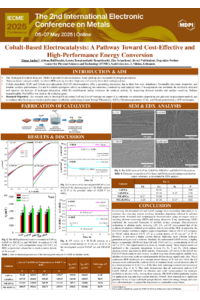
The significant demand for sustainable and cost-effective energy solutions has led to extensive research into non-noble and earth-abundant metal-based electrocatalysts for energy conversion reactions, such as hydrogen evolution reactions (HERs). While noble metals such as platinum (Pt) and iridium (Ir) have historically dominated due to their exceptional catalytic performance, palladium (Pd) has emerged as a compelling alternative. This is primarily due to its comparatively lower cost, excellent hydrogen adsorption and desorption properties, high catalytic activity, and improved durability. Recent strategies, such as Pd-based alloying with non-noble metals (e.g., Ni, Co, Mo) and nanostructuring techniques, have resulted in enhanced catalytic performance, greater active site exposure, and better stability in alkaline conditions. Herein, cobalt–phosphorus (CoP) and cobalt–iron–phosphorus (CoFeP) coatings were deposited on the copper (Cu) substrate using an electroless deposition method. The incorporation of Pd nanoparticles on the CoP and CoFeP coatings using the galvanic displacement method has been shown to enhance the catalytic activity of the coatings. The morphology, structure, and composition of the catalytic materials were thoroughly examined using scanning electron microscopy (SEM), energy-dispersive X-ray spectroscopy (EDS), X-ray diffraction (XRD), and inductively coupled plasma optical emission spectroscopy (ICP-OES). Moreover, the electrocatalytic activity of the catalysts for the HER in an alkaline solution (1 M KOH) was studied using linear sweep voltammetry (LSV). Electrochemical measurements revealed that PdCoFeP exhibited superior HER activity with a lower overpotential of 180 mV at 10 mA cm⁻² compared to PdCoP due to synergistic effects between Pd, Fe, and Co, which promote efficient charge transfer and reduce the reaction overpotential. This work highlights that Pd-based non-noble metal electrocatalysts have the potential to accelerate the transition towards sustainable hydrogen production, thus contributing to the broader goal of clean and renewable energy technologies.
Acknowledgement
This research was funded by a grant (No. P-MIP-23-467) from the Research Council of Lithuania.
Keywords
electroless deposition
galvanic displacement
hydrogen evolution reaction
palladium
cobalt
iron
phosphorus
Poster
sciforum-119493 huma amber.pdf
Methodological Routes for Failure Analysis in Continuous Rods for Artificial Lift Systems: A Data-Driven and Damage Characteristic Approach
Functionalization of metal surfaces through plasma electrolytic oxidation (PEO) treatments with the addition of particles