Event submissions
Published
This submission belongs to the session S7. Corrosion, Wear, and Protection of the event The 2nd International Electronic Conference on Metals
Published date
02 May, 2025
Academic Editor
'%3e%3cpath%20d='M12.6657%2010.9104C12.4185%2010.325%2012.0599%209.79327%2011.6097%209.34482C11.1609%208.89508%2010.6293%208.5365%2010.0442%208.28888C10.0389%208.28626%2010.0337%208.28495%2010.0285%208.28233C10.8446%207.69279%2011.3752%206.73249%2011.3752%205.64904C11.3752%203.8542%209.92103%202.39999%208.1262%202.39999C6.33136%202.39999%204.87715%203.8542%204.87715%205.64904C4.87715%206.73249%205.40774%207.69279%206.22393%208.28364C6.21869%208.28626%206.21345%208.28757%206.20821%208.29019C5.62129%208.5378%205.09463%208.89284%204.64265%209.34613C4.1929%209.79493%203.83432%2010.3266%203.58671%2010.9117C3.34345%2011.4845%203.21226%2012.0987%203.20023%2012.7209C3.19988%2012.7349%203.20233%2012.7488%203.20744%2012.7619C3.21255%2012.7749%203.22022%2012.7867%203.22998%2012.7968C3.23975%2012.8068%203.25142%2012.8147%203.26431%2012.8202C3.2772%2012.8256%203.29105%2012.8284%203.30504%2012.8284H4.09109C4.14874%2012.8284%204.19459%2012.7825%204.1959%2012.7262C4.2221%2011.7148%204.62823%2010.7676%205.34617%2010.0497C6.08899%209.30683%207.0755%208.89808%208.1262%208.89808C9.17689%208.89808%2010.1634%209.30683%2010.9062%2010.0497C11.6242%2010.7676%2012.0303%2011.7148%2012.0565%2012.7262C12.0578%2012.7838%2012.1037%2012.8284%2012.1613%2012.8284H12.9474C12.9613%2012.8284%2012.9752%2012.8256%2012.9881%2012.8202C13.001%2012.8147%2013.0126%2012.8068%2013.0224%2012.7968C13.0322%2012.7867%2013.0398%2012.7749%2013.0449%2012.7619C13.0501%2012.7488%2013.0525%2012.7349%2013.0522%2012.7209C13.0391%2012.0947%2012.9094%2011.4855%2012.6657%2010.9104ZM8.1262%207.9024C7.52486%207.9024%206.9589%207.6679%206.53312%207.24211C6.10733%206.81633%205.87283%206.25037%205.87283%205.64904C5.87283%205.0477%206.10733%204.48174%206.53312%204.05596C6.9589%203.63018%207.52486%203.39567%208.1262%203.39567C8.72753%203.39567%209.29349%203.63018%209.71927%204.05596C10.1451%204.48174%2010.3796%205.0477%2010.3796%205.64904C10.3796%206.25037%2010.1451%206.81633%209.71927%207.24211C9.29349%207.6679%208.72753%207.9024%208.1262%207.9024Z'%20fill='%235D1EE1'/%3e%3c/g%3e%3c/svg%3e) Branimir Grgur
Branimir GrgurCitation
Nina Kovač, Slavko Kralj, Ingrid Milošev, Barbara Kapun, Peter Rodič, PMMA–Siloxane–Silica Coating to Enhance Corrosion Resistance of AZ31, in Proceedings of The 2nd International Electronic Conference on Metals, 5 May–7 May 2025, MDPI: Basel, Switzerland
Share
Email
Facebook
Twitter
LinkedIn
PMMA–Siloxane–Silica Coating to Enhance Corrosion Resistance of AZ31
'%3e%3cpath%20d='M12.6647%2010.9104C12.4176%2010.325%2012.0589%209.7933%2011.6088%209.34485C11.16%208.89511%2010.6283%208.53653%2010.0432%208.28891C10.038%208.28629%2010.0327%208.28498%2010.0275%208.28236C10.8437%207.69282%2011.3743%206.73252%2011.3743%205.64907C11.3743%203.85423%209.92005%202.40002%208.12522%202.40002C6.33038%202.40002%204.87618%203.85423%204.87618%205.64907C4.87618%206.73252%205.40677%207.69282%206.22296%208.28367C6.21772%208.28629%206.21248%208.2876%206.20724%208.29022C5.62031%208.53783%205.09365%208.89287%204.64167%209.34616C4.19192%209.79496%203.83334%2010.3266%203.58573%2010.9117C3.34247%2011.4846%203.21128%2012.0987%203.19925%2012.721C3.1989%2012.735%203.20135%2012.7489%203.20646%2012.7619C3.21157%2012.7749%203.21924%2012.7868%203.22901%2012.7968C3.23877%2012.8068%203.25045%2012.8148%203.26334%2012.8202C3.27623%2012.8256%203.29007%2012.8284%203.30406%2012.8284H4.09012C4.14776%2012.8284%204.19362%2012.7825%204.19493%2012.7262C4.22113%2011.7148%204.62726%2010.7676%205.34519%2010.0497C6.08802%209.30686%207.07452%208.89811%208.12522%208.89811C9.17592%208.89811%2010.1624%209.30686%2010.9052%2010.0497C11.6232%2010.7676%2012.0293%2011.7148%2012.0555%2012.7262C12.0568%2012.7839%2012.1027%2012.8284%2012.1603%2012.8284H12.9464C12.9604%2012.8284%2012.9742%2012.8256%2012.9871%2012.8202C13%2012.8148%2013.0117%2012.8068%2013.0214%2012.7968C13.0312%2012.7868%2013.0389%2012.7749%2013.044%2012.7619C13.0491%2012.7489%2013.0515%2012.735%2013.0512%2012.721C13.0381%2012.0947%2012.9084%2011.4856%2012.6647%2010.9104ZM8.12522%207.90243C7.52388%207.90243%206.95792%207.66793%206.53214%207.24215C6.10636%206.81636%205.87185%206.2504%205.87185%205.64907C5.87185%205.04773%206.10636%204.48177%206.53214%204.05599C6.95792%203.63021%207.52388%203.3957%208.12522%203.3957C8.72655%203.3957%209.29252%203.63021%209.7183%204.05599C10.1441%204.48177%2010.3786%205.04773%2010.3786%205.64907C10.3786%206.2504%2010.1441%206.81636%209.7183%207.24215C9.29252%207.66793%208.72655%207.90243%208.12522%207.90243Z'%20fill='%235D1EE1'/%3e%3c/g%3e%3c/svg%3e)
Nina Kovač 1,2

Slavko Kralj 3

Ingrid Milošev 1
Barbara Kapun 1
Peter Rodič 1
1. Jožef Stefan Institute, Department of Physical and Organic Chemistry, Jamova c. 39, 1000 Ljubljana, Slovenia
2. Jožef Stefan International Postgraduate School, 1000 Ljubljana, Jamova c. 39, Slovenia
3. Jožef Stefan Institute, Department for Materials Synthesis, Jamova c. 39, 1000 Ljubljana, Slovenia
Abstract
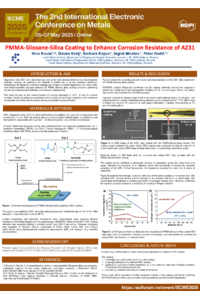
Several studies in biomedicine have demonstrated the advantages of biodegradable and biocompatible metals for temporary implants, as they naturally degrade within the body, eliminating the need for surgical removal. Among them, magnesium–aluminium–zinc alloys, such as AZ31, show potential for controlled degradation in physiological environments, but their primary limitation is their rapid degradation.[1] This accelerated corrosion compromises implant integrity, leading to premature failure and limiting clinical applications. Thus, effective protective strategies are essential to enhance their corrosion resistance.
This study aimed to (a) perform a surface pretreatment to improve adhesion between the protective coating and the AZ31 alloy, and (b) develop a PMMA–siloxane–silica coating to reduce degradation. The formulation, based on 3-(methacryloyloxy)propyl trimethoxysilane and methyl methacrylate, was optimized for enhanced protective properties[2]. Its synthesis was characterized using real-time Fourier transform infrared spectroscopy, while its surface morphology and composition were analyzed via scanning electron microscopy and energy-dispersive spectroscopy. Corrosion resistance was evaluated through immersion tests in simulated body fluid (SBF) using potentiodynamic polarization and electrochemical impedance spectroscopy. Additionally, degradation behaviour was evaluated by monitoring pH variations and hydrogen evolution in SBF over time.
The results confirm that the PMMA–siloxane–silica coating significantly enhanced AZ31 corrosion resistance, ensuring controlled degradation. These findings present the potential of siloxane–silica coatings for biomedical applications.
References:
[1] M. He, L. Chen, M. Yin, et al., Review on magnesium and magnesium-based alloys as biomaterials for bone immobilization, J. Mater. Res. Technol. 23 (2023) 4396–4419. https://doi.org/10.1016/j.jmrt.2023.02.037.
[2] P. Rodič, B. Kapun, I. Milošev, Durable Polyacrylic/Siloxane-Silica Coating for the Protection of Cast AlSi7Mg0.3 Alloy against Corrosion in Chloride Solution, Polymers 15 (2023) 3993. https://doi.org/10.3390/polym15193993.
Acknowledgements:
Financial support was provided by the Slovenian Research and Innovation Agency (ARIS) under research core funding P1-0134, P2-0393 and P2-0089 and through the ARIS project J2-60047.
Keywords
AZ31
surface pretreatment
corrosion protection
sol-gel coatings
PMMA-siloxane silica
Poster
sciforum-118392 Nina Novac.pdf
The effect of biocidal treatments on native thiosulfate-reducing bacteria that contibuteto biocorrosion in the oil and gas sectors
Exploring the Impact of MIG Brazing Techniques on Stability, Bead Morphology, and Joint Performance