Event submissions
Published
This submission belongs to the session S8. Metallic Materials Processing of the event The 2nd International Electronic Conference on Metals
Published date
02 May, 2025
Academic Editor
'%3e%3cpath%20d='M12.6657%2010.9104C12.4185%2010.325%2012.0599%209.79327%2011.6097%209.34482C11.1609%208.89508%2010.6293%208.5365%2010.0442%208.28888C10.0389%208.28626%2010.0337%208.28495%2010.0285%208.28233C10.8446%207.69279%2011.3752%206.73249%2011.3752%205.64904C11.3752%203.8542%209.92103%202.39999%208.1262%202.39999C6.33136%202.39999%204.87715%203.8542%204.87715%205.64904C4.87715%206.73249%205.40774%207.69279%206.22393%208.28364C6.21869%208.28626%206.21345%208.28757%206.20821%208.29019C5.62129%208.5378%205.09463%208.89284%204.64265%209.34613C4.1929%209.79493%203.83432%2010.3266%203.58671%2010.9117C3.34345%2011.4845%203.21226%2012.0987%203.20023%2012.7209C3.19988%2012.7349%203.20233%2012.7488%203.20744%2012.7619C3.21255%2012.7749%203.22022%2012.7867%203.22998%2012.7968C3.23975%2012.8068%203.25142%2012.8147%203.26431%2012.8202C3.2772%2012.8256%203.29105%2012.8284%203.30504%2012.8284H4.09109C4.14874%2012.8284%204.19459%2012.7825%204.1959%2012.7262C4.2221%2011.7148%204.62823%2010.7676%205.34617%2010.0497C6.08899%209.30683%207.0755%208.89808%208.1262%208.89808C9.17689%208.89808%2010.1634%209.30683%2010.9062%2010.0497C11.6242%2010.7676%2012.0303%2011.7148%2012.0565%2012.7262C12.0578%2012.7838%2012.1037%2012.8284%2012.1613%2012.8284H12.9474C12.9613%2012.8284%2012.9752%2012.8256%2012.9881%2012.8202C13.001%2012.8147%2013.0126%2012.8068%2013.0224%2012.7968C13.0322%2012.7867%2013.0398%2012.7749%2013.0449%2012.7619C13.0501%2012.7488%2013.0525%2012.7349%2013.0522%2012.7209C13.0391%2012.0947%2012.9094%2011.4855%2012.6657%2010.9104ZM8.1262%207.9024C7.52486%207.9024%206.9589%207.6679%206.53312%207.24211C6.10733%206.81633%205.87283%206.25037%205.87283%205.64904C5.87283%205.0477%206.10733%204.48174%206.53312%204.05596C6.9589%203.63018%207.52486%203.39567%208.1262%203.39567C8.72753%203.39567%209.29349%203.63018%209.71927%204.05596C10.1451%204.48174%2010.3796%205.0477%2010.3796%205.64904C10.3796%206.25037%2010.1451%206.81633%209.71927%207.24211C9.29349%207.6679%208.72753%207.9024%208.1262%207.9024Z'%20fill='%235D1EE1'/%3e%3c/g%3e%3c/svg%3e) Shusen Wu
Shusen WuCitation
Jesús Darío Tirado Montoya, Reynel Brito Beltrán, Claudia Marcela Méndez, Natalia Silvina Zadorozne, Alicia Esther Ares, The Directional Solidification of Al-Zn Alloys as a function of the Level of Convective Heat Transfer, in Proceedings of The 2nd International Electronic Conference on Metals, 5 May–7 May 2025, MDPI: Basel, Switzerland
Share
Email
Facebook
Twitter
LinkedIn
The Directional Solidification of Al-Zn Alloys as a function of the Level of Convective Heat Transfer
'%3e%3cpath%20d='M12.6647%2010.9104C12.4176%2010.325%2012.0589%209.7933%2011.6088%209.34485C11.16%208.89511%2010.6283%208.53653%2010.0432%208.28891C10.038%208.28629%2010.0327%208.28498%2010.0275%208.28236C10.8437%207.69282%2011.3743%206.73252%2011.3743%205.64907C11.3743%203.85423%209.92005%202.40002%208.12522%202.40002C6.33038%202.40002%204.87618%203.85423%204.87618%205.64907C4.87618%206.73252%205.40677%207.69282%206.22296%208.28367C6.21772%208.28629%206.21248%208.2876%206.20724%208.29022C5.62031%208.53783%205.09365%208.89287%204.64167%209.34616C4.19192%209.79496%203.83334%2010.3266%203.58573%2010.9117C3.34247%2011.4846%203.21128%2012.0987%203.19925%2012.721C3.1989%2012.735%203.20135%2012.7489%203.20646%2012.7619C3.21157%2012.7749%203.21924%2012.7868%203.22901%2012.7968C3.23877%2012.8068%203.25045%2012.8148%203.26334%2012.8202C3.27623%2012.8256%203.29007%2012.8284%203.30406%2012.8284H4.09012C4.14776%2012.8284%204.19362%2012.7825%204.19493%2012.7262C4.22113%2011.7148%204.62726%2010.7676%205.34519%2010.0497C6.08802%209.30686%207.07452%208.89811%208.12522%208.89811C9.17592%208.89811%2010.1624%209.30686%2010.9052%2010.0497C11.6232%2010.7676%2012.0293%2011.7148%2012.0555%2012.7262C12.0568%2012.7839%2012.1027%2012.8284%2012.1603%2012.8284H12.9464C12.9604%2012.8284%2012.9742%2012.8256%2012.9871%2012.8202C13%2012.8148%2013.0117%2012.8068%2013.0214%2012.7968C13.0312%2012.7868%2013.0389%2012.7749%2013.044%2012.7619C13.0491%2012.7489%2013.0515%2012.735%2013.0512%2012.721C13.0381%2012.0947%2012.9084%2011.4856%2012.6647%2010.9104ZM8.12522%207.90243C7.52388%207.90243%206.95792%207.66793%206.53214%207.24215C6.10636%206.81636%205.87185%206.2504%205.87185%205.64907C5.87185%205.04773%206.10636%204.48177%206.53214%204.05599C6.95792%203.63021%207.52388%203.3957%208.12522%203.3957C8.72655%203.3957%209.29252%203.63021%209.7183%204.05599C10.1441%204.48177%2010.3786%205.04773%2010.3786%205.64907C10.3786%206.2504%2010.1441%206.81636%209.7183%207.24215C9.29252%207.66793%208.72655%207.90243%208.12522%207.90243Z'%20fill='%235D1EE1'/%3e%3c/g%3e%3c/svg%3e)
Jesús Darío Tirado Montoya 1
Reynel Brito Beltrán 1
Claudia Marcela Méndez 1
Natalia Silvina Zadorozne 1

Alicia Esther Ares 1
1. Instituto de Materiales de Misiones (Consejo Nacional de Investigaciones Científicas y Técnicas - Universidad Nacional de Misiones)
Abstract
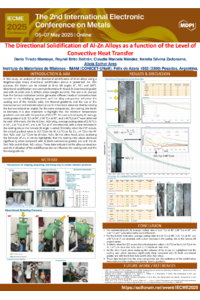
In this study, an analysis of the directional solidification of Al-Zn alloys using a Brigdman-type rotary directional solidification device is presented. For this purpose, the device can be rotated at three tilt angles (0°, 90°, and 180°). Directional solidification tests were performed with Al and Zn (commercial grade) and with Al-5%Zn and Al-10%Zn alloys (weight percent). The aim is to analyze how the furnace inclination (which generates different levels of convective heat transfer in the solidifying specimen) and the alloy composition influence the cooling rate of the metallic solid, the thermal gradients, and the size of the macrostructure and microstructure present. It has been observed that by varying the furnace inclination angles, for the same composition, the cooling rate tends to decrease; it is also important to highlight that the minimum temperature gradients coincide with the position of the CET. For commercial purity Al, average cooling rates of 2.21 °C/s at 90°, 2.05 °C/s at 45°, and 1.98 °C/s at 0° were obtained for each of the tests. For the Al-10wt. %Zn alloy, average cooling rates of 2.43 °C/s at 90°, 2.14 °C/s at 45°, and 1.99 °C/s at 0° are obtained, with a clear decrease in the cooling rate as the furnace tilt angle is varied. Similarly, when the CET occurs, the critical gradient value is -0.5 ºC/cm for Al, 0.1 ºC/cm for Zn, 1.4 ºC/cm for Al-5wt. %Zn, and -1.2 ºC/cm for Al-10wt. %Zn. On the other hand, when analyzing the behavior of Zn, it can be highlighted that the cooling rate values decrease significantly when compared with Al (both commercial grades) and with the Al-5wt. %Zn and Al-10wt. %Zn alloys. These data indicate that the alloy composition and the inclination of the solidification device influence the cooling rate and the thermal gradients.
Keywords
Al-Zn alloys
CET
Natural convection
Thermal parameters
Poster
sciforum-114991 (ARES A.E.).pdf
Creation of thin TiNi wires with stabilized martensite phase
Development of new stainless steel via Laser powder bed fusion process