Event submissions
Published
This submission belongs to the session S9. Metallic Materials for Biomedical Applications of the event The 2nd International Electronic Conference on Metals
Published date
02 May, 2025
Academic Editor
'%3e%3cpath%20d='M12.6657%2010.9104C12.4185%2010.325%2012.0599%209.79327%2011.6097%209.34482C11.1609%208.89508%2010.6293%208.5365%2010.0442%208.28888C10.0389%208.28626%2010.0337%208.28495%2010.0285%208.28233C10.8446%207.69279%2011.3752%206.73249%2011.3752%205.64904C11.3752%203.8542%209.92103%202.39999%208.1262%202.39999C6.33136%202.39999%204.87715%203.8542%204.87715%205.64904C4.87715%206.73249%205.40774%207.69279%206.22393%208.28364C6.21869%208.28626%206.21345%208.28757%206.20821%208.29019C5.62129%208.5378%205.09463%208.89284%204.64265%209.34613C4.1929%209.79493%203.83432%2010.3266%203.58671%2010.9117C3.34345%2011.4845%203.21226%2012.0987%203.20023%2012.7209C3.19988%2012.7349%203.20233%2012.7488%203.20744%2012.7619C3.21255%2012.7749%203.22022%2012.7867%203.22998%2012.7968C3.23975%2012.8068%203.25142%2012.8147%203.26431%2012.8202C3.2772%2012.8256%203.29105%2012.8284%203.30504%2012.8284H4.09109C4.14874%2012.8284%204.19459%2012.7825%204.1959%2012.7262C4.2221%2011.7148%204.62823%2010.7676%205.34617%2010.0497C6.08899%209.30683%207.0755%208.89808%208.1262%208.89808C9.17689%208.89808%2010.1634%209.30683%2010.9062%2010.0497C11.6242%2010.7676%2012.0303%2011.7148%2012.0565%2012.7262C12.0578%2012.7838%2012.1037%2012.8284%2012.1613%2012.8284H12.9474C12.9613%2012.8284%2012.9752%2012.8256%2012.9881%2012.8202C13.001%2012.8147%2013.0126%2012.8068%2013.0224%2012.7968C13.0322%2012.7867%2013.0398%2012.7749%2013.0449%2012.7619C13.0501%2012.7488%2013.0525%2012.7349%2013.0522%2012.7209C13.0391%2012.0947%2012.9094%2011.4855%2012.6657%2010.9104ZM8.1262%207.9024C7.52486%207.9024%206.9589%207.6679%206.53312%207.24211C6.10733%206.81633%205.87283%206.25037%205.87283%205.64904C5.87283%205.0477%206.10733%204.48174%206.53312%204.05596C6.9589%203.63018%207.52486%203.39567%208.1262%203.39567C8.72753%203.39567%209.29349%203.63018%209.71927%204.05596C10.1451%204.48174%2010.3796%205.0477%2010.3796%205.64904C10.3796%206.25037%2010.1451%206.81633%209.71927%207.24211C9.29349%207.6679%208.72753%207.9024%208.1262%207.9024Z'%20fill='%235D1EE1'/%3e%3c/g%3e%3c/svg%3e) Francesca Borgioli
Francesca BorgioliCitation
Danilo Cervantes Mauricio, Vinícius Richieri Manso Gonçalves, Jhuliene Elen Muro Torrento, Carlos Roberto Grandini, Diego Rafael Nespeque Correa, Mechanical and tribological evaluation of a biomedical high-entropy alloy reinforced with TiC and TiB, in Proceedings of The 2nd International Electronic Conference on Metals, 5 May–7 May 2025, MDPI: Basel, Switzerland
Share
Email
Facebook
Twitter
LinkedIn
Mechanical and tribological evaluation of a biomedical high-entropy alloy reinforced with TiC and TiB
'%3e%3cpath%20d='M12.6647%2010.9104C12.4176%2010.325%2012.0589%209.7933%2011.6088%209.34485C11.16%208.89511%2010.6283%208.53653%2010.0432%208.28891C10.038%208.28629%2010.0327%208.28498%2010.0275%208.28236C10.8437%207.69282%2011.3743%206.73252%2011.3743%205.64907C11.3743%203.85423%209.92005%202.40002%208.12522%202.40002C6.33038%202.40002%204.87618%203.85423%204.87618%205.64907C4.87618%206.73252%205.40677%207.69282%206.22296%208.28367C6.21772%208.28629%206.21248%208.2876%206.20724%208.29022C5.62031%208.53783%205.09365%208.89287%204.64167%209.34616C4.19192%209.79496%203.83334%2010.3266%203.58573%2010.9117C3.34247%2011.4846%203.21128%2012.0987%203.19925%2012.721C3.1989%2012.735%203.20135%2012.7489%203.20646%2012.7619C3.21157%2012.7749%203.21924%2012.7868%203.22901%2012.7968C3.23877%2012.8068%203.25045%2012.8148%203.26334%2012.8202C3.27623%2012.8256%203.29007%2012.8284%203.30406%2012.8284H4.09012C4.14776%2012.8284%204.19362%2012.7825%204.19493%2012.7262C4.22113%2011.7148%204.62726%2010.7676%205.34519%2010.0497C6.08802%209.30686%207.07452%208.89811%208.12522%208.89811C9.17592%208.89811%2010.1624%209.30686%2010.9052%2010.0497C11.6232%2010.7676%2012.0293%2011.7148%2012.0555%2012.7262C12.0568%2012.7839%2012.1027%2012.8284%2012.1603%2012.8284H12.9464C12.9604%2012.8284%2012.9742%2012.8256%2012.9871%2012.8202C13%2012.8148%2013.0117%2012.8068%2013.0214%2012.7968C13.0312%2012.7868%2013.0389%2012.7749%2013.044%2012.7619C13.0491%2012.7489%2013.0515%2012.735%2013.0512%2012.721C13.0381%2012.0947%2012.9084%2011.4856%2012.6647%2010.9104ZM8.12522%207.90243C7.52388%207.90243%206.95792%207.66793%206.53214%207.24215C6.10636%206.81636%205.87185%206.2504%205.87185%205.64907C5.87185%205.04773%206.10636%204.48177%206.53214%204.05599C6.95792%203.63021%207.52388%203.3957%208.12522%203.3957C8.72655%203.3957%209.29252%203.63021%209.7183%204.05599C10.1441%204.48177%2010.3786%205.04773%2010.3786%205.64907C10.3786%206.2504%2010.1441%206.81636%209.7183%207.24215C9.29252%207.66793%208.72655%207.90243%208.12522%207.90243Z'%20fill='%235D1EE1'/%3e%3c/g%3e%3c/svg%3e)
Danilo Cervantes Mauricio 1
Vinícius Richieri Manso Gonçalves 2
Jhuliene Elen Muro Torrento 3

Carlos Roberto Grandini 3

Diego Rafael Nespeque Correa 1
1. São Paulo State University (UNESP), School of Sciences, Bauru, Laboratório de Anelasticidade e Biomateriais,
17033-360, Bauru, Brazil
2. Federal University of São Carlos (UFSCar), Department of Materials Engineering, 3565-905, São Carlos, Brazil
3. São Paulo State University (UNESP), School of Sciences, Campus Bauru, Laboratory of Anelasticity and Biomaterials, 17.033-360 Bauru, SP, Brazil
Abstract
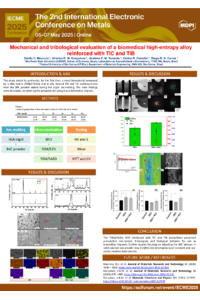
High-entropy alloys (HEAs) are emerging materials that have recently been considered for biomedical applications. However, further adjustments in their properties are still needed to potentialize this application. Thus, research on novel processing routes is interesting for producing such advanced biomedical HEAs. In this study, we synthesized a novel metal–matrix composite (MMC) using an HEA as the matrix, which was reinforced with TiB and TiC particles. The sample was produced by argon arc melting a TiNbZrTaMo ingot with B4C powder to induce in situ reactions. The resulting sample underwent extensive evaluations, including physical, chemical, structural, microstructural, mechanical, tribological, and biological assessments, and was compared to the unreinforced HEA sample. X-ray diffraction confirmed the in situ reactions, revealing a dual-phase (BCC + HCP) matrix with TiC and TiB peaks. Scanning and transmission electron microscopy showed that the BCC phase was enriched with refractory metals (Ta, Mo, and Nb), while the HCP and carbide precipitate phases were enriched with Ti and Zr. The results demonstrated strong interfacial bonding between the TiC precipitate and the matrix. Mechanical property analysis indicated that the precipitates retained a combination of high microhardness and a relatively low elastic modulus. Despite this, the precipitates enhanced wear resistance without offering any benefits in terms of corrosion resistance. Cytotoxicity tests showed that the precipitates positively influenced cell viability and adhesion. These findings highlight the potential for developing novel biomedical materials by combining HEA and MMC concepts. (Financial support: CNPq and FAPESP grant #2024/03148-3)
Keywords
biomaterial
metal-matrix composite
high entropy alloy
mechanical
tribology
Poster
sciforum-114883 Diego Rafael Nespeque Correa.pdf
Innovation in Manufacturing Technologies with Eco-Sustainable Magnetic Materials
Anomalous metallic and half-metallic properties of the Gd4Sb3 intermetallic compound