Event submissions
Published
This submission belongs to the session E. Nanomaterials and Smart Surfaces in Biosensors of the event The 5th International Electronic Conference on Biosensors
Published date
02 May, 2025
Academic Editor
'%3e%3cpath%20d='M12.6657%2010.9104C12.4185%2010.325%2012.0599%209.79327%2011.6097%209.34482C11.1609%208.89508%2010.6293%208.5365%2010.0442%208.28888C10.0389%208.28626%2010.0337%208.28495%2010.0285%208.28233C10.8446%207.69279%2011.3752%206.73249%2011.3752%205.64904C11.3752%203.8542%209.92103%202.39999%208.1262%202.39999C6.33136%202.39999%204.87715%203.8542%204.87715%205.64904C4.87715%206.73249%205.40774%207.69279%206.22393%208.28364C6.21869%208.28626%206.21345%208.28757%206.20821%208.29019C5.62129%208.5378%205.09463%208.89284%204.64265%209.34613C4.1929%209.79493%203.83432%2010.3266%203.58671%2010.9117C3.34345%2011.4845%203.21226%2012.0987%203.20023%2012.7209C3.19988%2012.7349%203.20233%2012.7488%203.20744%2012.7619C3.21255%2012.7749%203.22022%2012.7867%203.22998%2012.7968C3.23975%2012.8068%203.25142%2012.8147%203.26431%2012.8202C3.2772%2012.8256%203.29105%2012.8284%203.30504%2012.8284H4.09109C4.14874%2012.8284%204.19459%2012.7825%204.1959%2012.7262C4.2221%2011.7148%204.62823%2010.7676%205.34617%2010.0497C6.08899%209.30683%207.0755%208.89808%208.1262%208.89808C9.17689%208.89808%2010.1634%209.30683%2010.9062%2010.0497C11.6242%2010.7676%2012.0303%2011.7148%2012.0565%2012.7262C12.0578%2012.7838%2012.1037%2012.8284%2012.1613%2012.8284H12.9474C12.9613%2012.8284%2012.9752%2012.8256%2012.9881%2012.8202C13.001%2012.8147%2013.0126%2012.8068%2013.0224%2012.7968C13.0322%2012.7867%2013.0398%2012.7749%2013.0449%2012.7619C13.0501%2012.7488%2013.0525%2012.7349%2013.0522%2012.7209C13.0391%2012.0947%2012.9094%2011.4855%2012.6657%2010.9104ZM8.1262%207.9024C7.52486%207.9024%206.9589%207.6679%206.53312%207.24211C6.10733%206.81633%205.87283%206.25037%205.87283%205.64904C5.87283%205.0477%206.10733%204.48174%206.53312%204.05596C6.9589%203.63018%207.52486%203.39567%208.1262%203.39567C8.72753%203.39567%209.29349%203.63018%209.71927%204.05596C10.1451%204.48174%2010.3796%205.0477%2010.3796%205.64904C10.3796%206.25037%2010.1451%206.81633%209.71927%207.24211C9.29349%207.6679%208.72753%207.9024%208.1262%207.9024Z'%20fill='%235D1EE1'/%3e%3c/g%3e%3c/svg%3e) Michael Thompson
Michael ThompsonCitation
Sambasivan Venkat Eswaran, Manurbhav Arya, Sujeet Kumar Thakur, Potential sensing applications based on Gwal Pahari Acid, in Proceedings of The 5th International Electronic Conference on Biosensors, 26 May–28 May 2025, MDPI: Basel, Switzerland
Share
Email
Facebook
Twitter
LinkedIn
Potential sensing applications based on Gwal Pahari Acid
'%3e%3cpath%20d='M12.6647%2010.9104C12.4176%2010.325%2012.0589%209.7933%2011.6088%209.34485C11.16%208.89511%2010.6283%208.53653%2010.0432%208.28891C10.038%208.28629%2010.0327%208.28498%2010.0275%208.28236C10.8437%207.69282%2011.3743%206.73252%2011.3743%205.64907C11.3743%203.85423%209.92005%202.40002%208.12522%202.40002C6.33038%202.40002%204.87618%203.85423%204.87618%205.64907C4.87618%206.73252%205.40677%207.69282%206.22296%208.28367C6.21772%208.28629%206.21248%208.2876%206.20724%208.29022C5.62031%208.53783%205.09365%208.89287%204.64167%209.34616C4.19192%209.79496%203.83334%2010.3266%203.58573%2010.9117C3.34247%2011.4846%203.21128%2012.0987%203.19925%2012.721C3.1989%2012.735%203.20135%2012.7489%203.20646%2012.7619C3.21157%2012.7749%203.21924%2012.7868%203.22901%2012.7968C3.23877%2012.8068%203.25045%2012.8148%203.26334%2012.8202C3.27623%2012.8256%203.29007%2012.8284%203.30406%2012.8284H4.09012C4.14776%2012.8284%204.19362%2012.7825%204.19493%2012.7262C4.22113%2011.7148%204.62726%2010.7676%205.34519%2010.0497C6.08802%209.30686%207.07452%208.89811%208.12522%208.89811C9.17592%208.89811%2010.1624%209.30686%2010.9052%2010.0497C11.6232%2010.7676%2012.0293%2011.7148%2012.0555%2012.7262C12.0568%2012.7839%2012.1027%2012.8284%2012.1603%2012.8284H12.9464C12.9604%2012.8284%2012.9742%2012.8256%2012.9871%2012.8202C13%2012.8148%2013.0117%2012.8068%2013.0214%2012.7968C13.0312%2012.7868%2013.0389%2012.7749%2013.044%2012.7619C13.0491%2012.7489%2013.0515%2012.735%2013.0512%2012.721C13.0381%2012.0947%2012.9084%2011.4856%2012.6647%2010.9104ZM8.12522%207.90243C7.52388%207.90243%206.95792%207.66793%206.53214%207.24215C6.10636%206.81636%205.87185%206.2504%205.87185%205.64907C5.87185%205.04773%206.10636%204.48177%206.53214%204.05599C6.95792%203.63021%207.52388%203.3957%208.12522%203.3957C8.72655%203.3957%209.29252%203.63021%209.7183%204.05599C10.1441%204.48177%2010.3786%205.04773%2010.3786%205.64907C10.3786%206.2504%2010.1441%206.81636%209.7183%207.24215C9.29252%207.66793%208.72655%207.90243%208.12522%207.90243Z'%20fill='%235D1EE1'/%3e%3c/g%3e%3c/svg%3e)
Sambasivan Venkat Eswaran 1,2,3,4
Manurbhav Arya 4,5,6
Sujeet Kumar Thakur 4,5
1. Ex-Head (Chemistry Department), Dean (Academics), St. Stephen’s College, Delhi-110007, India
2. Professor of Practice, KPRIET Coimbatore, India
3. Honorary Professor, Amity University, Noida, India
4. FITT-IIT Delhi, C Block 4th floor 1G, Hauz Khas, New Delhi, 110016
5. TERI School of Advanced Studies, Delhi, India
6. Deakin University, Geelong, Australia
Abstract
Introduction
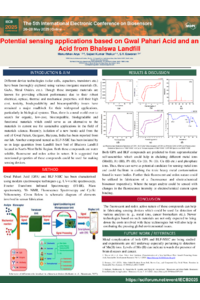
Different device technologies (solar cells, capacitors, transistors, etc.) have been thoroughly explored using various inorganic materials (Si, GaAs, metal oxides, etc.). Though these inorganic materials are known for providing efficient performance due to their robust electrical, optical, thermal, and mechanical properties, their high cost, toxicity, biodegradability, and biocompatibility issues have remained a major roadblock for their widespread applications, particularly in biological systems. Thus, there is a need worldwide to search for organic, low-cost, biocompatible, biodegradable, and functional materials which could serve as an alternative to the materials in current use for sustainable applications in the field of materials science. Focusing on the natural resources which are available abundantly and making use of these could offer exciting opportunities for researchers.
Methods
Recently, the isolation of a new humic acid from the soil of Gwal Pahari, Gurgaon, Haryana, India, has been reported from our lab. This water-soluble, fluorescent, and ninhydrin-positive Gwal Pahari Acid (GPA) has been characterized using modern spectroscopic techniques, e.g., UV–visible spectroscopy, Fourier-Transform Infrared Spectroscopy (FT-IR), mass spectrometry, 1H- NMR and 2D-NMR studies, Scanning Electron Microscopy, and Zeta Potential.
Results and Conclusions
GPA is predicted to form supramolecular self-assemblies which could help in chelating different metal ions (Fe (III), Pb (II), Co (II), Ni (II), Cu (II), etc.) and phosphate ions. Thus, GPA may serve as a potential candidate for sensing metal ions and could facilitate in curbing the toxic heavy metal contamination found in water bodies. Further, its fluorescent nature can be utilized in the fabrication of a fluorescence-based biosensor where the target analyte could be sensed with changes in the fluorescence signal. Newer technologies based on such materials are not only expected to bring down the costs involved with these technologies but will also help in combating the pressing global environmental issues.
Keywords
Gwal Pahari Acid
sensors
biosensors
biocompatibility
metal ions
Poster
Poster for MDPI Conference 2025.pdf
Modified Laser-Induced Graphene Electrodes for Dual-Mode Capacitive Sensing: From Nitrite Detection to Kanamycin Monitoring
Development of a Flexible Biosensor based on Green-Synthesized Hematite–Graphene Oxide Nanocomposites for Electrochemical Detection of Bisphenol A