Event submissions
Published
This submission belongs to the session E. Nanomaterials and Smart Surfaces in Biosensors of the event The 5th International Electronic Conference on Biosensors
Published date
02 May, 2025
Academic Editor
'%3e%3cpath%20d='M12.6657%2010.9104C12.4185%2010.325%2012.0599%209.79327%2011.6097%209.34482C11.1609%208.89508%2010.6293%208.5365%2010.0442%208.28888C10.0389%208.28626%2010.0337%208.28495%2010.0285%208.28233C10.8446%207.69279%2011.3752%206.73249%2011.3752%205.64904C11.3752%203.8542%209.92103%202.39999%208.1262%202.39999C6.33136%202.39999%204.87715%203.8542%204.87715%205.64904C4.87715%206.73249%205.40774%207.69279%206.22393%208.28364C6.21869%208.28626%206.21345%208.28757%206.20821%208.29019C5.62129%208.5378%205.09463%208.89284%204.64265%209.34613C4.1929%209.79493%203.83432%2010.3266%203.58671%2010.9117C3.34345%2011.4845%203.21226%2012.0987%203.20023%2012.7209C3.19988%2012.7349%203.20233%2012.7488%203.20744%2012.7619C3.21255%2012.7749%203.22022%2012.7867%203.22998%2012.7968C3.23975%2012.8068%203.25142%2012.8147%203.26431%2012.8202C3.2772%2012.8256%203.29105%2012.8284%203.30504%2012.8284H4.09109C4.14874%2012.8284%204.19459%2012.7825%204.1959%2012.7262C4.2221%2011.7148%204.62823%2010.7676%205.34617%2010.0497C6.08899%209.30683%207.0755%208.89808%208.1262%208.89808C9.17689%208.89808%2010.1634%209.30683%2010.9062%2010.0497C11.6242%2010.7676%2012.0303%2011.7148%2012.0565%2012.7262C12.0578%2012.7838%2012.1037%2012.8284%2012.1613%2012.8284H12.9474C12.9613%2012.8284%2012.9752%2012.8256%2012.9881%2012.8202C13.001%2012.8147%2013.0126%2012.8068%2013.0224%2012.7968C13.0322%2012.7867%2013.0398%2012.7749%2013.0449%2012.7619C13.0501%2012.7488%2013.0525%2012.7349%2013.0522%2012.7209C13.0391%2012.0947%2012.9094%2011.4855%2012.6657%2010.9104ZM8.1262%207.9024C7.52486%207.9024%206.9589%207.6679%206.53312%207.24211C6.10733%206.81633%205.87283%206.25037%205.87283%205.64904C5.87283%205.0477%206.10733%204.48174%206.53312%204.05596C6.9589%203.63018%207.52486%203.39567%208.1262%203.39567C8.72753%203.39567%209.29349%203.63018%209.71927%204.05596C10.1451%204.48174%2010.3796%205.0477%2010.3796%205.64904C10.3796%206.25037%2010.1451%206.81633%209.71927%207.24211C9.29349%207.6679%208.72753%207.9024%208.1262%207.9024Z'%20fill='%235D1EE1'/%3e%3c/g%3e%3c/svg%3e) Michael Thompson
Michael ThompsonCitation
Laura N. Fernandez Solis, Andrea Ferroni, Mailen Neira, Martín A. Fernández-Baldo, Daniel Matias Gaston Regiart, Portable electrochemical immunosensor with dual-function mesoporous nanostructure for mycotoxin detection in mixed cereal samples, in Proceedings of The 5th International Electronic Conference on Biosensors, 26 May–28 May 2025, MDPI: Basel, Switzerland
Share
Email
Facebook
Twitter
LinkedIn
Portable electrochemical immunosensor with dual-function mesoporous nanostructure for mycotoxin detection in mixed cereal samples
'%3e%3cpath%20d='M12.6647%2010.9104C12.4176%2010.325%2012.0589%209.7933%2011.6088%209.34485C11.16%208.89511%2010.6283%208.53653%2010.0432%208.28891C10.038%208.28629%2010.0327%208.28498%2010.0275%208.28236C10.8437%207.69282%2011.3743%206.73252%2011.3743%205.64907C11.3743%203.85423%209.92005%202.40002%208.12522%202.40002C6.33038%202.40002%204.87618%203.85423%204.87618%205.64907C4.87618%206.73252%205.40677%207.69282%206.22296%208.28367C6.21772%208.28629%206.21248%208.2876%206.20724%208.29022C5.62031%208.53783%205.09365%208.89287%204.64167%209.34616C4.19192%209.79496%203.83334%2010.3266%203.58573%2010.9117C3.34247%2011.4846%203.21128%2012.0987%203.19925%2012.721C3.1989%2012.735%203.20135%2012.7489%203.20646%2012.7619C3.21157%2012.7749%203.21924%2012.7868%203.22901%2012.7968C3.23877%2012.8068%203.25045%2012.8148%203.26334%2012.8202C3.27623%2012.8256%203.29007%2012.8284%203.30406%2012.8284H4.09012C4.14776%2012.8284%204.19362%2012.7825%204.19493%2012.7262C4.22113%2011.7148%204.62726%2010.7676%205.34519%2010.0497C6.08802%209.30686%207.07452%208.89811%208.12522%208.89811C9.17592%208.89811%2010.1624%209.30686%2010.9052%2010.0497C11.6232%2010.7676%2012.0293%2011.7148%2012.0555%2012.7262C12.0568%2012.7839%2012.1027%2012.8284%2012.1603%2012.8284H12.9464C12.9604%2012.8284%2012.9742%2012.8256%2012.9871%2012.8202C13%2012.8148%2013.0117%2012.8068%2013.0214%2012.7968C13.0312%2012.7868%2013.0389%2012.7749%2013.044%2012.7619C13.0491%2012.7489%2013.0515%2012.735%2013.0512%2012.721C13.0381%2012.0947%2012.9084%2011.4856%2012.6647%2010.9104ZM8.12522%207.90243C7.52388%207.90243%206.95792%207.66793%206.53214%207.24215C6.10636%206.81636%205.87185%206.2504%205.87185%205.64907C5.87185%205.04773%206.10636%204.48177%206.53214%204.05599C6.95792%203.63021%207.52388%203.3957%208.12522%203.3957C8.72655%203.3957%209.29252%203.63021%209.7183%204.05599C10.1441%204.48177%2010.3786%205.04773%2010.3786%205.64907C10.3786%206.2504%2010.1441%206.81636%209.7183%207.24215C9.29252%207.66793%208.72655%207.90243%208.12522%207.90243Z'%20fill='%235D1EE1'/%3e%3c/g%3e%3c/svg%3e)
Laura N. Fernandez Solis 1
Andrea Ferroni 1
Mailen Neira 1

Martín A. Fernández-Baldo 1
Daniel Matias Gaston Regiart 2
1. Universidad Nacional de San Luis, Facultad de Química, Bioquímica y Farmacia, Instituto de Química de San Luis, INQUISAL (UNSL - CONICET), Chacabuco 917, D5700BWS, San Luis, Argentina.
2. Instituto de Quimica San Luis (INQUISAL), Consejo Nacional de Investigaciones Científicas y Técnicas (CONICET), Universidad Nacional de San Luis (UNSL), San Luis, Argentina.
Abstract
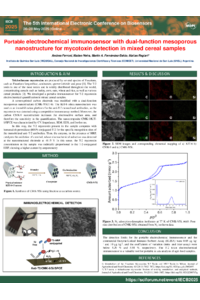
Introduction: Trichothecene mycotoxins are produced by several species of Fusarium, such as Fusarium langsethiae, acuinatum, sporotrichioide and poae. The T-2 toxin is one of the most toxics and is widely distributed throughout the world, contaminating cereals such as barley, corn, oats, wheat and rice, as well as various cereal products. We developed a portable immunosensor for T-2 mycotoxin electrochemical quantification in mixed cereal samples.
Methods: A screen-printed carbon electrode was modified with a dual-function mesoporous nanostructure (CMK-9/KIT-6). The KIT-6 silica nanostructure was used as an immobilization platform for the anti-T-2 monoclonal antibodies, so the mycotoxin was detected using a competitive immunoassay method. Moreover, the carbon CMK-9 nanostructure increases the electroactive surface area, and therefore the sensitivity in the quantification. The nanocomposite CMK-9/KIT-6/SPCE was characterized by CV, Impedance, SEM, EDS, and Isotherms. In this way, the T-2 mycotoxin present in the sample competes with horseradish peroxidase (HRP)-conjugated T-2 for the specific recognition sites of the immobilized anti-T-2 antibodies. Then, the enzyme, in the presence of HRP, catalyzes the oxidation of catechol, whose electrochemical reduction was detected at the nanostructured electrode at -0.15 V. In this sense, the T-2 mycotoxin concentration in the sample was indirectly proportional to the T-2-conjugated HRP , showing a higher current by amperometry.
Results: The detection limits for the portable immunosensor with electrochemical detection and the Enzyme-Linked ImmunoSorbent Assay (ELISA) were 0.05 μg kg-1 and 10 μg kg-1, and the coefficients of variation (intra- and inter-assay) were below 4.29 % and 5.98 %, respectively.
Conclusions: The T-2 toxin electrochemical immunosensor is a valuable tool for portable in situ analysis of agri-food samples.
Keywords
Immunosensor
Electrochemical
Nanomaterial
Mycotoxin
CMK-9/KIT-6
Poster
Poster presentation REGIART.pdf
Antibody-embedded functionalized magnetic nanoparticles for the immunodetection of venom proteins: a preliminary study
Electrochemiluminescence resonance energy transfer immunosensing system based on PTC@UIO-66-NH2 metal–organic framework and MnO2 nanosheets for sensitive detection of vascular endothelial growth factor