Event submissions
Published
This submission belongs to the session E. Nanomaterials and Smart Surfaces in Biosensors of the event The 5th International Electronic Conference on Biosensors
Published date
02 May, 2025
Academic Editor
'%3e%3cpath%20d='M12.6657%2010.9104C12.4185%2010.325%2012.0599%209.79327%2011.6097%209.34482C11.1609%208.89508%2010.6293%208.5365%2010.0442%208.28888C10.0389%208.28626%2010.0337%208.28495%2010.0285%208.28233C10.8446%207.69279%2011.3752%206.73249%2011.3752%205.64904C11.3752%203.8542%209.92103%202.39999%208.1262%202.39999C6.33136%202.39999%204.87715%203.8542%204.87715%205.64904C4.87715%206.73249%205.40774%207.69279%206.22393%208.28364C6.21869%208.28626%206.21345%208.28757%206.20821%208.29019C5.62129%208.5378%205.09463%208.89284%204.64265%209.34613C4.1929%209.79493%203.83432%2010.3266%203.58671%2010.9117C3.34345%2011.4845%203.21226%2012.0987%203.20023%2012.7209C3.19988%2012.7349%203.20233%2012.7488%203.20744%2012.7619C3.21255%2012.7749%203.22022%2012.7867%203.22998%2012.7968C3.23975%2012.8068%203.25142%2012.8147%203.26431%2012.8202C3.2772%2012.8256%203.29105%2012.8284%203.30504%2012.8284H4.09109C4.14874%2012.8284%204.19459%2012.7825%204.1959%2012.7262C4.2221%2011.7148%204.62823%2010.7676%205.34617%2010.0497C6.08899%209.30683%207.0755%208.89808%208.1262%208.89808C9.17689%208.89808%2010.1634%209.30683%2010.9062%2010.0497C11.6242%2010.7676%2012.0303%2011.7148%2012.0565%2012.7262C12.0578%2012.7838%2012.1037%2012.8284%2012.1613%2012.8284H12.9474C12.9613%2012.8284%2012.9752%2012.8256%2012.9881%2012.8202C13.001%2012.8147%2013.0126%2012.8068%2013.0224%2012.7968C13.0322%2012.7867%2013.0398%2012.7749%2013.0449%2012.7619C13.0501%2012.7488%2013.0525%2012.7349%2013.0522%2012.7209C13.0391%2012.0947%2012.9094%2011.4855%2012.6657%2010.9104ZM8.1262%207.9024C7.52486%207.9024%206.9589%207.6679%206.53312%207.24211C6.10733%206.81633%205.87283%206.25037%205.87283%205.64904C5.87283%205.0477%206.10733%204.48174%206.53312%204.05596C6.9589%203.63018%207.52486%203.39567%208.1262%203.39567C8.72753%203.39567%209.29349%203.63018%209.71927%204.05596C10.1451%204.48174%2010.3796%205.0477%2010.3796%205.64904C10.3796%206.25037%2010.1451%206.81633%209.71927%207.24211C9.29349%207.6679%208.72753%207.9024%208.1262%207.9024Z'%20fill='%235D1EE1'/%3e%3c/g%3e%3c/svg%3e) Michael Thompson
Michael ThompsonCitation
Xuan Chen, Wenqing Jia, Zichao Guo, Ren Zhao, Nengqin Jia, Electrochemiluminescence resonance energy transfer immunosensing system based on PTC@UIO-66-NH₂ metal–organic framework and MnO₂ nanosheets for sensitive detection of vascular endothelial growth factor, in Proceedings of The 5th International Electronic Conference on Biosensors, 26 May–28 May 2025, MDPI: Basel, Switzerland
Share
Email
Facebook
Twitter
LinkedIn
Electrochemiluminescence resonance energy transfer immunosensing system based on PTC@UIO-66-NH2 metal–organic framework and MnO2 nanosheets for sensitive detection of vascular endothelial growth factor
'%3e%3cpath%20d='M12.6647%2010.9104C12.4176%2010.325%2012.0589%209.7933%2011.6088%209.34485C11.16%208.89511%2010.6283%208.53653%2010.0432%208.28891C10.038%208.28629%2010.0327%208.28498%2010.0275%208.28236C10.8437%207.69282%2011.3743%206.73252%2011.3743%205.64907C11.3743%203.85423%209.92005%202.40002%208.12522%202.40002C6.33038%202.40002%204.87618%203.85423%204.87618%205.64907C4.87618%206.73252%205.40677%207.69282%206.22296%208.28367C6.21772%208.28629%206.21248%208.2876%206.20724%208.29022C5.62031%208.53783%205.09365%208.89287%204.64167%209.34616C4.19192%209.79496%203.83334%2010.3266%203.58573%2010.9117C3.34247%2011.4846%203.21128%2012.0987%203.19925%2012.721C3.1989%2012.735%203.20135%2012.7489%203.20646%2012.7619C3.21157%2012.7749%203.21924%2012.7868%203.22901%2012.7968C3.23877%2012.8068%203.25045%2012.8148%203.26334%2012.8202C3.27623%2012.8256%203.29007%2012.8284%203.30406%2012.8284H4.09012C4.14776%2012.8284%204.19362%2012.7825%204.19493%2012.7262C4.22113%2011.7148%204.62726%2010.7676%205.34519%2010.0497C6.08802%209.30686%207.07452%208.89811%208.12522%208.89811C9.17592%208.89811%2010.1624%209.30686%2010.9052%2010.0497C11.6232%2010.7676%2012.0293%2011.7148%2012.0555%2012.7262C12.0568%2012.7839%2012.1027%2012.8284%2012.1603%2012.8284H12.9464C12.9604%2012.8284%2012.9742%2012.8256%2012.9871%2012.8202C13%2012.8148%2013.0117%2012.8068%2013.0214%2012.7968C13.0312%2012.7868%2013.0389%2012.7749%2013.044%2012.7619C13.0491%2012.7489%2013.0515%2012.735%2013.0512%2012.721C13.0381%2012.0947%2012.9084%2011.4856%2012.6647%2010.9104ZM8.12522%207.90243C7.52388%207.90243%206.95792%207.66793%206.53214%207.24215C6.10636%206.81636%205.87185%206.2504%205.87185%205.64907C5.87185%205.04773%206.10636%204.48177%206.53214%204.05599C6.95792%203.63021%207.52388%203.3957%208.12522%203.3957C8.72655%203.3957%209.29252%203.63021%209.7183%204.05599C10.1441%204.48177%2010.3786%205.04773%2010.3786%205.64907C10.3786%206.2504%2010.1441%206.81636%209.7183%207.24215C9.29252%207.66793%208.72655%207.90243%208.12522%207.90243Z'%20fill='%235D1EE1'/%3e%3c/g%3e%3c/svg%3e)
Xuan Chen 1
Wenqing Jia 2
Zichao Guo 2
Ren Zhao 2
Nengqin Jia 1
1. College of Chemistry and Materials Science, Shanghai Normal University, Shanghai,China.
2. Department of General Surgery, Ruijin Hospital, Shanghai Jiao Tong University School of Medicine, Shanghai, China
Abstract
Introduction: Vascular endothelial growth factor (VEGF) is acknowledged as a crucial biomarker for tumor angiogenesis, playing a significant role in the progression, development, and metastasis of tumors. Therefore, developing an ultra-sensitive detection method for VEGF is vital for early cancer prevention and surveillance of disease status.
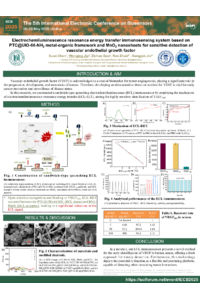
Methods: In this research, we constructed a sandwich-style quenching electrochemiluminescence (ECL) immunosensor by employing the mechanism of electrochemiluminescence resonance energy transfer (ECL-RET), aiming for highly sensitive identification of VEGF165.
Results: The PTC@UIO-66-NH2 complex was prepared by integrating the organic luminescent probe, derived from the ammonolysis of Perylene-3,4,9,10-tetracarboxylic dianhydride (PTC), into the UIO-66-NH2 metal–organic framework. This complex was subsequently modified on the surface of a polished carbon electrode to serve as an ECL substrate. The VEGF antibody was then conjugated to this substrate via an amide reaction. Meanwhile, bovine serum albumin-functionalized MnO2 nanosheets (BSA-MnO2), which were linked to VEGF165 aptamers, functioned as the ECL acceptor. Upon selective recognition and binding to VEGF165, ECL-RET occurred between the PTC@UIO-66-NH2 (ECL donor) and BSA-MnO2 (ECL acceptor), leading to a significant reduction in the ECL signal, which could be readily captured by the instrument. Additionally, the intensity of the ECL response diminished as the concentration of VEGF165 increased. Under optimal experimental conditions, the ECL immunosensor exhibited a linear detection range spanning from 5 pg/mL to 50 ng/mL, with a minimum detectable limit of 3.5 pg/mL, which underscores its exceptional sensitivity. Furthermore, the ECL-RET immunoassay was subjected to rigorous validation procedures to confirm its specificity and stability.
Conclusions: In a nutshell, our ECL immunosensor presents a novel method for the early identification of VEGF in human serum, offering a fresh approach for timely detection. Furthermore, this technology depicts its potential to function as a flexible and promising platform, capable of detecting other circulating tumor biomarkers.
Keywords
Electrochemiluminescence
Resonance energy transfer
Immunosensor
Vascular endothelial growth factor
Poster
poster 20250517 ver 4.0.pdf
Portable electrochemical immunosensor with dual-function mesoporous nanostructure for mycotoxin detection in mixed cereal samples
Metal–organic composite material-based electrochemical sensors for biomolecule quantification