Event submissions
Published
This submission belongs to the session E. Nanomaterials and Smart Surfaces in Biosensors of the event The 5th International Electronic Conference on Biosensors
Published date
02 May, 2025
Academic Editor
'%3e%3cpath%20d='M12.6657%2010.9104C12.4185%2010.325%2012.0599%209.79327%2011.6097%209.34482C11.1609%208.89508%2010.6293%208.5365%2010.0442%208.28888C10.0389%208.28626%2010.0337%208.28495%2010.0285%208.28233C10.8446%207.69279%2011.3752%206.73249%2011.3752%205.64904C11.3752%203.8542%209.92103%202.39999%208.1262%202.39999C6.33136%202.39999%204.87715%203.8542%204.87715%205.64904C4.87715%206.73249%205.40774%207.69279%206.22393%208.28364C6.21869%208.28626%206.21345%208.28757%206.20821%208.29019C5.62129%208.5378%205.09463%208.89284%204.64265%209.34613C4.1929%209.79493%203.83432%2010.3266%203.58671%2010.9117C3.34345%2011.4845%203.21226%2012.0987%203.20023%2012.7209C3.19988%2012.7349%203.20233%2012.7488%203.20744%2012.7619C3.21255%2012.7749%203.22022%2012.7867%203.22998%2012.7968C3.23975%2012.8068%203.25142%2012.8147%203.26431%2012.8202C3.2772%2012.8256%203.29105%2012.8284%203.30504%2012.8284H4.09109C4.14874%2012.8284%204.19459%2012.7825%204.1959%2012.7262C4.2221%2011.7148%204.62823%2010.7676%205.34617%2010.0497C6.08899%209.30683%207.0755%208.89808%208.1262%208.89808C9.17689%208.89808%2010.1634%209.30683%2010.9062%2010.0497C11.6242%2010.7676%2012.0303%2011.7148%2012.0565%2012.7262C12.0578%2012.7838%2012.1037%2012.8284%2012.1613%2012.8284H12.9474C12.9613%2012.8284%2012.9752%2012.8256%2012.9881%2012.8202C13.001%2012.8147%2013.0126%2012.8068%2013.0224%2012.7968C13.0322%2012.7867%2013.0398%2012.7749%2013.0449%2012.7619C13.0501%2012.7488%2013.0525%2012.7349%2013.0522%2012.7209C13.0391%2012.0947%2012.9094%2011.4855%2012.6657%2010.9104ZM8.1262%207.9024C7.52486%207.9024%206.9589%207.6679%206.53312%207.24211C6.10733%206.81633%205.87283%206.25037%205.87283%205.64904C5.87283%205.0477%206.10733%204.48174%206.53312%204.05596C6.9589%203.63018%207.52486%203.39567%208.1262%203.39567C8.72753%203.39567%209.29349%203.63018%209.71927%204.05596C10.1451%204.48174%2010.3796%205.0477%2010.3796%205.64904C10.3796%206.25037%2010.1451%206.81633%209.71927%207.24211C9.29349%207.6679%208.72753%207.9024%208.1262%207.9024Z'%20fill='%235D1EE1'/%3e%3c/g%3e%3c/svg%3e) Michael Thompson
Michael ThompsonCitation
Sorina-Alexandra Leau, Cecilia Lete, Laura Pigani, Stelian Lupu, Metal–organic composite material-based electrochemical sensors for biomolecule quantification, in Proceedings of The 5th International Electronic Conference on Biosensors, 26 May–28 May 2025, MDPI: Basel, Switzerland
Share
Email
Facebook
Twitter
LinkedIn
Metal–organic composite material-based electrochemical sensors for biomolecule quantification
'%3e%3cpath%20d='M12.6647%2010.9104C12.4176%2010.325%2012.0589%209.7933%2011.6088%209.34485C11.16%208.89511%2010.6283%208.53653%2010.0432%208.28891C10.038%208.28629%2010.0327%208.28498%2010.0275%208.28236C10.8437%207.69282%2011.3743%206.73252%2011.3743%205.64907C11.3743%203.85423%209.92005%202.40002%208.12522%202.40002C6.33038%202.40002%204.87618%203.85423%204.87618%205.64907C4.87618%206.73252%205.40677%207.69282%206.22296%208.28367C6.21772%208.28629%206.21248%208.2876%206.20724%208.29022C5.62031%208.53783%205.09365%208.89287%204.64167%209.34616C4.19192%209.79496%203.83334%2010.3266%203.58573%2010.9117C3.34247%2011.4846%203.21128%2012.0987%203.19925%2012.721C3.1989%2012.735%203.20135%2012.7489%203.20646%2012.7619C3.21157%2012.7749%203.21924%2012.7868%203.22901%2012.7968C3.23877%2012.8068%203.25045%2012.8148%203.26334%2012.8202C3.27623%2012.8256%203.29007%2012.8284%203.30406%2012.8284H4.09012C4.14776%2012.8284%204.19362%2012.7825%204.19493%2012.7262C4.22113%2011.7148%204.62726%2010.7676%205.34519%2010.0497C6.08802%209.30686%207.07452%208.89811%208.12522%208.89811C9.17592%208.89811%2010.1624%209.30686%2010.9052%2010.0497C11.6232%2010.7676%2012.0293%2011.7148%2012.0555%2012.7262C12.0568%2012.7839%2012.1027%2012.8284%2012.1603%2012.8284H12.9464C12.9604%2012.8284%2012.9742%2012.8256%2012.9871%2012.8202C13%2012.8148%2013.0117%2012.8068%2013.0214%2012.7968C13.0312%2012.7868%2013.0389%2012.7749%2013.044%2012.7619C13.0491%2012.7489%2013.0515%2012.735%2013.0512%2012.721C13.0381%2012.0947%2012.9084%2011.4856%2012.6647%2010.9104ZM8.12522%207.90243C7.52388%207.90243%206.95792%207.66793%206.53214%207.24215C6.10636%206.81636%205.87185%206.2504%205.87185%205.64907C5.87185%205.04773%206.10636%204.48177%206.53214%204.05599C6.95792%203.63021%207.52388%203.3957%208.12522%203.3957C8.72655%203.3957%209.29252%203.63021%209.7183%204.05599C10.1441%204.48177%2010.3786%205.04773%2010.3786%205.64907C10.3786%206.2504%2010.1441%206.81636%209.7183%207.24215C9.29252%207.66793%208.72655%207.90243%208.12522%207.90243Z'%20fill='%235D1EE1'/%3e%3c/g%3e%3c/svg%3e)
Sorina-Alexandra Leau 1,2

Cecilia Lete 1

Laura Pigani 3

Stelian Lupu 4
1. Institute of Physical Chemistry-Ilie Murgulescu of the Romanian Academy, 202 Splaiul Independentei, 060021 Bucharest, Romania
2. National University of Science and Technology Politehnica of Bucharest, Doctoral School of Chemical Engineering and Biotechnologies, 1-7 Polizu Gheorghe, 011061 Bucharest, Romania
3. University of Modena and Reggio Emilia, Department of Chemical and Geological Sciences, 41125, Modena, Italy
4. National University of Science and Technology Politehnica of Bucharest, Faculty of Chemical Engineering and Biotechnologies, Department of Analytical Chemistry and Environmental Engineering, 1-7 Polizu Gheorghe, 011061 Bucharest, Romania
Abstract
A novel electrochemical sensor offering superior analytical performance criteria has been developed to quantify various biomolecules involved in life-threatening ailments [1,2]. The composite material comprises a layer of poly(3,4-ethylenedioxythiophene) conducting polymer (PEDOT) and platinum nanoparticles (PtNPs) electrodeposited on a glassy carbon electrode (GCE) surface through the application of a sinusoidal voltage (SV) procedure with tailored electrochemical parameters. The sinusoidal voltage method relies on the application of a sinusoidal voltage on a constant voltage for a precisely monitored timeframe. The antifouling capability of the polymeric matrix, combined with the enhanced sensitivity and the remarkable catalytic properties offered by the metallic nanoparticles, ensures the accurate and reliable detection of biologically important molecules. Moreover, the newly synthesized analytical device displays a trend of cost-effective production associated with the potential for additional functionalization using renewable or sustainable material sources for environmental protection. The GCE-PEDOT/PtNP electrochemical sensor was successfully implemented for serotonin determination in a synthetic buffer solution. The sensor responded selectively to serotonin, with a linear response range of 1-80 µM. The sensor’s optimum analytical capacity was validated, achieving a detection limit of 1.8 µM for the target analyte. Moreover, the analytical performance of the devised sensing platform proved to be in agreement with the data available in the literature. The results point to the effectiveness of the SV procedure for the selective determination of target analytes in a complex medium featuring various interfering molecules.
Acknowledgments: This work was performed within the research theme “Development of Electrochemical Sensors for Biologically Active Compounds Determination” of the Erasmus+ Traineeship Program between POLITEHNICA University of Bucharest and the University of Modena and Reggio Emilia.
References
[1] Leau et al. Chemosensors (2023). 11.3:179.
[2] Monari et al. Talanta (2025). 282-126958.
Keywords
electrochemical sensor
sinusoidal voltage
platinum nanoparticles
serotonin.
Poster
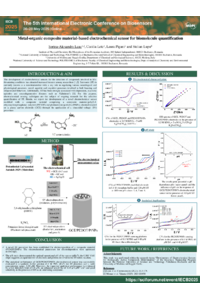
Poster IECB 2025_Leau Sorina.pdf
Electrochemiluminescence resonance energy transfer immunosensing system based on PTC@UIO-66-NH2 metal–organic framework and MnO2 nanosheets for sensitive detection of vascular endothelial growth factor
Functionalized S-layer protein surface to target folate receptors in cancer cells