Event submissions
Published
This submission belongs to the session E. Nanomaterials and Smart Surfaces in Biosensors of the event The 5th International Electronic Conference on Biosensors
Published date
02 May, 2025
Academic Editor
'%3e%3cpath%20d='M12.6657%2010.9104C12.4185%2010.325%2012.0599%209.79327%2011.6097%209.34482C11.1609%208.89508%2010.6293%208.5365%2010.0442%208.28888C10.0389%208.28626%2010.0337%208.28495%2010.0285%208.28233C10.8446%207.69279%2011.3752%206.73249%2011.3752%205.64904C11.3752%203.8542%209.92103%202.39999%208.1262%202.39999C6.33136%202.39999%204.87715%203.8542%204.87715%205.64904C4.87715%206.73249%205.40774%207.69279%206.22393%208.28364C6.21869%208.28626%206.21345%208.28757%206.20821%208.29019C5.62129%208.5378%205.09463%208.89284%204.64265%209.34613C4.1929%209.79493%203.83432%2010.3266%203.58671%2010.9117C3.34345%2011.4845%203.21226%2012.0987%203.20023%2012.7209C3.19988%2012.7349%203.20233%2012.7488%203.20744%2012.7619C3.21255%2012.7749%203.22022%2012.7867%203.22998%2012.7968C3.23975%2012.8068%203.25142%2012.8147%203.26431%2012.8202C3.2772%2012.8256%203.29105%2012.8284%203.30504%2012.8284H4.09109C4.14874%2012.8284%204.19459%2012.7825%204.1959%2012.7262C4.2221%2011.7148%204.62823%2010.7676%205.34617%2010.0497C6.08899%209.30683%207.0755%208.89808%208.1262%208.89808C9.17689%208.89808%2010.1634%209.30683%2010.9062%2010.0497C11.6242%2010.7676%2012.0303%2011.7148%2012.0565%2012.7262C12.0578%2012.7838%2012.1037%2012.8284%2012.1613%2012.8284H12.9474C12.9613%2012.8284%2012.9752%2012.8256%2012.9881%2012.8202C13.001%2012.8147%2013.0126%2012.8068%2013.0224%2012.7968C13.0322%2012.7867%2013.0398%2012.7749%2013.0449%2012.7619C13.0501%2012.7488%2013.0525%2012.7349%2013.0522%2012.7209C13.0391%2012.0947%2012.9094%2011.4855%2012.6657%2010.9104ZM8.1262%207.9024C7.52486%207.9024%206.9589%207.6679%206.53312%207.24211C6.10733%206.81633%205.87283%206.25037%205.87283%205.64904C5.87283%205.0477%206.10733%204.48174%206.53312%204.05596C6.9589%203.63018%207.52486%203.39567%208.1262%203.39567C8.72753%203.39567%209.29349%203.63018%209.71927%204.05596C10.1451%204.48174%2010.3796%205.0477%2010.3796%205.64904C10.3796%206.25037%2010.1451%206.81633%209.71927%207.24211C9.29349%207.6679%208.72753%207.9024%208.1262%207.9024Z'%20fill='%235D1EE1'/%3e%3c/g%3e%3c/svg%3e) Michael Thompson
Michael ThompsonCitation
Ana Lorena Neagu, Ana Mihaela Gavrila, Andreea Miron, Iulia Elena Neblea, Marinela Victoria Dumitru, Hugues Brisset, Horia Iovu, Tanta Verona Iordache, Design of amino-functionalized MIP silica particles for biosensor development with selective recognition of lipopolysaccharides, in Proceedings of The 5th International Electronic Conference on Biosensors, 26 May–28 May 2025, MDPI: Basel, Switzerland
Share
Email
Facebook
Twitter
LinkedIn
Design of amino-functionalized MIP silica particles for biosensor development with selective recognition of lipopolysaccharides
'%3e%3cpath%20d='M12.6647%2010.9104C12.4176%2010.325%2012.0589%209.7933%2011.6088%209.34485C11.16%208.89511%2010.6283%208.53653%2010.0432%208.28891C10.038%208.28629%2010.0327%208.28498%2010.0275%208.28236C10.8437%207.69282%2011.3743%206.73252%2011.3743%205.64907C11.3743%203.85423%209.92005%202.40002%208.12522%202.40002C6.33038%202.40002%204.87618%203.85423%204.87618%205.64907C4.87618%206.73252%205.40677%207.69282%206.22296%208.28367C6.21772%208.28629%206.21248%208.2876%206.20724%208.29022C5.62031%208.53783%205.09365%208.89287%204.64167%209.34616C4.19192%209.79496%203.83334%2010.3266%203.58573%2010.9117C3.34247%2011.4846%203.21128%2012.0987%203.19925%2012.721C3.1989%2012.735%203.20135%2012.7489%203.20646%2012.7619C3.21157%2012.7749%203.21924%2012.7868%203.22901%2012.7968C3.23877%2012.8068%203.25045%2012.8148%203.26334%2012.8202C3.27623%2012.8256%203.29007%2012.8284%203.30406%2012.8284H4.09012C4.14776%2012.8284%204.19362%2012.7825%204.19493%2012.7262C4.22113%2011.7148%204.62726%2010.7676%205.34519%2010.0497C6.08802%209.30686%207.07452%208.89811%208.12522%208.89811C9.17592%208.89811%2010.1624%209.30686%2010.9052%2010.0497C11.6232%2010.7676%2012.0293%2011.7148%2012.0555%2012.7262C12.0568%2012.7839%2012.1027%2012.8284%2012.1603%2012.8284H12.9464C12.9604%2012.8284%2012.9742%2012.8256%2012.9871%2012.8202C13%2012.8148%2013.0117%2012.8068%2013.0214%2012.7968C13.0312%2012.7868%2013.0389%2012.7749%2013.044%2012.7619C13.0491%2012.7489%2013.0515%2012.735%2013.0512%2012.721C13.0381%2012.0947%2012.9084%2011.4856%2012.6647%2010.9104ZM8.12522%207.90243C7.52388%207.90243%206.95792%207.66793%206.53214%207.24215C6.10636%206.81636%205.87185%206.2504%205.87185%205.64907C5.87185%205.04773%206.10636%204.48177%206.53214%204.05599C6.95792%203.63021%207.52388%203.3957%208.12522%203.3957C8.72655%203.3957%209.29252%203.63021%209.7183%204.05599C10.1441%204.48177%2010.3786%205.04773%2010.3786%205.64907C10.3786%206.2504%2010.1441%206.81636%209.7183%207.24215C9.29252%207.66793%208.72655%207.90243%208.12522%207.90243Z'%20fill='%235D1EE1'/%3e%3c/g%3e%3c/svg%3e)
Ana Lorena Neagu 1

Ana Mihaela Gavrila 1
Andreea Miron 1
Iulia Elena Neblea 1
Marinela Victoria Dumitru 1
Hugues Brisset 2

Horia Iovu 3

Tanta Verona Iordache 1
1. National Institute for Research & Development in Chemistry and Petrochemistry-ICECHIM Bucharest, 202 Spl. Independentei, 060021, Bucharest, Romania
2. Université de Toulon, Laboratoire Matériaux Polymères Interfaces Environnement Marin (MAPIEM), Toulon, France
3. Advanced Polymer Materials Group, University POLITEHNICA of Bucharest, 011061 Bucharest
Abstract
The global spread of pathogenic bacteria is an ongoing issue, where detecting bacterial endotoxins, known as lipopolysaccharides (LPSs), is vital for addressing environmental and healthcare challenges. LPS is responsible for various infections and has recently been implicated in the development of Parkinson's disease. Traditional methods for detecting LPS in research and clinical settings, such as ELISA and LAL assay, have significant drawbacks. These techniques often exhibit low sensitivity and involve complicated, time-consuming processes. Consequently, there is an increasing demand for the development of innovative and cost-effective methods, e.g., electrochemical detection, especially in the fields of environmental science and medicine. This work describes the design of amino-functionalized MIP silica particles for the selective recognition of a specific targeted type of LPS (i.e., LPS from Pseudomonas aeruginosa) from different bacterial strains. The obtained MIP particles were incorporated in a lab-made carbon paste formulation and drop-casted on the working electrode surface of a screen-printed electrode (SPCE). MIP silica particles were synthesized using the Stöber method in the presence of the target molecule LPS via the polycondensation of the functional monomer 3-Aminopropyltriethoxysilane and the structural monomer, tetraethyl orthosilicate, in the basic medium. Herein, two types of cationic surfactants (cetyltrimethylammonium bromide and benzyl trimethyl ammonium chloride) were utilized to stimulate and control the formation of silica particles at a nano level. To ensure the capacity of the MIP particles of recognizing LPS, computational docking was assessed to predict the binding affinity of 3-Aminopropyltriethoxysilane towards LPS. The 1H-NMR results sustained the docking predictions. Other modern techniques, including structural and morphological analyses, were employed to characterize the obtained MIP particles in the raw phase and after their embedment and deposition on the final biosensors. Cyclic voltammetry and differential pulse voltammetry, along with the static and selective adsorption analysis, were submitted to determine the imprinting factor, sensitivity, and selectivity for the targeted LPS. As a result, the obtained amino-functionalized MIP silica particles proved to be an effective and low-cost alternative for biosensor development for the detection of lipopolysaccharide from Pseudomonas aeruginosa.
Keywords
Stöber method
molecularly imprinted particles
LPS detection
selective recognition
SPCE
Poster
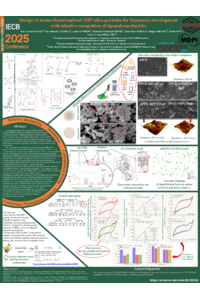
Poster IECB_final .pdf
Functionalized S-layer protein surface to target folate receptors in cancer cells
Tandem β-mercaptoethanol and 2-(3-trichlorosilylpropyloxy)-ethyltrifluoroacetate Coating on Flat Gold Surfaces to Significantly Prevent Non-Specific Adsorption