Event submissions
Published
This submission belongs to the session S2. Metallic Materials Chemistry of the event The 2nd International Electronic Conference on Metals
Published date
02 May, 2025
Academic Editor
'%3e%3cpath%20d='M12.6657%2010.9104C12.4185%2010.325%2012.0599%209.79327%2011.6097%209.34482C11.1609%208.89508%2010.6293%208.5365%2010.0442%208.28888C10.0389%208.28626%2010.0337%208.28495%2010.0285%208.28233C10.8446%207.69279%2011.3752%206.73249%2011.3752%205.64904C11.3752%203.8542%209.92103%202.39999%208.1262%202.39999C6.33136%202.39999%204.87715%203.8542%204.87715%205.64904C4.87715%206.73249%205.40774%207.69279%206.22393%208.28364C6.21869%208.28626%206.21345%208.28757%206.20821%208.29019C5.62129%208.5378%205.09463%208.89284%204.64265%209.34613C4.1929%209.79493%203.83432%2010.3266%203.58671%2010.9117C3.34345%2011.4845%203.21226%2012.0987%203.20023%2012.7209C3.19988%2012.7349%203.20233%2012.7488%203.20744%2012.7619C3.21255%2012.7749%203.22022%2012.7867%203.22998%2012.7968C3.23975%2012.8068%203.25142%2012.8147%203.26431%2012.8202C3.2772%2012.8256%203.29105%2012.8284%203.30504%2012.8284H4.09109C4.14874%2012.8284%204.19459%2012.7825%204.1959%2012.7262C4.2221%2011.7148%204.62823%2010.7676%205.34617%2010.0497C6.08899%209.30683%207.0755%208.89808%208.1262%208.89808C9.17689%208.89808%2010.1634%209.30683%2010.9062%2010.0497C11.6242%2010.7676%2012.0303%2011.7148%2012.0565%2012.7262C12.0578%2012.7838%2012.1037%2012.8284%2012.1613%2012.8284H12.9474C12.9613%2012.8284%2012.9752%2012.8256%2012.9881%2012.8202C13.001%2012.8147%2013.0126%2012.8068%2013.0224%2012.7968C13.0322%2012.7867%2013.0398%2012.7749%2013.0449%2012.7619C13.0501%2012.7488%2013.0525%2012.7349%2013.0522%2012.7209C13.0391%2012.0947%2012.9094%2011.4855%2012.6657%2010.9104ZM8.1262%207.9024C7.52486%207.9024%206.9589%207.6679%206.53312%207.24211C6.10733%206.81633%205.87283%206.25037%205.87283%205.64904C5.87283%205.0477%206.10733%204.48174%206.53312%204.05596C6.9589%203.63018%207.52486%203.39567%208.1262%203.39567C8.72753%203.39567%209.29349%203.63018%209.71927%204.05596C10.1451%204.48174%2010.3796%205.0477%2010.3796%205.64904C10.3796%206.25037%2010.1451%206.81633%209.71927%207.24211C9.29349%207.6679%208.72753%207.9024%208.1262%207.9024Z'%20fill='%235D1EE1'/%3e%3c/g%3e%3c/svg%3e) Yung Shin
Yung ShinCitation
Elena-Alexandra Ilie (Săndulescu), Crina Anastasescu, Luminita Predoana, Silviu Preda, Dana Culita, Adriana Rusu, Jeanina Pandele-Cusu, Ioan Balint, Maria Zaharescu, PRISTINE AND Pt-MODIFIED TiO₂ DRIVE ORGANIC COMPOUND PHOTODEGRADATION, in Proceedings of The 2nd International Electronic Conference on Metals, 5 May–7 May 2025, MDPI: Basel, Switzerland
Share
Email
Facebook
Twitter
LinkedIn
PRISTINE AND Pt-MODIFIED TiO2 DRIVE ORGANIC COMPOUND PHOTODEGRADATION
.jpg)
Elena-Alexandra Ilie (Săndulescu) 1
'%3e%3cpath%20d='M12.6647%2010.9104C12.4176%2010.325%2012.0589%209.7933%2011.6088%209.34485C11.16%208.89511%2010.6283%208.53653%2010.0432%208.28891C10.038%208.28629%2010.0327%208.28498%2010.0275%208.28236C10.8437%207.69282%2011.3743%206.73252%2011.3743%205.64907C11.3743%203.85423%209.92005%202.40002%208.12522%202.40002C6.33038%202.40002%204.87618%203.85423%204.87618%205.64907C4.87618%206.73252%205.40677%207.69282%206.22296%208.28367C6.21772%208.28629%206.21248%208.2876%206.20724%208.29022C5.62031%208.53783%205.09365%208.89287%204.64167%209.34616C4.19192%209.79496%203.83334%2010.3266%203.58573%2010.9117C3.34247%2011.4846%203.21128%2012.0987%203.19925%2012.721C3.1989%2012.735%203.20135%2012.7489%203.20646%2012.7619C3.21157%2012.7749%203.21924%2012.7868%203.22901%2012.7968C3.23877%2012.8068%203.25045%2012.8148%203.26334%2012.8202C3.27623%2012.8256%203.29007%2012.8284%203.30406%2012.8284H4.09012C4.14776%2012.8284%204.19362%2012.7825%204.19493%2012.7262C4.22113%2011.7148%204.62726%2010.7676%205.34519%2010.0497C6.08802%209.30686%207.07452%208.89811%208.12522%208.89811C9.17592%208.89811%2010.1624%209.30686%2010.9052%2010.0497C11.6232%2010.7676%2012.0293%2011.7148%2012.0555%2012.7262C12.0568%2012.7839%2012.1027%2012.8284%2012.1603%2012.8284H12.9464C12.9604%2012.8284%2012.9742%2012.8256%2012.9871%2012.8202C13%2012.8148%2013.0117%2012.8068%2013.0214%2012.7968C13.0312%2012.7868%2013.0389%2012.7749%2013.044%2012.7619C13.0491%2012.7489%2013.0515%2012.735%2013.0512%2012.721C13.0381%2012.0947%2012.9084%2011.4856%2012.6647%2010.9104ZM8.12522%207.90243C7.52388%207.90243%206.95792%207.66793%206.53214%207.24215C6.10636%206.81636%205.87185%206.2504%205.87185%205.64907C5.87185%205.04773%206.10636%204.48177%206.53214%204.05599C6.95792%203.63021%207.52388%203.3957%208.12522%203.3957C8.72655%203.3957%209.29252%203.63021%209.7183%204.05599C10.1441%204.48177%2010.3786%205.04773%2010.3786%205.64907C10.3786%206.2504%2010.1441%206.81636%209.7183%207.24215C9.29252%207.66793%208.72655%207.90243%208.12522%207.90243Z'%20fill='%235D1EE1'/%3e%3c/g%3e%3c/svg%3e)
Crina Anastasescu 2
Luminita Predoana 2
Silviu Preda 2
Dana Culita 2
Adriana Rusu 2
Jeanina Pandele-Cusu 2

Ioan Balint 2
Maria Zaharescu 3
1. "Ilie Murgulescu” Institute of Physical Chemistry, Romanian Academy, Bucharest, 060021, Romania
2. „Ilie Murgulescu” Institute of Physical Chemistry of the Romanian Academy, 202 Spl. Independentei, 6th district, 060021 Bucharest, Romania
3. Romanian Academy, 125 Victoriei Avenue, 1st district, 010071 Bucharest, Romania
Abstract
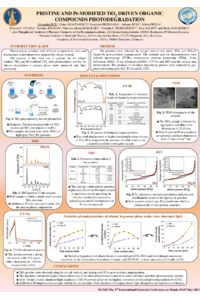
Introduction: Sunlight-induced photocatalytic oxidation of organic matter is significant for a number of reasons, including (i) its low cost, (ii) its ability to purify air and water [1], and (iii) its role as an alternative to the selective synthesis of high-value oxygenated compounds [2].
Methods: Materials used: ethanol, TiO2, and Pt/TiO2 powders (obtained by sol–gel method). The reaction products of gas-phase oxidation processes were analyzed by gas-phase chromatography (GC-TCD and GC-FID).
Results: Considering light-induced ethanol oxidation on a noble metal (Pt) loaded with TiO2, both the support and noble metals are crucial for light absorption, charge separation, and carbon dioxide generation. Platinum nanoparticles on TiO2 can primarily cause the separation of photogenerated charges and a red shift in the light absorption edge.
Figure 1. Oxidative conversion of ethanol driven by solar light.
Conclusions: The light-initiated photo-oxidative routes ofan organic substrate over TiO2 charged with noble metals are revealed in this study. The production of carbon dioxide, the separation of the light-generated charges by platinum addition, and the mechanism of the oxidative conversion reaction of ethanol are the main topics of this analysis of the intricate phenomena connected to the photocatalytic processes.
References:
- Paz, Application of TiO2 photocatalysis for air treatment: Patents overview, Appl. Catal. B 2010, 99, 448-460.
- Kou et all, Selectivity enhancement in heterogeneous photocatalytic transformation, Chem. Rev. 2017, 117, 1445-1514.
Keywords
sol-gel method
catalyst
photocatalysis
Pt-doped titanium dioxide
Poster
Poster IECME_Elena-Alexandra ILIE_5-7 Mai 2025.pdf
Effective modeling of cold rolling of metals
Synergistic applications of polypyrrole coatings in aluminum food cans: From corrosion protection to VOC sensing