Event submissions
Published
This submission belongs to the session S3. Tumor Microenvironment of the event The 3rd International Electronic Conference on Biomedicines
Published date
09 May, 2025
Academic Editor
'%3e%3cpath%20d='M12.6657%2010.9104C12.4185%2010.325%2012.0599%209.79327%2011.6097%209.34482C11.1609%208.89508%2010.6293%208.5365%2010.0442%208.28888C10.0389%208.28626%2010.0337%208.28495%2010.0285%208.28233C10.8446%207.69279%2011.3752%206.73249%2011.3752%205.64904C11.3752%203.8542%209.92103%202.39999%208.1262%202.39999C6.33136%202.39999%204.87715%203.8542%204.87715%205.64904C4.87715%206.73249%205.40774%207.69279%206.22393%208.28364C6.21869%208.28626%206.21345%208.28757%206.20821%208.29019C5.62129%208.5378%205.09463%208.89284%204.64265%209.34613C4.1929%209.79493%203.83432%2010.3266%203.58671%2010.9117C3.34345%2011.4845%203.21226%2012.0987%203.20023%2012.7209C3.19988%2012.7349%203.20233%2012.7488%203.20744%2012.7619C3.21255%2012.7749%203.22022%2012.7867%203.22998%2012.7968C3.23975%2012.8068%203.25142%2012.8147%203.26431%2012.8202C3.2772%2012.8256%203.29105%2012.8284%203.30504%2012.8284H4.09109C4.14874%2012.8284%204.19459%2012.7825%204.1959%2012.7262C4.2221%2011.7148%204.62823%2010.7676%205.34617%2010.0497C6.08899%209.30683%207.0755%208.89808%208.1262%208.89808C9.17689%208.89808%2010.1634%209.30683%2010.9062%2010.0497C11.6242%2010.7676%2012.0303%2011.7148%2012.0565%2012.7262C12.0578%2012.7838%2012.1037%2012.8284%2012.1613%2012.8284H12.9474C12.9613%2012.8284%2012.9752%2012.8256%2012.9881%2012.8202C13.001%2012.8147%2013.0126%2012.8068%2013.0224%2012.7968C13.0322%2012.7867%2013.0398%2012.7749%2013.0449%2012.7619C13.0501%2012.7488%2013.0525%2012.7349%2013.0522%2012.7209C13.0391%2012.0947%2012.9094%2011.4855%2012.6657%2010.9104ZM8.1262%207.9024C7.52486%207.9024%206.9589%207.6679%206.53312%207.24211C6.10733%206.81633%205.87283%206.25037%205.87283%205.64904C5.87283%205.0477%206.10733%204.48174%206.53312%204.05596C6.9589%203.63018%207.52486%203.39567%208.1262%203.39567C8.72753%203.39567%209.29349%203.63018%209.71927%204.05596C10.1451%204.48174%2010.3796%205.0477%2010.3796%205.64904C10.3796%206.25037%2010.1451%206.81633%209.71927%207.24211C9.29349%207.6679%208.72753%207.9024%208.1262%207.9024Z'%20fill='%235D1EE1'/%3e%3c/g%3e%3c/svg%3e) Georgia Levidou
Georgia LevidouCitation
Roya Rahimivaghar, Seyed Shahriar Arab, Justin Tze-Yang Ng, Yaw Sing Tan, Unveiling Natural Inhibitors For ABCC1 (MRP1) Membrane Transporter Through Molecular Docking And Molecular Dynamics Simulations, in Proceedings of The 3rd International Electronic Conference on Biomedicines, 12 May–15 May 2025, MDPI: Basel, Switzerland
Share
Email
Facebook
Twitter
LinkedIn
Unveiling Natural Inhibitors For ABCC1 (MRP1) Membrane Transporter Through Molecular Docking And Molecular Dynamics Simulations
'%3e%3cpath%20d='M12.6647%2010.9104C12.4176%2010.325%2012.0589%209.7933%2011.6088%209.34485C11.16%208.89511%2010.6283%208.53653%2010.0432%208.28891C10.038%208.28629%2010.0327%208.28498%2010.0275%208.28236C10.8437%207.69282%2011.3743%206.73252%2011.3743%205.64907C11.3743%203.85423%209.92005%202.40002%208.12522%202.40002C6.33038%202.40002%204.87618%203.85423%204.87618%205.64907C4.87618%206.73252%205.40677%207.69282%206.22296%208.28367C6.21772%208.28629%206.21248%208.2876%206.20724%208.29022C5.62031%208.53783%205.09365%208.89287%204.64167%209.34616C4.19192%209.79496%203.83334%2010.3266%203.58573%2010.9117C3.34247%2011.4846%203.21128%2012.0987%203.19925%2012.721C3.1989%2012.735%203.20135%2012.7489%203.20646%2012.7619C3.21157%2012.7749%203.21924%2012.7868%203.22901%2012.7968C3.23877%2012.8068%203.25045%2012.8148%203.26334%2012.8202C3.27623%2012.8256%203.29007%2012.8284%203.30406%2012.8284H4.09012C4.14776%2012.8284%204.19362%2012.7825%204.19493%2012.7262C4.22113%2011.7148%204.62726%2010.7676%205.34519%2010.0497C6.08802%209.30686%207.07452%208.89811%208.12522%208.89811C9.17592%208.89811%2010.1624%209.30686%2010.9052%2010.0497C11.6232%2010.7676%2012.0293%2011.7148%2012.0555%2012.7262C12.0568%2012.7839%2012.1027%2012.8284%2012.1603%2012.8284H12.9464C12.9604%2012.8284%2012.9742%2012.8256%2012.9871%2012.8202C13%2012.8148%2013.0117%2012.8068%2013.0214%2012.7968C13.0312%2012.7868%2013.0389%2012.7749%2013.044%2012.7619C13.0491%2012.7489%2013.0515%2012.735%2013.0512%2012.721C13.0381%2012.0947%2012.9084%2011.4856%2012.6647%2010.9104ZM8.12522%207.90243C7.52388%207.90243%206.95792%207.66793%206.53214%207.24215C6.10636%206.81636%205.87185%206.2504%205.87185%205.64907C5.87185%205.04773%206.10636%204.48177%206.53214%204.05599C6.95792%203.63021%207.52388%203.3957%208.12522%203.3957C8.72655%203.3957%209.29252%203.63021%209.7183%204.05599C10.1441%204.48177%2010.3786%205.04773%2010.3786%205.64907C10.3786%206.2504%2010.1441%206.81636%209.7183%207.24215C9.29252%207.66793%208.72655%207.90243%208.12522%207.90243Z'%20fill='%235D1EE1'/%3e%3c/g%3e%3c/svg%3e)
Roya Rahimivaghar 1,2
Seyed Shahriar Arab 1
Justin Tze-Yang Ng 2

Yaw Sing Tan 2
1. Department of Biophysics, Faculty of Biological Sciences, Tarbiat Modares University, Tehran, Iran
2. Bioinformatics Institute, Agency for Science, Technology and Research (A*STAR), 30 Biopolis Street, #07-01 Matrix, Singapore 138671, Singapore
Abstract
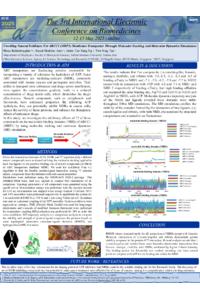
ABC transporters are fascinating proteins responsible for transporting a variety of substrates through the hydrolysis of ATP. Some ABC transporters are multidrug-resistant (MDR), commonly associated with human cancers and pathogenic microbes. Their ability to transport toxic substances and drugs across membranes, even against the concentration gradient, leads to a reduced concentration of drugs inside cells, which diminishes the drug's effectiveness. Natural compounds, such as polyphenols and flavonoids, have anticancer properties. By inhibiting ATP hydrolysis, they can potentially inhibit MDRs in cancer cells, reduce the activity of these proteins, and enhance the therapeutic effects of anticancer drugs. In this study, we investigate the inhibitory effects of 77 of these compounds on the nucleotide-binding domains (NBDs) of ABCC1 (MRP1) by using molecular docking and molecular dynamics (MD) simulation. The results indicate that five compounds, (-)-catechingallat, limonin, naringin, rhoifolin, and robinin with -7.8,-8.5, -8.3, -8.3, and -8.5 binding affinity in NBD1 and -7.1, -7.9, -8.2, -7.9, and -7.7 in NBD2, respectively, in comparison with ATP with -6.8 and -7.1 in NBD1 and NBD 2, respectively, had high binding affinities and occupied the same binding site, namely Asp793 and Tyr831 in NBD1 and Arg1445 in NBD2, with ATP. A molecular dynamics trajectory analysis of the NBDs and ligands revealed these domains were stable throughout 200ns MD simulations. The MD simulations confirm the stability of the complex formed by the interaction of five ligands with NBD, characterized by structural compactness and minimal to no fluctuations. This in silico study offers key information for developing potential ATP inhibitors that NBDs could be the suitable binding site for the flavonoid family. The discovery of novel MDR-inhibiting compounds has the potential to make cancer treatment more effective for all types of cancers, making it a comprehensive solution to drug resistance.
Keywords
ABC Transporters
Multidrug-resistant(MDR)
ATP
Nucleotide-Ninding Domains (NBD)
MD Simulations
Flavonoid
Poster
Biomedicine(Roya Rahimvaghar).pdf
Non-chromatographic, Ligand-free Platform for Immunoglobulin Purification
A New Edible Plant-Derived Toxin as Potential Candidate for Immunotherapy: Evaluation of Cytotoxic Profile on Intestinal Cells