Event submissions
Published
This submission belongs to the session S8. Rare Diseases of the event The 3rd International Electronic Conference on Biomedicines
Published date
09 May, 2025
Academic Editor
'%3e%3cpath%20d='M12.6657%2010.9104C12.4185%2010.325%2012.0599%209.79327%2011.6097%209.34482C11.1609%208.89508%2010.6293%208.5365%2010.0442%208.28888C10.0389%208.28626%2010.0337%208.28495%2010.0285%208.28233C10.8446%207.69279%2011.3752%206.73249%2011.3752%205.64904C11.3752%203.8542%209.92103%202.39999%208.1262%202.39999C6.33136%202.39999%204.87715%203.8542%204.87715%205.64904C4.87715%206.73249%205.40774%207.69279%206.22393%208.28364C6.21869%208.28626%206.21345%208.28757%206.20821%208.29019C5.62129%208.5378%205.09463%208.89284%204.64265%209.34613C4.1929%209.79493%203.83432%2010.3266%203.58671%2010.9117C3.34345%2011.4845%203.21226%2012.0987%203.20023%2012.7209C3.19988%2012.7349%203.20233%2012.7488%203.20744%2012.7619C3.21255%2012.7749%203.22022%2012.7867%203.22998%2012.7968C3.23975%2012.8068%203.25142%2012.8147%203.26431%2012.8202C3.2772%2012.8256%203.29105%2012.8284%203.30504%2012.8284H4.09109C4.14874%2012.8284%204.19459%2012.7825%204.1959%2012.7262C4.2221%2011.7148%204.62823%2010.7676%205.34617%2010.0497C6.08899%209.30683%207.0755%208.89808%208.1262%208.89808C9.17689%208.89808%2010.1634%209.30683%2010.9062%2010.0497C11.6242%2010.7676%2012.0303%2011.7148%2012.0565%2012.7262C12.0578%2012.7838%2012.1037%2012.8284%2012.1613%2012.8284H12.9474C12.9613%2012.8284%2012.9752%2012.8256%2012.9881%2012.8202C13.001%2012.8147%2013.0126%2012.8068%2013.0224%2012.7968C13.0322%2012.7867%2013.0398%2012.7749%2013.0449%2012.7619C13.0501%2012.7488%2013.0525%2012.7349%2013.0522%2012.7209C13.0391%2012.0947%2012.9094%2011.4855%2012.6657%2010.9104ZM8.1262%207.9024C7.52486%207.9024%206.9589%207.6679%206.53312%207.24211C6.10733%206.81633%205.87283%206.25037%205.87283%205.64904C5.87283%205.0477%206.10733%204.48174%206.53312%204.05596C6.9589%203.63018%207.52486%203.39567%208.1262%203.39567C8.72753%203.39567%209.29349%203.63018%209.71927%204.05596C10.1451%204.48174%2010.3796%205.0477%2010.3796%205.64904C10.3796%206.25037%2010.1451%206.81633%209.71927%207.24211C9.29349%207.6679%208.72753%207.9024%208.1262%207.9024Z'%20fill='%235D1EE1'/%3e%3c/g%3e%3c/svg%3e) Serafino Fazio
Serafino FazioCitation
Shadab Ahamad, Prachi Kukshal, Priti Sharma, Paramvir Singh, Navigating Life with Rare Syndromes and Congenital Heart Disease: The Unseen Link, in Proceedings of The 3rd International Electronic Conference on Biomedicines, 12 May–15 May 2025, MDPI: Basel, Switzerland
Share
Email
Facebook
Twitter
LinkedIn
Navigating Life with Rare Syndromes and Congenital Heart Disease: The Unseen Link
'%3e%3cpath%20d='M12.6647%2010.9104C12.4176%2010.325%2012.0589%209.7933%2011.6088%209.34485C11.16%208.89511%2010.6283%208.53653%2010.0432%208.28891C10.038%208.28629%2010.0327%208.28498%2010.0275%208.28236C10.8437%207.69282%2011.3743%206.73252%2011.3743%205.64907C11.3743%203.85423%209.92005%202.40002%208.12522%202.40002C6.33038%202.40002%204.87618%203.85423%204.87618%205.64907C4.87618%206.73252%205.40677%207.69282%206.22296%208.28367C6.21772%208.28629%206.21248%208.2876%206.20724%208.29022C5.62031%208.53783%205.09365%208.89287%204.64167%209.34616C4.19192%209.79496%203.83334%2010.3266%203.58573%2010.9117C3.34247%2011.4846%203.21128%2012.0987%203.19925%2012.721C3.1989%2012.735%203.20135%2012.7489%203.20646%2012.7619C3.21157%2012.7749%203.21924%2012.7868%203.22901%2012.7968C3.23877%2012.8068%203.25045%2012.8148%203.26334%2012.8202C3.27623%2012.8256%203.29007%2012.8284%203.30406%2012.8284H4.09012C4.14776%2012.8284%204.19362%2012.7825%204.19493%2012.7262C4.22113%2011.7148%204.62726%2010.7676%205.34519%2010.0497C6.08802%209.30686%207.07452%208.89811%208.12522%208.89811C9.17592%208.89811%2010.1624%209.30686%2010.9052%2010.0497C11.6232%2010.7676%2012.0293%2011.7148%2012.0555%2012.7262C12.0568%2012.7839%2012.1027%2012.8284%2012.1603%2012.8284H12.9464C12.9604%2012.8284%2012.9742%2012.8256%2012.9871%2012.8202C13%2012.8148%2013.0117%2012.8068%2013.0214%2012.7968C13.0312%2012.7868%2013.0389%2012.7749%2013.044%2012.7619C13.0491%2012.7489%2013.0515%2012.735%2013.0512%2012.721C13.0381%2012.0947%2012.9084%2011.4856%2012.6647%2010.9104ZM8.12522%207.90243C7.52388%207.90243%206.95792%207.66793%206.53214%207.24215C6.10636%206.81636%205.87185%206.2504%205.87185%205.64907C5.87185%205.04773%206.10636%204.48177%206.53214%204.05599C6.95792%203.63021%207.52388%203.3957%208.12522%203.3957C8.72655%203.3957%209.29252%203.63021%209.7183%204.05599C10.1441%204.48177%2010.3786%205.04773%2010.3786%205.64907C10.3786%206.2504%2010.1441%206.81636%209.7183%207.24215C9.29252%207.66793%208.72655%207.90243%208.12522%207.90243Z'%20fill='%235D1EE1'/%3e%3c/g%3e%3c/svg%3e)
Shadab Ahamad 1
Prachi Kukshal 1
Priti Sharma 1
Paramvir Singh 2
1. Sri Sathya Sai Sanjeevani Research Centre, Palwal, Haryana, India
2. Sri Sathya Sai Sanjeevani International Centre for Child Heart Care & Research, Palwal, Haryana, India
Abstract
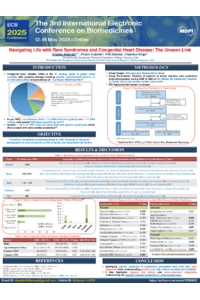
Introduction: Congenital heart disease (CHD) is the leading birth anomaly and a major contributor to infant mortality, especially in low- and middle-income countries, including India. Its etiology is multifactorial, involving both genetic and environmental factors. Notably, approximately 30 % of CHD cases are associated with genetic syndromes, which often present with extracardiac anomalies. This study seeks to explore rare genetic syndromes linked to CHD, with a focus on the socio-demographic, socio-economic, and clinical profiles of the affected families.
Method: A hospital-based population screening study for CHD, including clinical dysmorphism examinations, was conducted from 2018 to 2024 at the Sri Sathya Sai Sanjeevani International Center for Child Heart Care & Research, Haryana (India), a totally free-of-cost pediatric cardiac care centre. Comprehensive data were collected at the Sri Sathya Sai Sanjeevani Research Centre and analyzed using SPSS software.
Results: A total of 442 syndromic cases were identified, with Down’s syndrome being the most common (61.7 %). Rare syndromes included Noonan (17), Marfan (11), Ellis-Van Creveld (8), DiGeorge (6), Williams (6), Pentalogy of Cantrell (3), Treacher Collins (3), MRKH (2), TAR (2), Congenital facial Nerve Palsy (2), Goldenhar (2), Alagille (1), Cornelia de Lange (1), Heterotaxy (1), Holt Oram (1), etc. The most prevalent CHD phenotype observed was ventricular septal defects (24 %). Geographically, a significant proportion of syndromic cases came from the highly populated Indian state of Uttar Pradesh (55.6 %), with a large number of affected families from the upper-lower socio-economic class (Class IV; 46.6 %).
Discussion: Identifying the clinical variability in syndromes associated with CHD can facilitate early diagnosis, which is crucial for timely intervention and improved outcomes. This study also highlights the socio-economic disparities in access to care, emphasizing the need for increased healthcare resources in underserved regions. Understanding the genetic basis of phenotypic features may help reduce disease-related mortality and morbidity.
Keywords
Congenital heart disease
India
Quality of life
Rare syndromes
Poster
Shadab Ahamad_Poster (Sciforum 115223).pdf
Metabolic reprogramming by chemo-gene co-delivery nanoparticles for head and neck squamous-cell carcinoma chemo-immunotherapy
Anti-Arthritic Potential of Artemisia herba-alba in Carrageenan- and Complete Freund's Adjuvant-Induced Arthritis Models in Rats