Event submissions
Published
This submission belongs to the session S5. Biomedicine in Cardiovascular Diseases of the event The 3rd International Electronic Conference on Biomedicines
Published date
09 May, 2025
Academic Editor
'%3e%3cpath%20d='M12.6657%2010.9104C12.4185%2010.325%2012.0599%209.79327%2011.6097%209.34482C11.1609%208.89508%2010.6293%208.5365%2010.0442%208.28888C10.0389%208.28626%2010.0337%208.28495%2010.0285%208.28233C10.8446%207.69279%2011.3752%206.73249%2011.3752%205.64904C11.3752%203.8542%209.92103%202.39999%208.1262%202.39999C6.33136%202.39999%204.87715%203.8542%204.87715%205.64904C4.87715%206.73249%205.40774%207.69279%206.22393%208.28364C6.21869%208.28626%206.21345%208.28757%206.20821%208.29019C5.62129%208.5378%205.09463%208.89284%204.64265%209.34613C4.1929%209.79493%203.83432%2010.3266%203.58671%2010.9117C3.34345%2011.4845%203.21226%2012.0987%203.20023%2012.7209C3.19988%2012.7349%203.20233%2012.7488%203.20744%2012.7619C3.21255%2012.7749%203.22022%2012.7867%203.22998%2012.7968C3.23975%2012.8068%203.25142%2012.8147%203.26431%2012.8202C3.2772%2012.8256%203.29105%2012.8284%203.30504%2012.8284H4.09109C4.14874%2012.8284%204.19459%2012.7825%204.1959%2012.7262C4.2221%2011.7148%204.62823%2010.7676%205.34617%2010.0497C6.08899%209.30683%207.0755%208.89808%208.1262%208.89808C9.17689%208.89808%2010.1634%209.30683%2010.9062%2010.0497C11.6242%2010.7676%2012.0303%2011.7148%2012.0565%2012.7262C12.0578%2012.7838%2012.1037%2012.8284%2012.1613%2012.8284H12.9474C12.9613%2012.8284%2012.9752%2012.8256%2012.9881%2012.8202C13.001%2012.8147%2013.0126%2012.8068%2013.0224%2012.7968C13.0322%2012.7867%2013.0398%2012.7749%2013.0449%2012.7619C13.0501%2012.7488%2013.0525%2012.7349%2013.0522%2012.7209C13.0391%2012.0947%2012.9094%2011.4855%2012.6657%2010.9104ZM8.1262%207.9024C7.52486%207.9024%206.9589%207.6679%206.53312%207.24211C6.10733%206.81633%205.87283%206.25037%205.87283%205.64904C5.87283%205.0477%206.10733%204.48174%206.53312%204.05596C6.9589%203.63018%207.52486%203.39567%208.1262%203.39567C8.72753%203.39567%209.29349%203.63018%209.71927%204.05596C10.1451%204.48174%2010.3796%205.0477%2010.3796%205.64904C10.3796%206.25037%2010.1451%206.81633%209.71927%207.24211C9.29349%207.6679%208.72753%207.9024%208.1262%207.9024Z'%20fill='%235D1EE1'/%3e%3c/g%3e%3c/svg%3e) Georgia Levidou
Georgia LevidouCitation
Irina Danilovna Syrova, Olga A Trubnikova, Stanislaw E Semenov, Risk factors for stroke and dementia after coronary artery bypass grafting (5-year observation), in Proceedings of The 3rd International Electronic Conference on Biomedicines, 12 May–15 May 2025, MDPI: Basel, Switzerland
Share
Email
Facebook
Twitter
LinkedIn
Risk factors for stroke and dementia after coronary artery bypass grafting (5-year observation)
'%3e%3cpath%20d='M12.6647%2010.9104C12.4176%2010.325%2012.0589%209.7933%2011.6088%209.34485C11.16%208.89511%2010.6283%208.53653%2010.0432%208.28891C10.038%208.28629%2010.0327%208.28498%2010.0275%208.28236C10.8437%207.69282%2011.3743%206.73252%2011.3743%205.64907C11.3743%203.85423%209.92005%202.40002%208.12522%202.40002C6.33038%202.40002%204.87618%203.85423%204.87618%205.64907C4.87618%206.73252%205.40677%207.69282%206.22296%208.28367C6.21772%208.28629%206.21248%208.2876%206.20724%208.29022C5.62031%208.53783%205.09365%208.89287%204.64167%209.34616C4.19192%209.79496%203.83334%2010.3266%203.58573%2010.9117C3.34247%2011.4846%203.21128%2012.0987%203.19925%2012.721C3.1989%2012.735%203.20135%2012.7489%203.20646%2012.7619C3.21157%2012.7749%203.21924%2012.7868%203.22901%2012.7968C3.23877%2012.8068%203.25045%2012.8148%203.26334%2012.8202C3.27623%2012.8256%203.29007%2012.8284%203.30406%2012.8284H4.09012C4.14776%2012.8284%204.19362%2012.7825%204.19493%2012.7262C4.22113%2011.7148%204.62726%2010.7676%205.34519%2010.0497C6.08802%209.30686%207.07452%208.89811%208.12522%208.89811C9.17592%208.89811%2010.1624%209.30686%2010.9052%2010.0497C11.6232%2010.7676%2012.0293%2011.7148%2012.0555%2012.7262C12.0568%2012.7839%2012.1027%2012.8284%2012.1603%2012.8284H12.9464C12.9604%2012.8284%2012.9742%2012.8256%2012.9871%2012.8202C13%2012.8148%2013.0117%2012.8068%2013.0214%2012.7968C13.0312%2012.7868%2013.0389%2012.7749%2013.044%2012.7619C13.0491%2012.7489%2013.0515%2012.735%2013.0512%2012.721C13.0381%2012.0947%2012.9084%2011.4856%2012.6647%2010.9104ZM8.12522%207.90243C7.52388%207.90243%206.95792%207.66793%206.53214%207.24215C6.10636%206.81636%205.87185%206.2504%205.87185%205.64907C5.87185%205.04773%206.10636%204.48177%206.53214%204.05599C6.95792%203.63021%207.52388%203.3957%208.12522%203.3957C8.72655%203.3957%209.29252%203.63021%209.7183%204.05599C10.1441%204.48177%2010.3786%205.04773%2010.3786%205.64907C10.3786%206.2504%2010.1441%206.81636%209.7183%207.24215C9.29252%207.66793%208.72655%207.90243%208.12522%207.90243Z'%20fill='%235D1EE1'/%3e%3c/g%3e%3c/svg%3e)
Irina Danilovna Syrova 1
Olga A Trubnikova 1
Stanislaw E Semenov 1
1. Research Institute for Complex Issues of Cardiovascular Diseases, Kemerovo, Russian Federation
Abstract
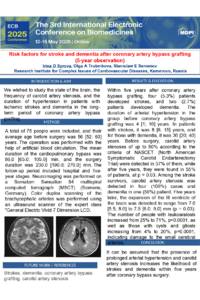
Objective: We wished to study the state of the brain, the frequency of carotid artery stenosis, and the duration of hypertension in patients with ischemic strokes and dementia in the long-term period of coronary artery bypass grafting.
Methods: A total of 75 people were included, and their average age before surgery was 56 [52; 60] years. The operation was performed with the help of artificial blood circulation. The mean duration of the cardiopulmonary bypass was 86.0 [65.0; 105.0] min, and the surgery duration was 230.0 [190.0; 270.0] min. The follow-up period included hospital and five-year stages. Neuroimaging was performed on a Somatom Sensation 64 multispiral computed tomograph (MSCT) (Siemens, Germany). Color duplex scanning of the brachycephalic arteries was performed using an ultrasound scanner of the expert class "General Electric Vivid 7 Dimension LCD", USA.
Results: Within five years after coronary artery bypass grafting, four (5.3%) patients developed strokes, and two (2.7%) patients developed dementia. The duration of arterial hypertension in the group before coronary artery bypass grafting was 4 [1; 10] years. In patients with strokes, it was 8 [6; 15] years, and for those with dementia, it was 30 [20; 40] years. Before surgery, carotid artery stenoses of up to 50% according to the criteria of NASCET (North American Symptomatic Carotid Endarterectomy Trial) were detected in 37% of them, while after five years, they were found in 55% of patients, at p = 0.03. Among the stroke survivors, carotid artery stenosis was detected in four (100%) cases and dementia in one (50%) patient. Five years later, the expansion of the III ventricle of the brain was detected to range from 7.0 [5.5; 8.0] to 7.5 [6.0; 9.0] mm (p = 0.03). The number of people with leukoaraiosis increased from 25% to 71%, p=0.0001, as well as those with cysts and gliosis increasing from 4% to 20%, p=0.0001, indicating damage to the small cerebral arteries.
Conclusions: It can be assumed that the presence of prolonged arterial hypertension and carotid artery stenosis increases the likelihood of strokes and dementia within five years after coronary bypass surgery.
Keywords
strokes
dementia
coronary artery bypass grafting
carotid artery stenosis
Poster
ID Syrova (1).pdf
Anti-Arthritic Potential of Artemisia herba-alba in Carrageenan- and Complete Freund's Adjuvant-Induced Arthritis Models in Rats
Protein Aggregating and Misfolding in Neurodegenerative Diseases: A Meta-Analysis