Event submissions
Published
This submission belongs to the session S8. Rare Diseases of the event The 3rd International Electronic Conference on Biomedicines
Published date
09 May, 2025
Academic Editor
'%3e%3cpath%20d='M12.6657%2010.9104C12.4185%2010.325%2012.0599%209.79327%2011.6097%209.34482C11.1609%208.89508%2010.6293%208.5365%2010.0442%208.28888C10.0389%208.28626%2010.0337%208.28495%2010.0285%208.28233C10.8446%207.69279%2011.3752%206.73249%2011.3752%205.64904C11.3752%203.8542%209.92103%202.39999%208.1262%202.39999C6.33136%202.39999%204.87715%203.8542%204.87715%205.64904C4.87715%206.73249%205.40774%207.69279%206.22393%208.28364C6.21869%208.28626%206.21345%208.28757%206.20821%208.29019C5.62129%208.5378%205.09463%208.89284%204.64265%209.34613C4.1929%209.79493%203.83432%2010.3266%203.58671%2010.9117C3.34345%2011.4845%203.21226%2012.0987%203.20023%2012.7209C3.19988%2012.7349%203.20233%2012.7488%203.20744%2012.7619C3.21255%2012.7749%203.22022%2012.7867%203.22998%2012.7968C3.23975%2012.8068%203.25142%2012.8147%203.26431%2012.8202C3.2772%2012.8256%203.29105%2012.8284%203.30504%2012.8284H4.09109C4.14874%2012.8284%204.19459%2012.7825%204.1959%2012.7262C4.2221%2011.7148%204.62823%2010.7676%205.34617%2010.0497C6.08899%209.30683%207.0755%208.89808%208.1262%208.89808C9.17689%208.89808%2010.1634%209.30683%2010.9062%2010.0497C11.6242%2010.7676%2012.0303%2011.7148%2012.0565%2012.7262C12.0578%2012.7838%2012.1037%2012.8284%2012.1613%2012.8284H12.9474C12.9613%2012.8284%2012.9752%2012.8256%2012.9881%2012.8202C13.001%2012.8147%2013.0126%2012.8068%2013.0224%2012.7968C13.0322%2012.7867%2013.0398%2012.7749%2013.0449%2012.7619C13.0501%2012.7488%2013.0525%2012.7349%2013.0522%2012.7209C13.0391%2012.0947%2012.9094%2011.4855%2012.6657%2010.9104ZM8.1262%207.9024C7.52486%207.9024%206.9589%207.6679%206.53312%207.24211C6.10733%206.81633%205.87283%206.25037%205.87283%205.64904C5.87283%205.0477%206.10733%204.48174%206.53312%204.05596C6.9589%203.63018%207.52486%203.39567%208.1262%203.39567C8.72753%203.39567%209.29349%203.63018%209.71927%204.05596C10.1451%204.48174%2010.3796%205.0477%2010.3796%205.64904C10.3796%206.25037%2010.1451%206.81633%209.71927%207.24211C9.29349%207.6679%208.72753%207.9024%208.1262%207.9024Z'%20fill='%235D1EE1'/%3e%3c/g%3e%3c/svg%3e) Georgia Levidou
Georgia LevidouCitation
Mariam Moalla, Imene Boujelbene, Mouna Mnif, Hassen Kamoun, Genetic Diagnosis of 46,XY Disorders of Sex Development (DSDs): Insights for Personalized Management, in Proceedings of The 3rd International Electronic Conference on Biomedicines, 12 May–15 May 2025, MDPI: Basel, Switzerland
Share
Email
Facebook
Twitter
LinkedIn
Genetic Diagnosis of 46,XY Disorders of Sex Development (DSDs): Insights for Personalized Management
'%3e%3cpath%20d='M12.6647%2010.9104C12.4176%2010.325%2012.0589%209.7933%2011.6088%209.34485C11.16%208.89511%2010.6283%208.53653%2010.0432%208.28891C10.038%208.28629%2010.0327%208.28498%2010.0275%208.28236C10.8437%207.69282%2011.3743%206.73252%2011.3743%205.64907C11.3743%203.85423%209.92005%202.40002%208.12522%202.40002C6.33038%202.40002%204.87618%203.85423%204.87618%205.64907C4.87618%206.73252%205.40677%207.69282%206.22296%208.28367C6.21772%208.28629%206.21248%208.2876%206.20724%208.29022C5.62031%208.53783%205.09365%208.89287%204.64167%209.34616C4.19192%209.79496%203.83334%2010.3266%203.58573%2010.9117C3.34247%2011.4846%203.21128%2012.0987%203.19925%2012.721C3.1989%2012.735%203.20135%2012.7489%203.20646%2012.7619C3.21157%2012.7749%203.21924%2012.7868%203.22901%2012.7968C3.23877%2012.8068%203.25045%2012.8148%203.26334%2012.8202C3.27623%2012.8256%203.29007%2012.8284%203.30406%2012.8284H4.09012C4.14776%2012.8284%204.19362%2012.7825%204.19493%2012.7262C4.22113%2011.7148%204.62726%2010.7676%205.34519%2010.0497C6.08802%209.30686%207.07452%208.89811%208.12522%208.89811C9.17592%208.89811%2010.1624%209.30686%2010.9052%2010.0497C11.6232%2010.7676%2012.0293%2011.7148%2012.0555%2012.7262C12.0568%2012.7839%2012.1027%2012.8284%2012.1603%2012.8284H12.9464C12.9604%2012.8284%2012.9742%2012.8256%2012.9871%2012.8202C13%2012.8148%2013.0117%2012.8068%2013.0214%2012.7968C13.0312%2012.7868%2013.0389%2012.7749%2013.044%2012.7619C13.0491%2012.7489%2013.0515%2012.735%2013.0512%2012.721C13.0381%2012.0947%2012.9084%2011.4856%2012.6647%2010.9104ZM8.12522%207.90243C7.52388%207.90243%206.95792%207.66793%206.53214%207.24215C6.10636%206.81636%205.87185%206.2504%205.87185%205.64907C5.87185%205.04773%206.10636%204.48177%206.53214%204.05599C6.95792%203.63021%207.52388%203.3957%208.12522%203.3957C8.72655%203.3957%209.29252%203.63021%209.7183%204.05599C10.1441%204.48177%2010.3786%205.04773%2010.3786%205.64907C10.3786%206.2504%2010.1441%206.81636%209.7183%207.24215C9.29252%207.66793%208.72655%207.90243%208.12522%207.90243Z'%20fill='%235D1EE1'/%3e%3c/g%3e%3c/svg%3e)
Mariam Moalla 1,2
Imene Boujelbene 2
Mouna Mnif 3
Hassen Kamoun 2
1. Laboratory of Human Molecular Genetics, Faculty of Medicine, Sfax, Tunisia
2. Department of Medical Genetics, C.H.U. Hedi Chaker, Sfax, Tunisia
3. Department of endocrinology, C.H.U Hedi Chaker, Sfax, Tunisia
Abstract
Disorders of sex development (DSDs) arise from discrepancies between chromosomal, gonadal, or phenotypic characteristics. These genetically complex conditions exhibit a broad phenotypic spectrum, ranging from hypospadias to fully masculinized or feminized genitalia that are incongruent with the karyotype. DSDs result from disruptions in gonadal formation (sex determination) or function (sex differentiation). Although rare, they have significant clinical implications and require a multidisciplinary approach to care. An accurate diagnosis, facilitated by various molecular techniques, is essential for personalized management, genetic counseling, and prognostic prediction for fertility and the risk of tumor development.
In this study, we present a cohort of 14 children with 46,XY DSDs referred to the genetics department for molecular diagnosis. Their phenotypic spectrum ranged from hypospadias to severely atypical external genitalia and female-typical external genitalia with palpable gonads in the presence of a male karyotype. Patients were classified based on the underlying pathophysiological mechanisms of the 46,XY DSD and screened for mutations in the AR, SF1, SRD5A2, and HSD17B3 genes using Sanger sequencing.
We identified three variants of uncertain significance (VUSs) in four out of nine (4/9) patients with complete or partial androgen insensitivity syndrome. Additionally, two VUSs in the HSD17B3 and SRD5A2 genes were detected in 3 patients (3/14) with androgen biosynthesis defects. A genetic analysis of the SF1 gene in 2 patients (2/14) revealed no pathogenic mutations.
This study details the genetic diagnoses of a heterogeneous cohort of children with 46,XY DSDs undergoing evaluations for surgical management. Molecular genetic testing enhances our understanding of the etiology and improves the diagnostic accuracy. However, identifying the underlying cause of 46,XY DSDs remains challenging, and in many cases, their etiology remains unknown.
Keywords
SRD5A2
HSD17B3
AR
SF1 genes
Poster
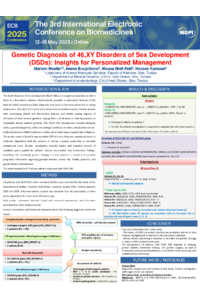
Mariam Moalla Poster ECB 2025 rare diseases.pdf
Protein Aggregating and Misfolding in Neurodegenerative Diseases: A Meta-Analysis
Natural Extracts and Autoimmunity: The Therapeutic Potential of Kiwi Polyphenols