Event submissions
Published
This submission belongs to the session S6. Diabetes, Obesity and Metabolic Diseases of the event The 3rd International Electronic Conference on Biomedicines
Published date
09 May, 2025
Academic Editor
'%3e%3cpath%20d='M12.6657%2010.9104C12.4185%2010.325%2012.0599%209.79327%2011.6097%209.34482C11.1609%208.89508%2010.6293%208.5365%2010.0442%208.28888C10.0389%208.28626%2010.0337%208.28495%2010.0285%208.28233C10.8446%207.69279%2011.3752%206.73249%2011.3752%205.64904C11.3752%203.8542%209.92103%202.39999%208.1262%202.39999C6.33136%202.39999%204.87715%203.8542%204.87715%205.64904C4.87715%206.73249%205.40774%207.69279%206.22393%208.28364C6.21869%208.28626%206.21345%208.28757%206.20821%208.29019C5.62129%208.5378%205.09463%208.89284%204.64265%209.34613C4.1929%209.79493%203.83432%2010.3266%203.58671%2010.9117C3.34345%2011.4845%203.21226%2012.0987%203.20023%2012.7209C3.19988%2012.7349%203.20233%2012.7488%203.20744%2012.7619C3.21255%2012.7749%203.22022%2012.7867%203.22998%2012.7968C3.23975%2012.8068%203.25142%2012.8147%203.26431%2012.8202C3.2772%2012.8256%203.29105%2012.8284%203.30504%2012.8284H4.09109C4.14874%2012.8284%204.19459%2012.7825%204.1959%2012.7262C4.2221%2011.7148%204.62823%2010.7676%205.34617%2010.0497C6.08899%209.30683%207.0755%208.89808%208.1262%208.89808C9.17689%208.89808%2010.1634%209.30683%2010.9062%2010.0497C11.6242%2010.7676%2012.0303%2011.7148%2012.0565%2012.7262C12.0578%2012.7838%2012.1037%2012.8284%2012.1613%2012.8284H12.9474C12.9613%2012.8284%2012.9752%2012.8256%2012.9881%2012.8202C13.001%2012.8147%2013.0126%2012.8068%2013.0224%2012.7968C13.0322%2012.7867%2013.0398%2012.7749%2013.0449%2012.7619C13.0501%2012.7488%2013.0525%2012.7349%2013.0522%2012.7209C13.0391%2012.0947%2012.9094%2011.4855%2012.6657%2010.9104ZM8.1262%207.9024C7.52486%207.9024%206.9589%207.6679%206.53312%207.24211C6.10733%206.81633%205.87283%206.25037%205.87283%205.64904C5.87283%205.0477%206.10733%204.48174%206.53312%204.05596C6.9589%203.63018%207.52486%203.39567%208.1262%203.39567C8.72753%203.39567%209.29349%203.63018%209.71927%204.05596C10.1451%204.48174%2010.3796%205.0477%2010.3796%205.64904C10.3796%206.25037%2010.1451%206.81633%209.71927%207.24211C9.29349%207.6679%208.72753%207.9024%208.1262%207.9024Z'%20fill='%235D1EE1'/%3e%3c/g%3e%3c/svg%3e) Georgia Levidou
Georgia LevidouCitation
Shubhra Vats, Dhiraj Kishore, Molecular Insights into Oxidative Stress in T2DM-Driven CAD: Clinical Implications and Biomarker Innovation, in Proceedings of The 3rd International Electronic Conference on Biomedicines, 12 May–15 May 2025, MDPI: Basel, Switzerland
Share
Email
Facebook
Twitter
LinkedIn
Molecular Insights into Oxidative Stress in T2DM-Driven CAD: Clinical Implications and Biomarker Innovation
'%3e%3cpath%20d='M12.6647%2010.9104C12.4176%2010.325%2012.0589%209.7933%2011.6088%209.34485C11.16%208.89511%2010.6283%208.53653%2010.0432%208.28891C10.038%208.28629%2010.0327%208.28498%2010.0275%208.28236C10.8437%207.69282%2011.3743%206.73252%2011.3743%205.64907C11.3743%203.85423%209.92005%202.40002%208.12522%202.40002C6.33038%202.40002%204.87618%203.85423%204.87618%205.64907C4.87618%206.73252%205.40677%207.69282%206.22296%208.28367C6.21772%208.28629%206.21248%208.2876%206.20724%208.29022C5.62031%208.53783%205.09365%208.89287%204.64167%209.34616C4.19192%209.79496%203.83334%2010.3266%203.58573%2010.9117C3.34247%2011.4846%203.21128%2012.0987%203.19925%2012.721C3.1989%2012.735%203.20135%2012.7489%203.20646%2012.7619C3.21157%2012.7749%203.21924%2012.7868%203.22901%2012.7968C3.23877%2012.8068%203.25045%2012.8148%203.26334%2012.8202C3.27623%2012.8256%203.29007%2012.8284%203.30406%2012.8284H4.09012C4.14776%2012.8284%204.19362%2012.7825%204.19493%2012.7262C4.22113%2011.7148%204.62726%2010.7676%205.34519%2010.0497C6.08802%209.30686%207.07452%208.89811%208.12522%208.89811C9.17592%208.89811%2010.1624%209.30686%2010.9052%2010.0497C11.6232%2010.7676%2012.0293%2011.7148%2012.0555%2012.7262C12.0568%2012.7839%2012.1027%2012.8284%2012.1603%2012.8284H12.9464C12.9604%2012.8284%2012.9742%2012.8256%2012.9871%2012.8202C13%2012.8148%2013.0117%2012.8068%2013.0214%2012.7968C13.0312%2012.7868%2013.0389%2012.7749%2013.044%2012.7619C13.0491%2012.7489%2013.0515%2012.735%2013.0512%2012.721C13.0381%2012.0947%2012.9084%2011.4856%2012.6647%2010.9104ZM8.12522%207.90243C7.52388%207.90243%206.95792%207.66793%206.53214%207.24215C6.10636%206.81636%205.87185%206.2504%205.87185%205.64907C5.87185%205.04773%206.10636%204.48177%206.53214%204.05599C6.95792%203.63021%207.52388%203.3957%208.12522%203.3957C8.72655%203.3957%209.29252%203.63021%209.7183%204.05599C10.1441%204.48177%2010.3786%205.04773%2010.3786%205.64907C10.3786%206.2504%2010.1441%206.81636%209.7183%207.24215C9.29252%207.66793%208.72655%207.90243%208.12522%207.90243Z'%20fill='%235D1EE1'/%3e%3c/g%3e%3c/svg%3e)
Shubhra Vats 1
Dhiraj Kishore 1
1. Department of General Medicine, Institute of Medical Sciences, Banaras Hindu University, Varanasi, Uttar Pradesh - 221005, India
Abstract
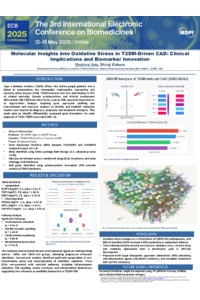
Introduction: Type 2 diabetes mellitus (T2DM) affects 462 million people globally and is linked to complications like retinopathy, nephropathy, neuropathy, and coronary artery disease (CAD). T2DM increases CAD risk, contributing to 75% of related mortality. Genetic predispositions and distinct mechanisms differentiate DM-CAD from other forms, such as CAD, caused by hypertension or degenerative changes, requiring gene expression profiling and transcriptome and reactome analyses to identify and establish molecular markers and improve its diagnosis, prognosis, and treatment strategies. Methods: The Gene Expression Omnibus (GEO) datasets GSE250283 and GSE90074 were used to identify the differentially expressed genes involved in DM-CAD. Biological targets were identified that coincided with the identified differentially expressed genes. The biological pathways were analyzed using KEGG, and hub genes were identified for a further functional and signaling pathway analysis.
Results: The differentially expressed gene biomarkers were identified between the control and DM and DM-CAD. NLRP3, TLR4, STAT3, IL6, TNF-α, and NF-κB were found to be upregulated, while PPARG, SIRT1, and ADIPOR1 were downregulated, indicating significant pathways with involvement, including the oxidative stress response, JAK-STAT signaling, and insulin resistance and mitochondrial dysfunction.
Conclusion: Oxidative stress emerges as a critical driver of T2DM-CAD pathogenesis, influencing inflammatory pathways and metabolic dysfunction. Genes such as SOD2, CAT, and GPX1 highlight disruptions in antioxidant defense mechanisms, aligning with mitochondrial dysfunction. Elevated STAT3 expression in the JAK-STAT pathway and NLRP3 activation further exacerbate oxidative damage and inflammation. Meanwhile, the downregulation of SIRT1 and ADIPOQ underscores impaired glucose regulation and insulin sensitivity. These findings position oxidative stress as a key therapeutic target, alongside inflammasome and immune signaling pathways like the JAK-STAT pathway as novel therapeutic targets for mitigating T2DM-CAD's severity.
Keywords
T2DM
CAD
BIOMARKERS
OXIDATIVE STRESS
Poster
BIOMEDICINE POSTER.pdf
Recent advances in nanomedicine for skin cancer immunotherapy: focus on nanosystems, drug repurposing, and co-loading for synergistic effects
Polyphenol-Mediated Activation of PPARγ and the Adiponectin Pathway for the Treatment of Type 2 Diabetes