Event submissions
Published
This submission belongs to the session S4. Immune System, Tumor Immunology and Autoimmune Disease of the event The 3rd International Electronic Conference on Biomedicines
Published date
09 May, 2025
Academic Editor
'%3e%3cpath%20d='M12.6657%2010.9104C12.4185%2010.325%2012.0599%209.79327%2011.6097%209.34482C11.1609%208.89508%2010.6293%208.5365%2010.0442%208.28888C10.0389%208.28626%2010.0337%208.28495%2010.0285%208.28233C10.8446%207.69279%2011.3752%206.73249%2011.3752%205.64904C11.3752%203.8542%209.92103%202.39999%208.1262%202.39999C6.33136%202.39999%204.87715%203.8542%204.87715%205.64904C4.87715%206.73249%205.40774%207.69279%206.22393%208.28364C6.21869%208.28626%206.21345%208.28757%206.20821%208.29019C5.62129%208.5378%205.09463%208.89284%204.64265%209.34613C4.1929%209.79493%203.83432%2010.3266%203.58671%2010.9117C3.34345%2011.4845%203.21226%2012.0987%203.20023%2012.7209C3.19988%2012.7349%203.20233%2012.7488%203.20744%2012.7619C3.21255%2012.7749%203.22022%2012.7867%203.22998%2012.7968C3.23975%2012.8068%203.25142%2012.8147%203.26431%2012.8202C3.2772%2012.8256%203.29105%2012.8284%203.30504%2012.8284H4.09109C4.14874%2012.8284%204.19459%2012.7825%204.1959%2012.7262C4.2221%2011.7148%204.62823%2010.7676%205.34617%2010.0497C6.08899%209.30683%207.0755%208.89808%208.1262%208.89808C9.17689%208.89808%2010.1634%209.30683%2010.9062%2010.0497C11.6242%2010.7676%2012.0303%2011.7148%2012.0565%2012.7262C12.0578%2012.7838%2012.1037%2012.8284%2012.1613%2012.8284H12.9474C12.9613%2012.8284%2012.9752%2012.8256%2012.9881%2012.8202C13.001%2012.8147%2013.0126%2012.8068%2013.0224%2012.7968C13.0322%2012.7867%2013.0398%2012.7749%2013.0449%2012.7619C13.0501%2012.7488%2013.0525%2012.7349%2013.0522%2012.7209C13.0391%2012.0947%2012.9094%2011.4855%2012.6657%2010.9104ZM8.1262%207.9024C7.52486%207.9024%206.9589%207.6679%206.53312%207.24211C6.10733%206.81633%205.87283%206.25037%205.87283%205.64904C5.87283%205.0477%206.10733%204.48174%206.53312%204.05596C6.9589%203.63018%207.52486%203.39567%208.1262%203.39567C8.72753%203.39567%209.29349%203.63018%209.71927%204.05596C10.1451%204.48174%2010.3796%205.0477%2010.3796%205.64904C10.3796%206.25037%2010.1451%206.81633%209.71927%207.24211C9.29349%207.6679%208.72753%207.9024%208.1262%207.9024Z'%20fill='%235D1EE1'/%3e%3c/g%3e%3c/svg%3e) Marianna Christodoulou
Marianna ChristodoulouCitation
Sara Ouari, Nadia Benzidane, Chahla Bencharif, Noureddine Bribi, Histological and Immunohistochemical study of Anti-Inflammatory effect of Inula viscosa (L). Aiton Leaf Extract in Formaldehyde-induced arthritis in Mice, in Proceedings of The 3rd International Electronic Conference on Biomedicines, 12 May–15 May 2025, MDPI: Basel, Switzerland
Share
Email
Facebook
Twitter
LinkedIn
Histological and Immunohistochemical study of Anti-Inflammatory effect of Inula viscosa (L). Aiton Leaf Extract in Formaldehyde-induced arthritis in Mice

Sara Ouari 1
'%3e%3cpath%20d='M12.6647%2010.9104C12.4176%2010.325%2012.0589%209.7933%2011.6088%209.34485C11.16%208.89511%2010.6283%208.53653%2010.0432%208.28891C10.038%208.28629%2010.0327%208.28498%2010.0275%208.28236C10.8437%207.69282%2011.3743%206.73252%2011.3743%205.64907C11.3743%203.85423%209.92005%202.40002%208.12522%202.40002C6.33038%202.40002%204.87618%203.85423%204.87618%205.64907C4.87618%206.73252%205.40677%207.69282%206.22296%208.28367C6.21772%208.28629%206.21248%208.2876%206.20724%208.29022C5.62031%208.53783%205.09365%208.89287%204.64167%209.34616C4.19192%209.79496%203.83334%2010.3266%203.58573%2010.9117C3.34247%2011.4846%203.21128%2012.0987%203.19925%2012.721C3.1989%2012.735%203.20135%2012.7489%203.20646%2012.7619C3.21157%2012.7749%203.21924%2012.7868%203.22901%2012.7968C3.23877%2012.8068%203.25045%2012.8148%203.26334%2012.8202C3.27623%2012.8256%203.29007%2012.8284%203.30406%2012.8284H4.09012C4.14776%2012.8284%204.19362%2012.7825%204.19493%2012.7262C4.22113%2011.7148%204.62726%2010.7676%205.34519%2010.0497C6.08802%209.30686%207.07452%208.89811%208.12522%208.89811C9.17592%208.89811%2010.1624%209.30686%2010.9052%2010.0497C11.6232%2010.7676%2012.0293%2011.7148%2012.0555%2012.7262C12.0568%2012.7839%2012.1027%2012.8284%2012.1603%2012.8284H12.9464C12.9604%2012.8284%2012.9742%2012.8256%2012.9871%2012.8202C13%2012.8148%2013.0117%2012.8068%2013.0214%2012.7968C13.0312%2012.7868%2013.0389%2012.7749%2013.044%2012.7619C13.0491%2012.7489%2013.0515%2012.735%2013.0512%2012.721C13.0381%2012.0947%2012.9084%2011.4856%2012.6647%2010.9104ZM8.12522%207.90243C7.52388%207.90243%206.95792%207.66793%206.53214%207.24215C6.10636%206.81636%205.87185%206.2504%205.87185%205.64907C5.87185%205.04773%206.10636%204.48177%206.53214%204.05599C6.95792%203.63021%207.52388%203.3957%208.12522%203.3957C8.72655%203.3957%209.29252%203.63021%209.7183%204.05599C10.1441%204.48177%2010.3786%205.04773%2010.3786%205.64907C10.3786%206.2504%2010.1441%206.81636%209.7183%207.24215C9.29252%207.66793%208.72655%207.90243%208.12522%207.90243Z'%20fill='%235D1EE1'/%3e%3c/g%3e%3c/svg%3e)
Nadia Benzidane 2
Chahla Bencharif 3

Noureddine Bribi 4
1. Laboratory of Applied Biochemistry, Faculty of Nature and Life Science, University Ferhat Abbes Setif 1, 19000, Setif, Algeria.
2. Laboratory of Applied Biochemistry, Faculty of Nature and Life Science, Setif 1 Ferhat Abbas University, 19000, Setif, Algeria.
3. Pathology laboratory, Khelil Amrane University Hospital of Bejaia, 06000, Bejaia, Algeria.
4. Laboratory of Plant Biotechnology and Ethnobotany, Faculty of Nature and Life Sciences, University of Bejaia, Bejaia, 06000, Algeria.
Abstract
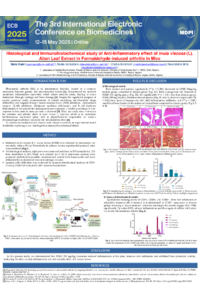
Introduction: Rheumatoid arthritis (RA) is a chronic and complex inflammatory disorder characterized by inflammation of the synovial membrane (synovitis), leading to cartilage and bone damage of articular joints. Given the adverse effects and different and non-affective responses of patients to synthetic disease-modifying anti-rheumatic drugs (DMARDs) and nonsteroidal anti-inflammatory drugs (NSAIDs), it is of interest to use medicinal plants exhibiting encouraging therapeutic results and fewer side effects. Objective: This study aimed to investigate the anti-arthritic effect of Inula viscosa (I. viscosa) on the progression of arthritis in an NMRI mouse model. Methods: Mice were divided into six groups (n=6) as follows: normal control, disease control, Diclofenac group (10 mg/kg, p.o. daily), and three groups who were treated daily with 50, 100, and 200 mg/kg IVME (p.o.). Formaldehyde models were obtained by means of sub-plantar administration of 20 µL of formaldehyde (3.75% v/v) into the right hind paws of NMRI albino mice on the first and third of the ten experimental days. Joint diameters were measured; arthritis severity was evaluated by means of inhibition of the paw oedema; histological changes, synovial hyperplasia, and immune cell infiltration were evaluated using histological and immunohistochemical analyses of CD3+, CD20+, and CD68+; and staining markers of ankle joint tissue sections were analyzed with the QuPath v0.5.1 software tool using adaptive thresholding to quantify the percentage staining of positive cells. Results: The administration of I. visocsa (at a low dose of 50 mg/kg) significantly (***p <0.001) ameliorated the induced arthritis severity, resulting in the restoration of the paw diameter, (*p <0.05), reduced hyperplasia of the synovial membrane, and bone erosion, and significantly (*p <0,1) decreased CD68+-staining immune cell infiltration. Conclusion: These findings suggest that I. viscosa leaves have an anti-arthritic property, which is due to the anti-inflammatory effect, probably through cytokine regulation.
Keywords
Immunohistochemical
medecinal plant
Rheumatoid arthritis
in vivo model
Immune biomarkers.
Poster
Poster Sara Ouari ECB2025 (1).pdf
The Effect of Short-Term Transcutaneous Electrical Stimulation of the Auricular Vagus Nerve on Parameters of Heart-Rate Variability
The Role of Interferon Therapy in Stabilizing Metabolic Liver Diseases