Event submissions
Published
This submission belongs to the session S6. Diabetes, Obesity and Metabolic Diseases of the event The 3rd International Electronic Conference on Biomedicines
Published date
09 May, 2025
Academic Editor
'%3e%3cpath%20d='M12.6657%2010.9104C12.4185%2010.325%2012.0599%209.79327%2011.6097%209.34482C11.1609%208.89508%2010.6293%208.5365%2010.0442%208.28888C10.0389%208.28626%2010.0337%208.28495%2010.0285%208.28233C10.8446%207.69279%2011.3752%206.73249%2011.3752%205.64904C11.3752%203.8542%209.92103%202.39999%208.1262%202.39999C6.33136%202.39999%204.87715%203.8542%204.87715%205.64904C4.87715%206.73249%205.40774%207.69279%206.22393%208.28364C6.21869%208.28626%206.21345%208.28757%206.20821%208.29019C5.62129%208.5378%205.09463%208.89284%204.64265%209.34613C4.1929%209.79493%203.83432%2010.3266%203.58671%2010.9117C3.34345%2011.4845%203.21226%2012.0987%203.20023%2012.7209C3.19988%2012.7349%203.20233%2012.7488%203.20744%2012.7619C3.21255%2012.7749%203.22022%2012.7867%203.22998%2012.7968C3.23975%2012.8068%203.25142%2012.8147%203.26431%2012.8202C3.2772%2012.8256%203.29105%2012.8284%203.30504%2012.8284H4.09109C4.14874%2012.8284%204.19459%2012.7825%204.1959%2012.7262C4.2221%2011.7148%204.62823%2010.7676%205.34617%2010.0497C6.08899%209.30683%207.0755%208.89808%208.1262%208.89808C9.17689%208.89808%2010.1634%209.30683%2010.9062%2010.0497C11.6242%2010.7676%2012.0303%2011.7148%2012.0565%2012.7262C12.0578%2012.7838%2012.1037%2012.8284%2012.1613%2012.8284H12.9474C12.9613%2012.8284%2012.9752%2012.8256%2012.9881%2012.8202C13.001%2012.8147%2013.0126%2012.8068%2013.0224%2012.7968C13.0322%2012.7867%2013.0398%2012.7749%2013.0449%2012.7619C13.0501%2012.7488%2013.0525%2012.7349%2013.0522%2012.7209C13.0391%2012.0947%2012.9094%2011.4855%2012.6657%2010.9104ZM8.1262%207.9024C7.52486%207.9024%206.9589%207.6679%206.53312%207.24211C6.10733%206.81633%205.87283%206.25037%205.87283%205.64904C5.87283%205.0477%206.10733%204.48174%206.53312%204.05596C6.9589%203.63018%207.52486%203.39567%208.1262%203.39567C8.72753%203.39567%209.29349%203.63018%209.71927%204.05596C10.1451%204.48174%2010.3796%205.0477%2010.3796%205.64904C10.3796%206.25037%2010.1451%206.81633%209.71927%207.24211C9.29349%207.6679%208.72753%207.9024%208.1262%207.9024Z'%20fill='%235D1EE1'/%3e%3c/g%3e%3c/svg%3e) Serafino Fazio
Serafino FazioCitation
MEGALA T, NANDHA GOPAL T, SIVA PRADEEP M, SIVABALAN M, YASOTHA A, RAJA N, The Role of Interferon Therapy in Stabilizing Metabolic Liver Diseases, in Proceedings of The 3rd International Electronic Conference on Biomedicines, 12 May–15 May 2025, MDPI: Basel, Switzerland
Share
Email
Facebook
Twitter
LinkedIn
The Role of Interferon Therapy in Stabilizing Metabolic Liver Diseases
'%3e%3cpath%20d='M12.6647%2010.9104C12.4176%2010.325%2012.0589%209.7933%2011.6088%209.34485C11.16%208.89511%2010.6283%208.53653%2010.0432%208.28891C10.038%208.28629%2010.0327%208.28498%2010.0275%208.28236C10.8437%207.69282%2011.3743%206.73252%2011.3743%205.64907C11.3743%203.85423%209.92005%202.40002%208.12522%202.40002C6.33038%202.40002%204.87618%203.85423%204.87618%205.64907C4.87618%206.73252%205.40677%207.69282%206.22296%208.28367C6.21772%208.28629%206.21248%208.2876%206.20724%208.29022C5.62031%208.53783%205.09365%208.89287%204.64167%209.34616C4.19192%209.79496%203.83334%2010.3266%203.58573%2010.9117C3.34247%2011.4846%203.21128%2012.0987%203.19925%2012.721C3.1989%2012.735%203.20135%2012.7489%203.20646%2012.7619C3.21157%2012.7749%203.21924%2012.7868%203.22901%2012.7968C3.23877%2012.8068%203.25045%2012.8148%203.26334%2012.8202C3.27623%2012.8256%203.29007%2012.8284%203.30406%2012.8284H4.09012C4.14776%2012.8284%204.19362%2012.7825%204.19493%2012.7262C4.22113%2011.7148%204.62726%2010.7676%205.34519%2010.0497C6.08802%209.30686%207.07452%208.89811%208.12522%208.89811C9.17592%208.89811%2010.1624%209.30686%2010.9052%2010.0497C11.6232%2010.7676%2012.0293%2011.7148%2012.0555%2012.7262C12.0568%2012.7839%2012.1027%2012.8284%2012.1603%2012.8284H12.9464C12.9604%2012.8284%2012.9742%2012.8256%2012.9871%2012.8202C13%2012.8148%2013.0117%2012.8068%2013.0214%2012.7968C13.0312%2012.7868%2013.0389%2012.7749%2013.044%2012.7619C13.0491%2012.7489%2013.0515%2012.735%2013.0512%2012.721C13.0381%2012.0947%2012.9084%2011.4856%2012.6647%2010.9104ZM8.12522%207.90243C7.52388%207.90243%206.95792%207.66793%206.53214%207.24215C6.10636%206.81636%205.87185%206.2504%205.87185%205.64907C5.87185%205.04773%206.10636%204.48177%206.53214%204.05599C6.95792%203.63021%207.52388%203.3957%208.12522%203.3957C8.72655%203.3957%209.29252%203.63021%209.7183%204.05599C10.1441%204.48177%2010.3786%205.04773%2010.3786%205.64907C10.3786%206.2504%2010.1441%206.81636%209.7183%207.24215C9.29252%207.66793%208.72655%207.90243%208.12522%207.90243Z'%20fill='%235D1EE1'/%3e%3c/g%3e%3c/svg%3e)
MEGALA T 1
NANDHA GOPAL T 1
SIVA PRADEEP M 1
SIVABALAN M 1

YASOTHA A 2
RAJA N 1,3
1. SRI RAMAKRISHNA MISSION VIDYALAYA COLLEGE OF ARTS AND SCIENCE, COIMBATORE, TAMILNADU , INDIA.
2. UNITED INSTITUTE OF TECHNOLOGY, COIMBATORE, TAMILNADU, INDIA.
3. RATHINAM TECHNICAL CAMPUS, COIMBATORE, TAMIL NADU, INDIA.
Abstract
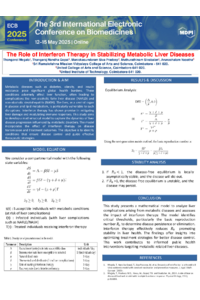
Metabolic diseases, including diabetes, obesity, and insulin resistance, have emerged as significant global health challenges with profound implications for liver health. As a central organ in glucose and lipid metabolism, the liver is particularly vulnerable to disruptions caused by these diseases. Such disturbances often result in complications like non-alcoholic fatty liver disease (NAFLD) and non-alcoholic steatohepatitis (NASH), which are major contributors to liver-related morbidity. This study develops a mathematical model to explore the progression of these conditions and evaluate the role of interferon therapy in controlling disease dynamics.
The analysis focuses on two key equilibrium states: the disease-free equilibrium (DFE), which represents the absence of disease, and the endemic equilibrium (EE), where the disease persists in the population. A critical component of the study is the basic reproduction number (R0), which serves as a threshold indicator of whether the disease will spread or die out. By comparing scenarios with and without interferon therapy, the study demonstrates how the therapy significantly reduces R0, shifting the system from an endemic state to a disease-free state under specific conditions.
The findings highlight the potential of interferon therapy to stabilize liver health and reduce the prevalence of liver-related complications associated with metabolic diseases. This research provides valuable insights into the conditions under which interferon therapy is most effective, offering practical guidance for optimizing treatment strategies and public health interventions. By addressing the underlying dynamics of these diseases, this study contributes to a deeper understanding of their progression and supports global efforts to alleviate their impact.
Keywords
Metabolic Diseases
Interferon Therapy
Stability Analysis
Liver disease
Poster
poster.pdf
Histological and Immunohistochemical study of Anti-Inflammatory effect of Inula viscosa (L). Aiton Leaf Extract in Formaldehyde-induced arthritis in Mice
Design of Partial Agonists of ADAMTS Metalloproteinases as Therapeutics for Neurodegenerative Diseases