Event submissions
Published
This submission belongs to the session S9. Molecular Mechanisms of Neurodegeneration of the event The 3rd International Electronic Conference on Biomedicines
Published date
09 May, 2025
Academic Editor
'%3e%3cpath%20d='M12.6657%2010.9104C12.4185%2010.325%2012.0599%209.79327%2011.6097%209.34482C11.1609%208.89508%2010.6293%208.5365%2010.0442%208.28888C10.0389%208.28626%2010.0337%208.28495%2010.0285%208.28233C10.8446%207.69279%2011.3752%206.73249%2011.3752%205.64904C11.3752%203.8542%209.92103%202.39999%208.1262%202.39999C6.33136%202.39999%204.87715%203.8542%204.87715%205.64904C4.87715%206.73249%205.40774%207.69279%206.22393%208.28364C6.21869%208.28626%206.21345%208.28757%206.20821%208.29019C5.62129%208.5378%205.09463%208.89284%204.64265%209.34613C4.1929%209.79493%203.83432%2010.3266%203.58671%2010.9117C3.34345%2011.4845%203.21226%2012.0987%203.20023%2012.7209C3.19988%2012.7349%203.20233%2012.7488%203.20744%2012.7619C3.21255%2012.7749%203.22022%2012.7867%203.22998%2012.7968C3.23975%2012.8068%203.25142%2012.8147%203.26431%2012.8202C3.2772%2012.8256%203.29105%2012.8284%203.30504%2012.8284H4.09109C4.14874%2012.8284%204.19459%2012.7825%204.1959%2012.7262C4.2221%2011.7148%204.62823%2010.7676%205.34617%2010.0497C6.08899%209.30683%207.0755%208.89808%208.1262%208.89808C9.17689%208.89808%2010.1634%209.30683%2010.9062%2010.0497C11.6242%2010.7676%2012.0303%2011.7148%2012.0565%2012.7262C12.0578%2012.7838%2012.1037%2012.8284%2012.1613%2012.8284H12.9474C12.9613%2012.8284%2012.9752%2012.8256%2012.9881%2012.8202C13.001%2012.8147%2013.0126%2012.8068%2013.0224%2012.7968C13.0322%2012.7867%2013.0398%2012.7749%2013.0449%2012.7619C13.0501%2012.7488%2013.0525%2012.7349%2013.0522%2012.7209C13.0391%2012.0947%2012.9094%2011.4855%2012.6657%2010.9104ZM8.1262%207.9024C7.52486%207.9024%206.9589%207.6679%206.53312%207.24211C6.10733%206.81633%205.87283%206.25037%205.87283%205.64904C5.87283%205.0477%206.10733%204.48174%206.53312%204.05596C6.9589%203.63018%207.52486%203.39567%208.1262%203.39567C8.72753%203.39567%209.29349%203.63018%209.71927%204.05596C10.1451%204.48174%2010.3796%205.0477%2010.3796%205.64904C10.3796%206.25037%2010.1451%206.81633%209.71927%207.24211C9.29349%207.6679%208.72753%207.9024%208.1262%207.9024Z'%20fill='%235D1EE1'/%3e%3c/g%3e%3c/svg%3e) Masaru Tanaka
Masaru TanakaCitation
Alexander Dygai, Edgar Pan, Natalia Ermakova, Mariia Zhukova, Valentina Pan, Irina Zharkikh, Victoria Skurikhina, Study of Hematopoiesis in Brain Trauma: Exploring New Approaches to Regulating Neuroinflammation and Neurogenesis, in Proceedings of The 3rd International Electronic Conference on Biomedicines, 12 May–15 May 2025, MDPI: Basel, Switzerland
Share
Email
Facebook
Twitter
LinkedIn
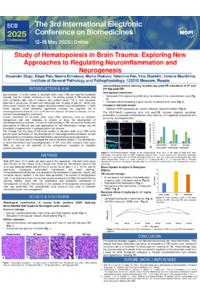
Study of Hematopoiesis in Brain Trauma: Exploring New Approaches to Regulating Neuroinflammation and Neurogenesis
'%3e%3cpath%20d='M12.6647%2010.9104C12.4176%2010.325%2012.0589%209.7933%2011.6088%209.34485C11.16%208.89511%2010.6283%208.53653%2010.0432%208.28891C10.038%208.28629%2010.0327%208.28498%2010.0275%208.28236C10.8437%207.69282%2011.3743%206.73252%2011.3743%205.64907C11.3743%203.85423%209.92005%202.40002%208.12522%202.40002C6.33038%202.40002%204.87618%203.85423%204.87618%205.64907C4.87618%206.73252%205.40677%207.69282%206.22296%208.28367C6.21772%208.28629%206.21248%208.2876%206.20724%208.29022C5.62031%208.53783%205.09365%208.89287%204.64167%209.34616C4.19192%209.79496%203.83334%2010.3266%203.58573%2010.9117C3.34247%2011.4846%203.21128%2012.0987%203.19925%2012.721C3.1989%2012.735%203.20135%2012.7489%203.20646%2012.7619C3.21157%2012.7749%203.21924%2012.7868%203.22901%2012.7968C3.23877%2012.8068%203.25045%2012.8148%203.26334%2012.8202C3.27623%2012.8256%203.29007%2012.8284%203.30406%2012.8284H4.09012C4.14776%2012.8284%204.19362%2012.7825%204.19493%2012.7262C4.22113%2011.7148%204.62726%2010.7676%205.34519%2010.0497C6.08802%209.30686%207.07452%208.89811%208.12522%208.89811C9.17592%208.89811%2010.1624%209.30686%2010.9052%2010.0497C11.6232%2010.7676%2012.0293%2011.7148%2012.0555%2012.7262C12.0568%2012.7839%2012.1027%2012.8284%2012.1603%2012.8284H12.9464C12.9604%2012.8284%2012.9742%2012.8256%2012.9871%2012.8202C13%2012.8148%2013.0117%2012.8068%2013.0214%2012.7968C13.0312%2012.7868%2013.0389%2012.7749%2013.044%2012.7619C13.0491%2012.7489%2013.0515%2012.735%2013.0512%2012.721C13.0381%2012.0947%2012.9084%2011.4856%2012.6647%2010.9104ZM8.12522%207.90243C7.52388%207.90243%206.95792%207.66793%206.53214%207.24215C6.10636%206.81636%205.87185%206.2504%205.87185%205.64907C5.87185%205.04773%206.10636%204.48177%206.53214%204.05599C6.95792%203.63021%207.52388%203.3957%208.12522%203.3957C8.72655%203.3957%209.29252%203.63021%209.7183%204.05599C10.1441%204.48177%2010.3786%205.04773%2010.3786%205.64907C10.3786%206.2504%2010.1441%206.81636%209.7183%207.24215C9.29252%207.66793%208.72655%207.90243%208.12522%207.90243Z'%20fill='%235D1EE1'/%3e%3c/g%3e%3c/svg%3e)
Alexander Dygai 1
Edgar Pan 1
Natalia Ermakova 1
Mariia Zhukova 1
Valentina Pan 1
Irina Zharkikh 1
Victoria Skurikhina 1
1. Institute of General Pathology and Pathophysiology, 125315 Moscow, Russia
Abstract
Background:
Current treatments for traumatic brain injury (TBI) commonly focus on symptom management and lack strategies to prevent or delay the development of neurodegenerative processes. The lack of understanding of TBI mechanisms hinders the development of effective and safe approaches for anti-inflammatory therapy and the stimulation of regeneration in damaged and/or lost neurons. The study of the blood system in TBI may provide new biomarkers for the development of neurodegenerative processes and methods for regulating neuroinflammation and neuroregeneration.
Materials and Methods:
Male ICR mice, 12-14 weeks old, were used in this experiment. Traumatic brain injury was induced by focal impact using a weight-drop model [Chakraborty, N., Hammamieh, R., Gautam, A., et al., 2021]. The neurological status of the mice was assessed before and at 6 hours, as well as on days 1, 3, 7, 14, 21, and 42 post-injury. Histological examination (hematoxylin and eosin staining), immunohistochemical staining, and analysis of the expression of astrocyte, mature, and immature neuron markers in the brain were performed. The content of hematopoietic cells in the blood and bone marrow was studied staining by the May–Grünwald–Giemsa staining method, along with the quantitative and qualitative composition of hematopoietic niches [Crocker P., Gordon S., 1985]. Additionally, an in vitro analysis of hematopoietic and progenitor cells was performed. The sympatholytic drug reserpine was used to modulate neuroinflammation and neurogenesis.
Results:
Reserpine, via decreasing hematopoietic activity, reduced brain damage, prevented neuroinflammation, and facilitated neurogenesis in mice subjected to TBI.
Conclusion:
Pharmacological blockade of the sympathetic component of hematopoiesis regulation may serve as a basis for developing new approaches to reduce neuroinflammation and promote neurogenesis in TBIs.
Keywords
Traumatic brain injury (TBI)
neuroinflammation
neurogenesis
hematopoiesis.
Poster
Pan_ES_Poster_ECB_2025.pdf
Biomedical Approaches involving the Carob Tree (Ceratonia siliqua L.) for the Management of Obesity and Diabetes
Natural Inhibitors of the β2-Adrenergic Receptor: A Computational Study for Targeting GPCR-Mediated Diseases