Event submissions
Published
This submission belongs to the session S5. Biomedicine in Cardiovascular Diseases of the event The 3rd International Electronic Conference on Biomedicines
Published date
09 May, 2025
Academic Editor
'%3e%3cpath%20d='M12.6657%2010.9104C12.4185%2010.325%2012.0599%209.79327%2011.6097%209.34482C11.1609%208.89508%2010.6293%208.5365%2010.0442%208.28888C10.0389%208.28626%2010.0337%208.28495%2010.0285%208.28233C10.8446%207.69279%2011.3752%206.73249%2011.3752%205.64904C11.3752%203.8542%209.92103%202.39999%208.1262%202.39999C6.33136%202.39999%204.87715%203.8542%204.87715%205.64904C4.87715%206.73249%205.40774%207.69279%206.22393%208.28364C6.21869%208.28626%206.21345%208.28757%206.20821%208.29019C5.62129%208.5378%205.09463%208.89284%204.64265%209.34613C4.1929%209.79493%203.83432%2010.3266%203.58671%2010.9117C3.34345%2011.4845%203.21226%2012.0987%203.20023%2012.7209C3.19988%2012.7349%203.20233%2012.7488%203.20744%2012.7619C3.21255%2012.7749%203.22022%2012.7867%203.22998%2012.7968C3.23975%2012.8068%203.25142%2012.8147%203.26431%2012.8202C3.2772%2012.8256%203.29105%2012.8284%203.30504%2012.8284H4.09109C4.14874%2012.8284%204.19459%2012.7825%204.1959%2012.7262C4.2221%2011.7148%204.62823%2010.7676%205.34617%2010.0497C6.08899%209.30683%207.0755%208.89808%208.1262%208.89808C9.17689%208.89808%2010.1634%209.30683%2010.9062%2010.0497C11.6242%2010.7676%2012.0303%2011.7148%2012.0565%2012.7262C12.0578%2012.7838%2012.1037%2012.8284%2012.1613%2012.8284H12.9474C12.9613%2012.8284%2012.9752%2012.8256%2012.9881%2012.8202C13.001%2012.8147%2013.0126%2012.8068%2013.0224%2012.7968C13.0322%2012.7867%2013.0398%2012.7749%2013.0449%2012.7619C13.0501%2012.7488%2013.0525%2012.7349%2013.0522%2012.7209C13.0391%2012.0947%2012.9094%2011.4855%2012.6657%2010.9104ZM8.1262%207.9024C7.52486%207.9024%206.9589%207.6679%206.53312%207.24211C6.10733%206.81633%205.87283%206.25037%205.87283%205.64904C5.87283%205.0477%206.10733%204.48174%206.53312%204.05596C6.9589%203.63018%207.52486%203.39567%208.1262%203.39567C8.72753%203.39567%209.29349%203.63018%209.71927%204.05596C10.1451%204.48174%2010.3796%205.0477%2010.3796%205.64904C10.3796%206.25037%2010.1451%206.81633%209.71927%207.24211C9.29349%207.6679%208.72753%207.9024%208.1262%207.9024Z'%20fill='%235D1EE1'/%3e%3c/g%3e%3c/svg%3e) Serafino Fazio
Serafino FazioCitation
Sepideh Jafari, Bojarska Joanna, In Silico Evaluation of Diketopiperazine (DPK) Derivatives as Potential Inhibitors for G-Protein-Coupled Receptors (GPCRs), in Proceedings of The 3rd International Electronic Conference on Biomedicines, 12 May–15 May 2025, MDPI: Basel, Switzerland
Share
Email
Facebook
Twitter
LinkedIn
In Silico Evaluation of Diketopiperazine (DPK) Derivatives as Potential Inhibitors for G-Protein-Coupled Receptors (GPCRs)
'%3e%3cpath%20d='M12.6647%2010.9104C12.4176%2010.325%2012.0589%209.7933%2011.6088%209.34485C11.16%208.89511%2010.6283%208.53653%2010.0432%208.28891C10.038%208.28629%2010.0327%208.28498%2010.0275%208.28236C10.8437%207.69282%2011.3743%206.73252%2011.3743%205.64907C11.3743%203.85423%209.92005%202.40002%208.12522%202.40002C6.33038%202.40002%204.87618%203.85423%204.87618%205.64907C4.87618%206.73252%205.40677%207.69282%206.22296%208.28367C6.21772%208.28629%206.21248%208.2876%206.20724%208.29022C5.62031%208.53783%205.09365%208.89287%204.64167%209.34616C4.19192%209.79496%203.83334%2010.3266%203.58573%2010.9117C3.34247%2011.4846%203.21128%2012.0987%203.19925%2012.721C3.1989%2012.735%203.20135%2012.7489%203.20646%2012.7619C3.21157%2012.7749%203.21924%2012.7868%203.22901%2012.7968C3.23877%2012.8068%203.25045%2012.8148%203.26334%2012.8202C3.27623%2012.8256%203.29007%2012.8284%203.30406%2012.8284H4.09012C4.14776%2012.8284%204.19362%2012.7825%204.19493%2012.7262C4.22113%2011.7148%204.62726%2010.7676%205.34519%2010.0497C6.08802%209.30686%207.07452%208.89811%208.12522%208.89811C9.17592%208.89811%2010.1624%209.30686%2010.9052%2010.0497C11.6232%2010.7676%2012.0293%2011.7148%2012.0555%2012.7262C12.0568%2012.7839%2012.1027%2012.8284%2012.1603%2012.8284H12.9464C12.9604%2012.8284%2012.9742%2012.8256%2012.9871%2012.8202C13%2012.8148%2013.0117%2012.8068%2013.0214%2012.7968C13.0312%2012.7868%2013.0389%2012.7749%2013.044%2012.7619C13.0491%2012.7489%2013.0515%2012.735%2013.0512%2012.721C13.0381%2012.0947%2012.9084%2011.4856%2012.6647%2010.9104ZM8.12522%207.90243C7.52388%207.90243%206.95792%207.66793%206.53214%207.24215C6.10636%206.81636%205.87185%206.2504%205.87185%205.64907C5.87185%205.04773%206.10636%204.48177%206.53214%204.05599C6.95792%203.63021%207.52388%203.3957%208.12522%203.3957C8.72655%203.3957%209.29252%203.63021%209.7183%204.05599C10.1441%204.48177%2010.3786%205.04773%2010.3786%205.64907C10.3786%206.2504%2010.1441%206.81636%209.7183%207.24215C9.29252%207.66793%208.72655%207.90243%208.12522%207.90243Z'%20fill='%235D1EE1'/%3e%3c/g%3e%3c/svg%3e)
Sepideh Jafari 1
Bojarska Joanna 1
1. Chemistry Department, Institute of Ecological and Inorganic Chemistry, Technical University of Lodz, 116 Zeromskiego St, Lodz 90-924, Poland
Abstract
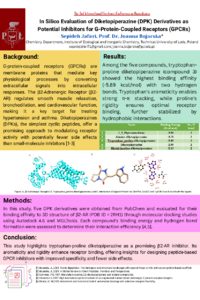
Background: G-protein-coupled receptors (GPCRs) are a diverse group of membrane proteins that mediate critical physiological processes by converting extracellular signals into intracellular responses. The β2-Adrenergic Receptor (β2-AR), a key GPCR, plays a pivotal role in smooth-muscle relaxation, bronchodilation, and cardiovascular function, making it a therapeutic target for conditions such hypertension or asthma. Diketopiperazines (DPKs), as the simplest cyclic peptides, have emerged as promising scaffolds for inhibiting protein interactions and modulating receptor activity, offering a novel, appealing therapeutic approach with potentially fewer side effects compared to small-molecule inhibitors.
Methods: In this study, five DPK derivatives were obtained from PubChem and evaluated for their binding affinity to 3D structure of β2-AR (PDB ID = 2RH1) through molecular docking studies using Autodock 4.6 and MGLTools. Each compound’s binding energy and hydrogen bond formation were assessed to determine their interaction efficiency.
Results: Among the five compounds, tryptophan–proline diketopiperazine (compound 3) exhibited the highest binding affinity with a binding energy of -5.89 kcal/mol and formed two hydrogen bonds. The enhanced interaction is attributed to the aromatic nature of tryptophan, which promotes strong π-π stacking interactions, and the rigidity of proline, which allows for optimal fitting within the receptor's binding pocket. The hydrophobic interactions further stabilized the complex.
Conclusion: This study highlights that diketopiperazine (DPK) derivatives, particularly tryptophan–proline diketopiperazine, are promising inhibitors of the β2-Adrenergic Receptor (β2-AR), a key G-protein-coupled receptor (GPCR). The compound’s aromaticity and rigidity enhance receptor interaction, providing insights into the design of peptide-based inhibitors for β2-AR and other GPCR-related diseases, with potential for improved specificity and fewer side effects.
Keywords
medicinal chemistry
cyclic dipeptides
cardiology
novel drugs
Poster
In Silico Evaluation of Diketopiperazine (DPK) Derivatives as Potential .pdf
Natural Inhibitors of the β2-Adrenergic Receptor: A Computational Study for Targeting GPCR-Mediated Diseases
Sepsis-Associated Aromatic Metabolites: Universal Markers of Bacterial Inflammation and Mortality in High-Risk Patients