Event submissions
Published
This submission belongs to the session S6. Diabetes, Obesity and Metabolic Diseases of the event The 3rd International Electronic Conference on Biomedicines
Published date
12 May, 2025
Academic Editor
'%3e%3cpath%20d='M12.6657%2010.9104C12.4185%2010.325%2012.0599%209.79327%2011.6097%209.34482C11.1609%208.89508%2010.6293%208.5365%2010.0442%208.28888C10.0389%208.28626%2010.0337%208.28495%2010.0285%208.28233C10.8446%207.69279%2011.3752%206.73249%2011.3752%205.64904C11.3752%203.8542%209.92103%202.39999%208.1262%202.39999C6.33136%202.39999%204.87715%203.8542%204.87715%205.64904C4.87715%206.73249%205.40774%207.69279%206.22393%208.28364C6.21869%208.28626%206.21345%208.28757%206.20821%208.29019C5.62129%208.5378%205.09463%208.89284%204.64265%209.34613C4.1929%209.79493%203.83432%2010.3266%203.58671%2010.9117C3.34345%2011.4845%203.21226%2012.0987%203.20023%2012.7209C3.19988%2012.7349%203.20233%2012.7488%203.20744%2012.7619C3.21255%2012.7749%203.22022%2012.7867%203.22998%2012.7968C3.23975%2012.8068%203.25142%2012.8147%203.26431%2012.8202C3.2772%2012.8256%203.29105%2012.8284%203.30504%2012.8284H4.09109C4.14874%2012.8284%204.19459%2012.7825%204.1959%2012.7262C4.2221%2011.7148%204.62823%2010.7676%205.34617%2010.0497C6.08899%209.30683%207.0755%208.89808%208.1262%208.89808C9.17689%208.89808%2010.1634%209.30683%2010.9062%2010.0497C11.6242%2010.7676%2012.0303%2011.7148%2012.0565%2012.7262C12.0578%2012.7838%2012.1037%2012.8284%2012.1613%2012.8284H12.9474C12.9613%2012.8284%2012.9752%2012.8256%2012.9881%2012.8202C13.001%2012.8147%2013.0126%2012.8068%2013.0224%2012.7968C13.0322%2012.7867%2013.0398%2012.7749%2013.0449%2012.7619C13.0501%2012.7488%2013.0525%2012.7349%2013.0522%2012.7209C13.0391%2012.0947%2012.9094%2011.4855%2012.6657%2010.9104ZM8.1262%207.9024C7.52486%207.9024%206.9589%207.6679%206.53312%207.24211C6.10733%206.81633%205.87283%206.25037%205.87283%205.64904C5.87283%205.0477%206.10733%204.48174%206.53312%204.05596C6.9589%203.63018%207.52486%203.39567%208.1262%203.39567C8.72753%203.39567%209.29349%203.63018%209.71927%204.05596C10.1451%204.48174%2010.3796%205.0477%2010.3796%205.64904C10.3796%206.25037%2010.1451%206.81633%209.71927%207.24211C9.29349%207.6679%208.72753%207.9024%208.1262%207.9024Z'%20fill='%235D1EE1'/%3e%3c/g%3e%3c/svg%3e) Serafino Fazio
Serafino FazioCitation
Celeste Moya-Valera, Alba Valverde-Porcar, Pedro Pons-Suñer, Francisco Lara-Hernandez, Maria Elena Quiroz-Rodriguez, Joaquim Arlandis, J.Ramón Navarro-Cerdán, Ana-Barbara Garcia-Garcia, Felipe Javier Chaves, Comprehensive Analysis of Genetic and Environmental Factors Influencing Type 2 Diabetes in the Spanish Population with NGS and the SEQENS Algorithm, in Proceedings of The 3rd International Electronic Conference on Biomedicines, 12 May–15 May 2025, MDPI: Basel, Switzerland
Share
Email
Facebook
Twitter
LinkedIn
Comprehensive Analysis of Genetic and Environmental Factors Influencing Type 2 Diabetes in the Spanish Population with NGS and the SEQENS Algorithm
'%3e%3cpath%20d='M12.6647%2010.9104C12.4176%2010.325%2012.0589%209.7933%2011.6088%209.34485C11.16%208.89511%2010.6283%208.53653%2010.0432%208.28891C10.038%208.28629%2010.0327%208.28498%2010.0275%208.28236C10.8437%207.69282%2011.3743%206.73252%2011.3743%205.64907C11.3743%203.85423%209.92005%202.40002%208.12522%202.40002C6.33038%202.40002%204.87618%203.85423%204.87618%205.64907C4.87618%206.73252%205.40677%207.69282%206.22296%208.28367C6.21772%208.28629%206.21248%208.2876%206.20724%208.29022C5.62031%208.53783%205.09365%208.89287%204.64167%209.34616C4.19192%209.79496%203.83334%2010.3266%203.58573%2010.9117C3.34247%2011.4846%203.21128%2012.0987%203.19925%2012.721C3.1989%2012.735%203.20135%2012.7489%203.20646%2012.7619C3.21157%2012.7749%203.21924%2012.7868%203.22901%2012.7968C3.23877%2012.8068%203.25045%2012.8148%203.26334%2012.8202C3.27623%2012.8256%203.29007%2012.8284%203.30406%2012.8284H4.09012C4.14776%2012.8284%204.19362%2012.7825%204.19493%2012.7262C4.22113%2011.7148%204.62726%2010.7676%205.34519%2010.0497C6.08802%209.30686%207.07452%208.89811%208.12522%208.89811C9.17592%208.89811%2010.1624%209.30686%2010.9052%2010.0497C11.6232%2010.7676%2012.0293%2011.7148%2012.0555%2012.7262C12.0568%2012.7839%2012.1027%2012.8284%2012.1603%2012.8284H12.9464C12.9604%2012.8284%2012.9742%2012.8256%2012.9871%2012.8202C13%2012.8148%2013.0117%2012.8068%2013.0214%2012.7968C13.0312%2012.7868%2013.0389%2012.7749%2013.044%2012.7619C13.0491%2012.7489%2013.0515%2012.735%2013.0512%2012.721C13.0381%2012.0947%2012.9084%2011.4856%2012.6647%2010.9104ZM8.12522%207.90243C7.52388%207.90243%206.95792%207.66793%206.53214%207.24215C6.10636%206.81636%205.87185%206.2504%205.87185%205.64907C5.87185%205.04773%206.10636%204.48177%206.53214%204.05599C6.95792%203.63021%207.52388%203.3957%208.12522%203.3957C8.72655%203.3957%209.29252%203.63021%209.7183%204.05599C10.1441%204.48177%2010.3786%205.04773%2010.3786%205.64907C10.3786%206.2504%2010.1441%206.81636%209.7183%207.24215C9.29252%207.66793%208.72655%207.90243%208.12522%207.90243Z'%20fill='%235D1EE1'/%3e%3c/g%3e%3c/svg%3e)
Celeste Moya-Valera 1
Alba Valverde-Porcar 2
Pedro Pons-Suñer 2
Francisco Lara-Hernandez 1
Maria Elena Quiroz-Rodriguez 1
Joaquim Arlandis 3
J.Ramón Navarro-Cerdán 3
Ana-Barbara Garcia-Garcia 1,4
Felipe Javier Chaves 1
1. Genomic and Diabetes Unit, INCLIVA Biomedical Research Institute, Valencia 46010, Spain
2. Instituto Tecnológico de Informática (ITI), Universitat Politècnica de
València, Camí de Vera, s/n, 46022 València, Spain
3. Instituto Tecnológico de Informática (ITI), Universitat Politècnica de València, Camí de Vera, s/n, 46022 València, Spain
4. CIBERDEM, ISCIII, Madrid, Spain
Abstract
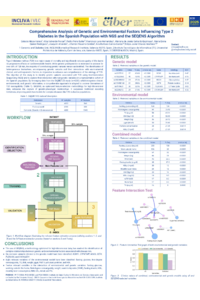
Type 2 diabetes mellitus (T2D) represents an indirect cause of mortality and a key factor in reduced quality of life due to its progressive impact on cardiometabolic health. Genetic predisposition is estimated to account for more than 50% of the risk of developing T2D, although most genetic variants remain unidentified. Identifying heterogeneous biomarkers, including genetic variants and their interaction with non-genetic factors, is crucial for advancing the understanding of T2D aetiology. This study aimed to identify genetic variants (SNPs) associated with T2D through Next-Generation Sequencing (NGS) and to investigate their interaction with environmental, clinical, and anthropometric factors in a cohort of the Spanish general population (DI@BET.ES dataset).
An exploratory analysis was conducted to evaluate the effect of prevalent genetic variants on T2D predisposition, as well as their interaction with environmental and clinical variables. To prioritize the identified variants, the SEQENS algorithm was employed to generate relevance rankings in stratified populations. Three different models were developed for the analysis: a genetic model, an environmental model, and a combined model. The performance of the prioritization models was evaluated using the concordance index of machine learning models predicting the risk of developing T2D as a function of age with the identified risk factors.
The combined model outperformed the individual models in variant prioritization and interaction analysis. The most relevant variables selected included fasting glucose, BMI, waist circumference, basal insulin, HDL and LDL cholesterol, triglycerides, consanguinity with first-degree relatives with T2D, body weight, WHR, monthly beer intake, nickel in particulate matter, and a specific genetic variant, rs78416608. This variant, located in the SCARA5 gene, is linked to immunity, apoptotic cell clearance, and lipid metabolism regulation, processes associated with T2D pathophysiology. These findings highlight the importance of an integrative approach to understanding T2D.
Keywords
Type 2 diabetes
NGS
genetic variant prioritisation
environmental factors
SEQENS
machine learning
Poster
ECB2025_eposter_MAY_2025_CMV.pdf
Deciphering Molecular Alterations of the Hippo Signaling Pathway in Thymic Epithelial Tumors Using Immunohistochemistry
Novel biomarkers for diagnosing prosthetic joint infection and chronic joint pain following total knee and hip arthroplasty: An exploratory study