Event submissions
Published
This submission belongs to the session S5. Novel Methods/Techniques for Coating Deposition and Characterization of the event 4th Coatings and Interfaces Online Conference
Published date
16 May, 2025
Academic Editor
'%3e%3cpath%20d='M12.6657%2010.9104C12.4185%2010.325%2012.0599%209.79327%2011.6097%209.34482C11.1609%208.89508%2010.6293%208.5365%2010.0442%208.28888C10.0389%208.28626%2010.0337%208.28495%2010.0285%208.28233C10.8446%207.69279%2011.3752%206.73249%2011.3752%205.64904C11.3752%203.8542%209.92103%202.39999%208.1262%202.39999C6.33136%202.39999%204.87715%203.8542%204.87715%205.64904C4.87715%206.73249%205.40774%207.69279%206.22393%208.28364C6.21869%208.28626%206.21345%208.28757%206.20821%208.29019C5.62129%208.5378%205.09463%208.89284%204.64265%209.34613C4.1929%209.79493%203.83432%2010.3266%203.58671%2010.9117C3.34345%2011.4845%203.21226%2012.0987%203.20023%2012.7209C3.19988%2012.7349%203.20233%2012.7488%203.20744%2012.7619C3.21255%2012.7749%203.22022%2012.7867%203.22998%2012.7968C3.23975%2012.8068%203.25142%2012.8147%203.26431%2012.8202C3.2772%2012.8256%203.29105%2012.8284%203.30504%2012.8284H4.09109C4.14874%2012.8284%204.19459%2012.7825%204.1959%2012.7262C4.2221%2011.7148%204.62823%2010.7676%205.34617%2010.0497C6.08899%209.30683%207.0755%208.89808%208.1262%208.89808C9.17689%208.89808%2010.1634%209.30683%2010.9062%2010.0497C11.6242%2010.7676%2012.0303%2011.7148%2012.0565%2012.7262C12.0578%2012.7838%2012.1037%2012.8284%2012.1613%2012.8284H12.9474C12.9613%2012.8284%2012.9752%2012.8256%2012.9881%2012.8202C13.001%2012.8147%2013.0126%2012.8068%2013.0224%2012.7968C13.0322%2012.7867%2013.0398%2012.7749%2013.0449%2012.7619C13.0501%2012.7488%2013.0525%2012.7349%2013.0522%2012.7209C13.0391%2012.0947%2012.9094%2011.4855%2012.6657%2010.9104ZM8.1262%207.9024C7.52486%207.9024%206.9589%207.6679%206.53312%207.24211C6.10733%206.81633%205.87283%206.25037%205.87283%205.64904C5.87283%205.0477%206.10733%204.48174%206.53312%204.05596C6.9589%203.63018%207.52486%203.39567%208.1262%203.39567C8.72753%203.39567%209.29349%203.63018%209.71927%204.05596C10.1451%204.48174%2010.3796%205.0477%2010.3796%205.64904C10.3796%206.25037%2010.1451%206.81633%209.71927%207.24211C9.29349%207.6679%208.72753%207.9024%208.1262%207.9024Z'%20fill='%235D1EE1'/%3e%3c/g%3e%3c/svg%3e) Heping Li
Heping LiCitation
Azizeh Rahmani Del Bakhshayesh, Maryam Ghahremani-nasab, Soraya Babaie, Mahdiyeh Rahmani Del Bakhshayesh, Revolutionizing Wound Healing: Integrating 4D Bioprinting with Adaptive Bioactive Coatings for Dynamic Tissue Regeneration, in Proceedings of 4th Coatings and Interfaces Online Conference, 21 May–23 May 2025, MDPI: Basel, Switzerland
Share
Email
Facebook
Twitter
LinkedIn
Revolutionizing Wound Healing: Integrating 4D Bioprinting with Adaptive Bioactive Coatings for Dynamic Tissue Regeneration
'%3e%3cpath%20d='M12.6647%2010.9104C12.4176%2010.325%2012.0589%209.7933%2011.6088%209.34485C11.16%208.89511%2010.6283%208.53653%2010.0432%208.28891C10.038%208.28629%2010.0327%208.28498%2010.0275%208.28236C10.8437%207.69282%2011.3743%206.73252%2011.3743%205.64907C11.3743%203.85423%209.92005%202.40002%208.12522%202.40002C6.33038%202.40002%204.87618%203.85423%204.87618%205.64907C4.87618%206.73252%205.40677%207.69282%206.22296%208.28367C6.21772%208.28629%206.21248%208.2876%206.20724%208.29022C5.62031%208.53783%205.09365%208.89287%204.64167%209.34616C4.19192%209.79496%203.83334%2010.3266%203.58573%2010.9117C3.34247%2011.4846%203.21128%2012.0987%203.19925%2012.721C3.1989%2012.735%203.20135%2012.7489%203.20646%2012.7619C3.21157%2012.7749%203.21924%2012.7868%203.22901%2012.7968C3.23877%2012.8068%203.25045%2012.8148%203.26334%2012.8202C3.27623%2012.8256%203.29007%2012.8284%203.30406%2012.8284H4.09012C4.14776%2012.8284%204.19362%2012.7825%204.19493%2012.7262C4.22113%2011.7148%204.62726%2010.7676%205.34519%2010.0497C6.08802%209.30686%207.07452%208.89811%208.12522%208.89811C9.17592%208.89811%2010.1624%209.30686%2010.9052%2010.0497C11.6232%2010.7676%2012.0293%2011.7148%2012.0555%2012.7262C12.0568%2012.7839%2012.1027%2012.8284%2012.1603%2012.8284H12.9464C12.9604%2012.8284%2012.9742%2012.8256%2012.9871%2012.8202C13%2012.8148%2013.0117%2012.8068%2013.0214%2012.7968C13.0312%2012.7868%2013.0389%2012.7749%2013.044%2012.7619C13.0491%2012.7489%2013.0515%2012.735%2013.0512%2012.721C13.0381%2012.0947%2012.9084%2011.4856%2012.6647%2010.9104ZM8.12522%207.90243C7.52388%207.90243%206.95792%207.66793%206.53214%207.24215C6.10636%206.81636%205.87185%206.2504%205.87185%205.64907C5.87185%205.04773%206.10636%204.48177%206.53214%204.05599C6.95792%203.63021%207.52388%203.3957%208.12522%203.3957C8.72655%203.3957%209.29252%203.63021%209.7183%204.05599C10.1441%204.48177%2010.3786%205.04773%2010.3786%205.64907C10.3786%206.2504%2010.1441%206.81636%209.7183%207.24215C9.29252%207.66793%208.72655%207.90243%208.12522%207.90243Z'%20fill='%235D1EE1'/%3e%3c/g%3e%3c/svg%3e)
Azizeh Rahmani Del Bakhshayesh 1
Maryam Ghahremani-nasab 1
Soraya Babaie 2
Mahdiyeh Rahmani Del Bakhshayesh 3
1. Department of Tissue Engineering, Faculty of Advanced Medical Sciences, Tabriz University of Medical Sciences, Tabriz, Iran
2. Physical Medicine and Rehabilitation Research Center, Aging Research Institute, Tabriz University of Medical Sciences, Tabriz, Iran
3. Al-Zahra Technical & Vocational College, Tabriz, Iran
Abstract
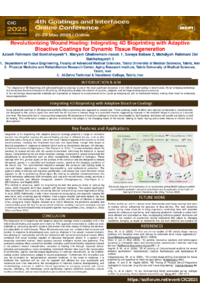
The field of wound healing has seen remarkable progress in recent years, and one of the most exciting innovations is the integration of 4D bioprinting with advanced coatings. 4D bioprinting, an emerging technology that adds the dimension of time to 3D printing, holds transformative potential in creating dynamic, adaptive, and self-regenerating tissue structures. This technology allows the fabrication of biocompatible materials that can respond to environmental stimuli, such as changes in temperature, pH, or mechanical forces, to enhance tissue regeneration.
By incorporating advanced coatings—composed of plant-based bioactive compounds (e.g., polyphenols) or nanomaterials (e.g., silver nanoparticles in hydrogels) and structured as thin, porous layers—into 4D-bioprinted scaffolds, we can create more effective, multifunctional systems for wound care. These coatings interact with the 4D structures by releasing therapeutic agents in response to the scaffolds’ shape or porosity changes over time, facilitating controlled delivery to the wound site. This approach’s novelty lies in the combination of time-responsive 4D-bioprinted structures with bioactive coatings that offer enhanced biocompatibility, antibacterial properties, and promote cellular activities necessary for wound closure, such as migration, proliferation, and extracellular matrix formation. Integrating such coatings with 4D-printed matrices creates dynamic wound-healing environments capable of responding to changes in the wound’s condition over time, optimizing healing and reducing the risk of chronic wounds.
This abstract discusses the potential of 4D bioprinting combined with advanced coatings to revolutionize wound healing by providing customized, adaptive solutions that address both immediate and long-term challenges in tissue regeneration. The proposed technology could significantly improve the efficacy and sustainability of wound care treatments, paving the way for more personalized, precision medicine approaches in the management of complex wounds.
Keywords
4D Bioprinting
Wound Healing
Adaptive Coatings
Bioactive Materials
Tissue Regeneration
Poster
sciforum-118014.pdf
Plasma-deposited polymer coatings for improved biocompatibility of titanium implants