Event submissions
Published
This submission belongs to the session S6. Protective Coatings in Cultural Heritage, Conservation and Preservation of the event 4th Coatings and Interfaces Online Conference
Published date
16 May, 2025
Academic Editor
'%3e%3cpath%20d='M12.6657%2010.9104C12.4185%2010.325%2012.0599%209.79327%2011.6097%209.34482C11.1609%208.89508%2010.6293%208.5365%2010.0442%208.28888C10.0389%208.28626%2010.0337%208.28495%2010.0285%208.28233C10.8446%207.69279%2011.3752%206.73249%2011.3752%205.64904C11.3752%203.8542%209.92103%202.39999%208.1262%202.39999C6.33136%202.39999%204.87715%203.8542%204.87715%205.64904C4.87715%206.73249%205.40774%207.69279%206.22393%208.28364C6.21869%208.28626%206.21345%208.28757%206.20821%208.29019C5.62129%208.5378%205.09463%208.89284%204.64265%209.34613C4.1929%209.79493%203.83432%2010.3266%203.58671%2010.9117C3.34345%2011.4845%203.21226%2012.0987%203.20023%2012.7209C3.19988%2012.7349%203.20233%2012.7488%203.20744%2012.7619C3.21255%2012.7749%203.22022%2012.7867%203.22998%2012.7968C3.23975%2012.8068%203.25142%2012.8147%203.26431%2012.8202C3.2772%2012.8256%203.29105%2012.8284%203.30504%2012.8284H4.09109C4.14874%2012.8284%204.19459%2012.7825%204.1959%2012.7262C4.2221%2011.7148%204.62823%2010.7676%205.34617%2010.0497C6.08899%209.30683%207.0755%208.89808%208.1262%208.89808C9.17689%208.89808%2010.1634%209.30683%2010.9062%2010.0497C11.6242%2010.7676%2012.0303%2011.7148%2012.0565%2012.7262C12.0578%2012.7838%2012.1037%2012.8284%2012.1613%2012.8284H12.9474C12.9613%2012.8284%2012.9752%2012.8256%2012.9881%2012.8202C13.001%2012.8147%2013.0126%2012.8068%2013.0224%2012.7968C13.0322%2012.7867%2013.0398%2012.7749%2013.0449%2012.7619C13.0501%2012.7488%2013.0525%2012.7349%2013.0522%2012.7209C13.0391%2012.0947%2012.9094%2011.4855%2012.6657%2010.9104ZM8.1262%207.9024C7.52486%207.9024%206.9589%207.6679%206.53312%207.24211C6.10733%206.81633%205.87283%206.25037%205.87283%205.64904C5.87283%205.0477%206.10733%204.48174%206.53312%204.05596C6.9589%203.63018%207.52486%203.39567%208.1262%203.39567C8.72753%203.39567%209.29349%203.63018%209.71927%204.05596C10.1451%204.48174%2010.3796%205.0477%2010.3796%205.64904C10.3796%206.25037%2010.1451%206.81633%209.71927%207.24211C9.29349%207.6679%208.72753%207.9024%208.1262%207.9024Z'%20fill='%235D1EE1'/%3e%3c/g%3e%3c/svg%3e) PELOSI CLAUDIA
PELOSI CLAUDIACitation
Kachana Kasulu, Anna Viktorovna Solovieva, Preservation of heritage through modern coatings: protection of historical structures and cultural artefacts, in Proceedings of 4th Coatings and Interfaces Online Conference, 21 May–23 May 2025, MDPI: Basel, Switzerland
Share
Email
Facebook
Twitter
LinkedIn
Preservation of heritage through modern coatings: protection of historical structures and cultural artefacts
'%3e%3cpath%20d='M12.6647%2010.9104C12.4176%2010.325%2012.0589%209.7933%2011.6088%209.34485C11.16%208.89511%2010.6283%208.53653%2010.0432%208.28891C10.038%208.28629%2010.0327%208.28498%2010.0275%208.28236C10.8437%207.69282%2011.3743%206.73252%2011.3743%205.64907C11.3743%203.85423%209.92005%202.40002%208.12522%202.40002C6.33038%202.40002%204.87618%203.85423%204.87618%205.64907C4.87618%206.73252%205.40677%207.69282%206.22296%208.28367C6.21772%208.28629%206.21248%208.2876%206.20724%208.29022C5.62031%208.53783%205.09365%208.89287%204.64167%209.34616C4.19192%209.79496%203.83334%2010.3266%203.58573%2010.9117C3.34247%2011.4846%203.21128%2012.0987%203.19925%2012.721C3.1989%2012.735%203.20135%2012.7489%203.20646%2012.7619C3.21157%2012.7749%203.21924%2012.7868%203.22901%2012.7968C3.23877%2012.8068%203.25045%2012.8148%203.26334%2012.8202C3.27623%2012.8256%203.29007%2012.8284%203.30406%2012.8284H4.09012C4.14776%2012.8284%204.19362%2012.7825%204.19493%2012.7262C4.22113%2011.7148%204.62726%2010.7676%205.34519%2010.0497C6.08802%209.30686%207.07452%208.89811%208.12522%208.89811C9.17592%208.89811%2010.1624%209.30686%2010.9052%2010.0497C11.6232%2010.7676%2012.0293%2011.7148%2012.0555%2012.7262C12.0568%2012.7839%2012.1027%2012.8284%2012.1603%2012.8284H12.9464C12.9604%2012.8284%2012.9742%2012.8256%2012.9871%2012.8202C13%2012.8148%2013.0117%2012.8068%2013.0214%2012.7968C13.0312%2012.7868%2013.0389%2012.7749%2013.044%2012.7619C13.0491%2012.7489%2013.0515%2012.735%2013.0512%2012.721C13.0381%2012.0947%2012.9084%2011.4856%2012.6647%2010.9104ZM8.12522%207.90243C7.52388%207.90243%206.95792%207.66793%206.53214%207.24215C6.10636%206.81636%205.87185%206.2504%205.87185%205.64907C5.87185%205.04773%206.10636%204.48177%206.53214%204.05599C6.95792%203.63021%207.52388%203.3957%208.12522%203.3957C8.72655%203.3957%209.29252%203.63021%209.7183%204.05599C10.1441%204.48177%2010.3786%205.04773%2010.3786%205.64907C10.3786%206.2504%2010.1441%206.81636%209.7183%207.24215C9.29252%207.66793%208.72655%207.90243%208.12522%207.90243Z'%20fill='%235D1EE1'/%3e%3c/g%3e%3c/svg%3e)
Kachana Kasulu 1
Anna Viktorovna Solovieva 1
1. Department of Architecture, Restoration and Design, Engineering Academy, Peoples Friendship University Of Russia, Moscow, Russia
Abstract
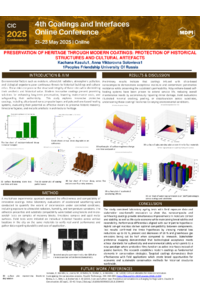
Introduction. Environmental factors such as moisture, ultraviolet radiation, atmospheric pollution, and biological organisms pose continuous threats to historical buildings and cultural relics. These risks compromise the structural integrity of these sites while diminishing their aesthetic and historical value. Modern innovative coatings present promising solutions for enhancing long-term preservation, lowering maintenance costs, and safeguarding their authenticity. This study explores innovative protective coatings, including silica-based nanocomposite layers and polyurethane-based healing systems, evaluating their potential as effective means to preserve historic masonry, limestone façades, and metallic artefacts in architectural heritage.
Method. A multiphase experimental approach assessed the effectiveness and compatibility of innovative coatings. Initial laboratory evaluations of accelerated weathering were conducted to quantify the extent of deterioration under controlled conditions, including exposure to ultraviolet radiation, humidity, and temperature variations. The adhesion properties and substrate compatibility were tested using tensile and micro-scratch tests on samples of masonry blocks, limestone samples and aged metal surfaces. Field tests were initiated on individual historical facades across various locations in the city on the same materials to verify real-world performance and gather data regarding durability and ease of application.
Results. Preliminary results indicate that coatings infused with silica-based nanocomposite demonstrate exceptional moisture and contaminant penetration resistance while preserving the substrate's permeability. Polyurethane-based self-healing systems have been proven to extend service life, reducing overall maintenance needs by autonomously repairing minor damage. Field evaluations illustrated minimal cracking, peeling, or discolouration across substrates, underscoring these coatings' resilience to varying environmental conditions.
Conclusions. This study confirms the viability of modern coatings as essential components of conservation initiatives. With targeted formulations and successful field application, these coatings offer broad prospects for sustainable and economical preservation of historically and culturally significant structures.
Keywords
Heritage Preservation
Protective Coatings
Nanocomposite Materials
Self-healing Systems
Environmental Degradation
Cultural Preservation
Historical Structures.
Poster
Kasulu - Artifacts.pdf
The Development of Extreme Wettability Coatings to Combat the Spread of Bacterial Infections and their Testing in Hospital Conditions
Electrochemical water splitting over heterostructure of titania nanotubes and Ni encapsulated within MXenes