Event submissions
Published
This submission belongs to the session S5. Novel Methods/Techniques for Coating Deposition and Characterization of the event 4th Coatings and Interfaces Online Conference
Published date
16 May, 2025
Academic Editor
'%3e%3cpath%20d='M12.6657%2010.9104C12.4185%2010.325%2012.0599%209.79327%2011.6097%209.34482C11.1609%208.89508%2010.6293%208.5365%2010.0442%208.28888C10.0389%208.28626%2010.0337%208.28495%2010.0285%208.28233C10.8446%207.69279%2011.3752%206.73249%2011.3752%205.64904C11.3752%203.8542%209.92103%202.39999%208.1262%202.39999C6.33136%202.39999%204.87715%203.8542%204.87715%205.64904C4.87715%206.73249%205.40774%207.69279%206.22393%208.28364C6.21869%208.28626%206.21345%208.28757%206.20821%208.29019C5.62129%208.5378%205.09463%208.89284%204.64265%209.34613C4.1929%209.79493%203.83432%2010.3266%203.58671%2010.9117C3.34345%2011.4845%203.21226%2012.0987%203.20023%2012.7209C3.19988%2012.7349%203.20233%2012.7488%203.20744%2012.7619C3.21255%2012.7749%203.22022%2012.7867%203.22998%2012.7968C3.23975%2012.8068%203.25142%2012.8147%203.26431%2012.8202C3.2772%2012.8256%203.29105%2012.8284%203.30504%2012.8284H4.09109C4.14874%2012.8284%204.19459%2012.7825%204.1959%2012.7262C4.2221%2011.7148%204.62823%2010.7676%205.34617%2010.0497C6.08899%209.30683%207.0755%208.89808%208.1262%208.89808C9.17689%208.89808%2010.1634%209.30683%2010.9062%2010.0497C11.6242%2010.7676%2012.0303%2011.7148%2012.0565%2012.7262C12.0578%2012.7838%2012.1037%2012.8284%2012.1613%2012.8284H12.9474C12.9613%2012.8284%2012.9752%2012.8256%2012.9881%2012.8202C13.001%2012.8147%2013.0126%2012.8068%2013.0224%2012.7968C13.0322%2012.7867%2013.0398%2012.7749%2013.0449%2012.7619C13.0501%2012.7488%2013.0525%2012.7349%2013.0522%2012.7209C13.0391%2012.0947%2012.9094%2011.4855%2012.6657%2010.9104ZM8.1262%207.9024C7.52486%207.9024%206.9589%207.6679%206.53312%207.24211C6.10733%206.81633%205.87283%206.25037%205.87283%205.64904C5.87283%205.0477%206.10733%204.48174%206.53312%204.05596C6.9589%203.63018%207.52486%203.39567%208.1262%203.39567C8.72753%203.39567%209.29349%203.63018%209.71927%204.05596C10.1451%204.48174%2010.3796%205.0477%2010.3796%205.64904C10.3796%206.25037%2010.1451%206.81633%209.71927%207.24211C9.29349%207.6679%208.72753%207.9024%208.1262%207.9024Z'%20fill='%235D1EE1'/%3e%3c/g%3e%3c/svg%3e) Heping Li
Heping LiCitation
Marinela Victoria DUMITRU, Ana Mihaela GAVRILA, Ana Lorena NEAGU (CIURLICA), Andreea MIRON, Iulia Elena NEBLEA, Sorin Viorel DOLANA, Anamaria ZAHARIA, Anita Laura CHIRIAC, Andrei SARBU, Tanta Verona IORDACHE, Teodor SANDU, Composite membranes based on chitosan coated with organosilane by sol–gel, in Proceedings of 4th Coatings and Interfaces Online Conference, 21 May–23 May 2025, MDPI: Basel, Switzerland
Share
Email
Facebook
Twitter
LinkedIn
Composite membranes based on chitosan coated with organosilane by sol–gel
'%3e%3cpath%20d='M12.6647%2010.9104C12.4176%2010.325%2012.0589%209.7933%2011.6088%209.34485C11.16%208.89511%2010.6283%208.53653%2010.0432%208.28891C10.038%208.28629%2010.0327%208.28498%2010.0275%208.28236C10.8437%207.69282%2011.3743%206.73252%2011.3743%205.64907C11.3743%203.85423%209.92005%202.40002%208.12522%202.40002C6.33038%202.40002%204.87618%203.85423%204.87618%205.64907C4.87618%206.73252%205.40677%207.69282%206.22296%208.28367C6.21772%208.28629%206.21248%208.2876%206.20724%208.29022C5.62031%208.53783%205.09365%208.89287%204.64167%209.34616C4.19192%209.79496%203.83334%2010.3266%203.58573%2010.9117C3.34247%2011.4846%203.21128%2012.0987%203.19925%2012.721C3.1989%2012.735%203.20135%2012.7489%203.20646%2012.7619C3.21157%2012.7749%203.21924%2012.7868%203.22901%2012.7968C3.23877%2012.8068%203.25045%2012.8148%203.26334%2012.8202C3.27623%2012.8256%203.29007%2012.8284%203.30406%2012.8284H4.09012C4.14776%2012.8284%204.19362%2012.7825%204.19493%2012.7262C4.22113%2011.7148%204.62726%2010.7676%205.34519%2010.0497C6.08802%209.30686%207.07452%208.89811%208.12522%208.89811C9.17592%208.89811%2010.1624%209.30686%2010.9052%2010.0497C11.6232%2010.7676%2012.0293%2011.7148%2012.0555%2012.7262C12.0568%2012.7839%2012.1027%2012.8284%2012.1603%2012.8284H12.9464C12.9604%2012.8284%2012.9742%2012.8256%2012.9871%2012.8202C13%2012.8148%2013.0117%2012.8068%2013.0214%2012.7968C13.0312%2012.7868%2013.0389%2012.7749%2013.044%2012.7619C13.0491%2012.7489%2013.0515%2012.735%2013.0512%2012.721C13.0381%2012.0947%2012.9084%2011.4856%2012.6647%2010.9104ZM8.12522%207.90243C7.52388%207.90243%206.95792%207.66793%206.53214%207.24215C6.10636%206.81636%205.87185%206.2504%205.87185%205.64907C5.87185%205.04773%206.10636%204.48177%206.53214%204.05599C6.95792%203.63021%207.52388%203.3957%208.12522%203.3957C8.72655%203.3957%209.29252%203.63021%209.7183%204.05599C10.1441%204.48177%2010.3786%205.04773%2010.3786%205.64907C10.3786%206.2504%2010.1441%206.81636%209.7183%207.24215C9.29252%207.66793%208.72655%207.90243%208.12522%207.90243Z'%20fill='%235D1EE1'/%3e%3c/g%3e%3c/svg%3e)
Marinela Victoria DUMITRU 1

Ana Mihaela GAVRILA 1
Ana Lorena NEAGU (CIURLICA) 1
Andreea MIRON 1
Iulia Elena NEBLEA 1
Sorin Viorel DOLANA 1

Anamaria ZAHARIA 1

Anita Laura CHIRIAC 1

Andrei SARBU 1

Tanta Verona IORDACHE 1
Teodor SANDU 1
1. INCDCP-ICECHIM Bucharest, 202 Spl. Independentei, 6th district, Romania
Abstract
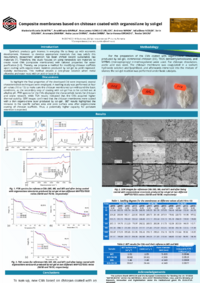
Synthetic products are becoming more popular in daily life as economic development levels rise. However, to create appropriate materials that may satisfy this need, researchers have been forced to concentrate on sustainable raw materials [1]. Therefore, this study focuses on the use of renewable raw materials to create novel CMs (composite membranes) with tailored properties for water purification [2-3]. Thereby, we propose a method for the modification of chitosan scaffolds by sol–gel, which can improve the stability of membranes. This method creates a one-phase solution when metal alkoxides and water react with an acid or base [4-5]. For the preparation of the CM coated with sol–gel, commercial chitosan (CC), TEOS (tetraethylortosilicate), and MPTMS (mercaptopropyl trimethoxysilane) were used. For chitosan dissolution, acetic acid was used. The chitosan membrane was coagulated in a sodium hydroxide solution and lyophilized, after which it was immersed into the mixture of silanes; the sol–gel reaction was performed in basic catalysis. A swelling study was performed at four values of pH (10 until 13) to determine if the chitosan membranes can withstand the basic conditions employed for the secondary step of coating by sol–gel. With the aim of highlighting the improvement inproperties for the CM, several characterization techniques were emplyed. FTIR spectra of the CMs confirmed the characteristic bands for chitosan and silane network, while TGA indicated that the CMs acquired higher thermal stability. SEM images confirmed that the chitosan membranes were coated with a thin sol–gel layer, and BET results highlighted the increase in the specific surface area and pore surface area after sol–gel coating of chitosan scaffolds; this indicates a potentially higher capacity for pollutant retention. New CMs based on chitosan coated with an organosilane layer, deposited by sol-gel, were developed. These materials show promising properties in terms of stability and capacity for pollutant adsorption, making them potential candidates for water purification.
Keywords
chitosan
membranes
sol-gel
organosilane
scaffolds
Poster
sciforum-112668.pdf
Electrochemical water splitting over heterostructure of titania nanotubes and Ni encapsulated within MXenes
High-Performance Bi-Layer TiO2 Structures in DSSC Application