Event submissions
Published
This submission belongs to the session S5. Novel Methods/Techniques for Coating Deposition and Characterization of the event 4th Coatings and Interfaces Online Conference
Published date
16 May, 2025
Academic Editor
'%3e%3cpath%20d='M12.6657%2010.9104C12.4185%2010.325%2012.0599%209.79327%2011.6097%209.34482C11.1609%208.89508%2010.6293%208.5365%2010.0442%208.28888C10.0389%208.28626%2010.0337%208.28495%2010.0285%208.28233C10.8446%207.69279%2011.3752%206.73249%2011.3752%205.64904C11.3752%203.8542%209.92103%202.39999%208.1262%202.39999C6.33136%202.39999%204.87715%203.8542%204.87715%205.64904C4.87715%206.73249%205.40774%207.69279%206.22393%208.28364C6.21869%208.28626%206.21345%208.28757%206.20821%208.29019C5.62129%208.5378%205.09463%208.89284%204.64265%209.34613C4.1929%209.79493%203.83432%2010.3266%203.58671%2010.9117C3.34345%2011.4845%203.21226%2012.0987%203.20023%2012.7209C3.19988%2012.7349%203.20233%2012.7488%203.20744%2012.7619C3.21255%2012.7749%203.22022%2012.7867%203.22998%2012.7968C3.23975%2012.8068%203.25142%2012.8147%203.26431%2012.8202C3.2772%2012.8256%203.29105%2012.8284%203.30504%2012.8284H4.09109C4.14874%2012.8284%204.19459%2012.7825%204.1959%2012.7262C4.2221%2011.7148%204.62823%2010.7676%205.34617%2010.0497C6.08899%209.30683%207.0755%208.89808%208.1262%208.89808C9.17689%208.89808%2010.1634%209.30683%2010.9062%2010.0497C11.6242%2010.7676%2012.0303%2011.7148%2012.0565%2012.7262C12.0578%2012.7838%2012.1037%2012.8284%2012.1613%2012.8284H12.9474C12.9613%2012.8284%2012.9752%2012.8256%2012.9881%2012.8202C13.001%2012.8147%2013.0126%2012.8068%2013.0224%2012.7968C13.0322%2012.7867%2013.0398%2012.7749%2013.0449%2012.7619C13.0501%2012.7488%2013.0525%2012.7349%2013.0522%2012.7209C13.0391%2012.0947%2012.9094%2011.4855%2012.6657%2010.9104ZM8.1262%207.9024C7.52486%207.9024%206.9589%207.6679%206.53312%207.24211C6.10733%206.81633%205.87283%206.25037%205.87283%205.64904C5.87283%205.0477%206.10733%204.48174%206.53312%204.05596C6.9589%203.63018%207.52486%203.39567%208.1262%203.39567C8.72753%203.39567%209.29349%203.63018%209.71927%204.05596C10.1451%204.48174%2010.3796%205.0477%2010.3796%205.64904C10.3796%206.25037%2010.1451%206.81633%209.71927%207.24211C9.29349%207.6679%208.72753%207.9024%208.1262%207.9024Z'%20fill='%235D1EE1'/%3e%3c/g%3e%3c/svg%3e) Heping Li
Heping LiCitation
Kerolina Sonowal, Partha Protim Borthakur, Recent Advances in Tool Coatings and Materials for Superior Performance in Machining Nickel-Based Alloys, in Proceedings of 4th Coatings and Interfaces Online Conference, 21 May–23 May 2025, MDPI: Basel, Switzerland
Share
Email
Facebook
Twitter
LinkedIn
Recent Advances in Tool Coatings and Materials for Superior Performance in Machining Nickel-Based Alloys
'%3e%3cpath%20d='M12.6647%2010.9104C12.4176%2010.325%2012.0589%209.7933%2011.6088%209.34485C11.16%208.89511%2010.6283%208.53653%2010.0432%208.28891C10.038%208.28629%2010.0327%208.28498%2010.0275%208.28236C10.8437%207.69282%2011.3743%206.73252%2011.3743%205.64907C11.3743%203.85423%209.92005%202.40002%208.12522%202.40002C6.33038%202.40002%204.87618%203.85423%204.87618%205.64907C4.87618%206.73252%205.40677%207.69282%206.22296%208.28367C6.21772%208.28629%206.21248%208.2876%206.20724%208.29022C5.62031%208.53783%205.09365%208.89287%204.64167%209.34616C4.19192%209.79496%203.83334%2010.3266%203.58573%2010.9117C3.34247%2011.4846%203.21128%2012.0987%203.19925%2012.721C3.1989%2012.735%203.20135%2012.7489%203.20646%2012.7619C3.21157%2012.7749%203.21924%2012.7868%203.22901%2012.7968C3.23877%2012.8068%203.25045%2012.8148%203.26334%2012.8202C3.27623%2012.8256%203.29007%2012.8284%203.30406%2012.8284H4.09012C4.14776%2012.8284%204.19362%2012.7825%204.19493%2012.7262C4.22113%2011.7148%204.62726%2010.7676%205.34519%2010.0497C6.08802%209.30686%207.07452%208.89811%208.12522%208.89811C9.17592%208.89811%2010.1624%209.30686%2010.9052%2010.0497C11.6232%2010.7676%2012.0293%2011.7148%2012.0555%2012.7262C12.0568%2012.7839%2012.1027%2012.8284%2012.1603%2012.8284H12.9464C12.9604%2012.8284%2012.9742%2012.8256%2012.9871%2012.8202C13%2012.8148%2013.0117%2012.8068%2013.0214%2012.7968C13.0312%2012.7868%2013.0389%2012.7749%2013.044%2012.7619C13.0491%2012.7489%2013.0515%2012.735%2013.0512%2012.721C13.0381%2012.0947%2012.9084%2011.4856%2012.6647%2010.9104ZM8.12522%207.90243C7.52388%207.90243%206.95792%207.66793%206.53214%207.24215C6.10636%206.81636%205.87185%206.2504%205.87185%205.64907C5.87185%205.04773%206.10636%204.48177%206.53214%204.05599C6.95792%203.63021%207.52388%203.3957%208.12522%203.3957C8.72655%203.3957%209.29252%203.63021%209.7183%204.05599C10.1441%204.48177%2010.3786%205.04773%2010.3786%205.64907C10.3786%206.2504%2010.1441%206.81636%209.7183%207.24215C9.29252%207.66793%208.72655%207.90243%208.12522%207.90243Z'%20fill='%235D1EE1'/%3e%3c/g%3e%3c/svg%3e)
Kerolina Sonowal 1

Partha Protim Borthakur 1
1. Department of Mechanical Engineering, Dibrugarh University, Assam 786004, India
Abstract
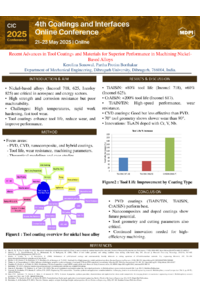
Nickel-based alloys, including Inconel 718 and alloy 625, are indispensable in industries such as aerospace, marine, and nuclear energy due to their exceptional mechanical strength, high-temperature performance, and corrosion resistance. Despite their advantages, these alloys present significant challenges during machining owing to their hardness, and low thermal conductivity. To address these issues, advancements in tool coatings and materials have become critical, driving innovation in machining technologies. Coatings such as Titanium Aluminum Nitride (TiAlN) and Titanium Silicon Nitride (TiSiN) are recognized for their high thermal stability, hardness, and oxidation resistance, making them ideal for high-speed and elevated-temperature machining. Nano-Composite Coating (nACo) provides enhanced wear resistance, while Titanium Nitride (TiN) and Titanium Carbonitride (TiCN) offer anti-friction properties and toughness, respectively. Aluminum Oxide (Al₂O₃) delivers superior thermal stability and resistance to abrasive wear. Advanced solutions include multilayer coatings like TiAlN/TiN, which combine thermal resistance and toughness, and doped Ti₃AlN coatings enhanced with chromium or vanadium to improve hardness and machining efficiency. Tool materials have also seen significant advancements. Cemented carbides remain widely used due to their balance of hardness and toughness, while ceramic tools offer exceptional thermal stability for high-speed operations. Polycrystalline Cubic Boron Nitride (PCBN) excels in machining hardened alloys, and Polycrystalline Diamond (PCD) extends tool life significantly, particularly in milling applications. Nanoscale structured tools, often combined with optimized coatings, provide enhanced cutting efficiency. Tool wear caused by the hardness and work-hardening nature of nickel-based alloys necessitates robust coatings like TiAlN and multilayer systems to maintain thermal and mechanical stability. The integration of innovative coatings and tool materials has significantly improved the machinability of nickel-based alloys. Technologies such as TiAlN, TiSiN, and advanced multilayer systems, coupled with cutting-edge materials like PCD, continue to enhance wear resistance, reduce cutting forces, and ensure superior surface integrity.
Keywords
Nickel-based alloys
Tool coatings
Titanium Aluminum Nitride (TiAlN)
Polycrystalline Diamond (PCD)
Multilayer coatings.
Poster
sciforum-113929.pdf
Surface preparation of carbonaceous films to increase wettability and integration with nanoparticles for electrochemical applications
Analytical spectroscopic characterization of green chitosan/copper nanocomposites for food packaging applications