Event submissions
Published
This submission belongs to the session S5. Novel Methods/Techniques for Coating Deposition and Characterization of the event 4th Coatings and Interfaces Online Conference
Published date
16 May, 2025
Academic Editor
'%3e%3cpath%20d='M12.6657%2010.9104C12.4185%2010.325%2012.0599%209.79327%2011.6097%209.34482C11.1609%208.89508%2010.6293%208.5365%2010.0442%208.28888C10.0389%208.28626%2010.0337%208.28495%2010.0285%208.28233C10.8446%207.69279%2011.3752%206.73249%2011.3752%205.64904C11.3752%203.8542%209.92103%202.39999%208.1262%202.39999C6.33136%202.39999%204.87715%203.8542%204.87715%205.64904C4.87715%206.73249%205.40774%207.69279%206.22393%208.28364C6.21869%208.28626%206.21345%208.28757%206.20821%208.29019C5.62129%208.5378%205.09463%208.89284%204.64265%209.34613C4.1929%209.79493%203.83432%2010.3266%203.58671%2010.9117C3.34345%2011.4845%203.21226%2012.0987%203.20023%2012.7209C3.19988%2012.7349%203.20233%2012.7488%203.20744%2012.7619C3.21255%2012.7749%203.22022%2012.7867%203.22998%2012.7968C3.23975%2012.8068%203.25142%2012.8147%203.26431%2012.8202C3.2772%2012.8256%203.29105%2012.8284%203.30504%2012.8284H4.09109C4.14874%2012.8284%204.19459%2012.7825%204.1959%2012.7262C4.2221%2011.7148%204.62823%2010.7676%205.34617%2010.0497C6.08899%209.30683%207.0755%208.89808%208.1262%208.89808C9.17689%208.89808%2010.1634%209.30683%2010.9062%2010.0497C11.6242%2010.7676%2012.0303%2011.7148%2012.0565%2012.7262C12.0578%2012.7838%2012.1037%2012.8284%2012.1613%2012.8284H12.9474C12.9613%2012.8284%2012.9752%2012.8256%2012.9881%2012.8202C13.001%2012.8147%2013.0126%2012.8068%2013.0224%2012.7968C13.0322%2012.7867%2013.0398%2012.7749%2013.0449%2012.7619C13.0501%2012.7488%2013.0525%2012.7349%2013.0522%2012.7209C13.0391%2012.0947%2012.9094%2011.4855%2012.6657%2010.9104ZM8.1262%207.9024C7.52486%207.9024%206.9589%207.6679%206.53312%207.24211C6.10733%206.81633%205.87283%206.25037%205.87283%205.64904C5.87283%205.0477%206.10733%204.48174%206.53312%204.05596C6.9589%203.63018%207.52486%203.39567%208.1262%203.39567C8.72753%203.39567%209.29349%203.63018%209.71927%204.05596C10.1451%204.48174%2010.3796%205.0477%2010.3796%205.64904C10.3796%206.25037%2010.1451%206.81633%209.71927%207.24211C9.29349%207.6679%208.72753%207.9024%208.1262%207.9024Z'%20fill='%235D1EE1'/%3e%3c/g%3e%3c/svg%3e) Heping Li
Heping LiCitation
Danilo d'Agostino, Luigi Gentile, Margherita Izzi, Simona Marianna Sanzani, Ornella Incerti, Nicola Cioffi, Maria Chiara Sportelli, Analytical spectroscopic characterization of green chitosan/copper nanocomposites for food packaging applications, in Proceedings of 4th Coatings and Interfaces Online Conference, 21 May–23 May 2025, MDPI: Basel, Switzerland
Share
Email
Facebook
Twitter
LinkedIn
Analytical spectroscopic characterization of green chitosan/copper nanocomposites for food packaging applications
'%3e%3cpath%20d='M12.6647%2010.9104C12.4176%2010.325%2012.0589%209.7933%2011.6088%209.34485C11.16%208.89511%2010.6283%208.53653%2010.0432%208.28891C10.038%208.28629%2010.0327%208.28498%2010.0275%208.28236C10.8437%207.69282%2011.3743%206.73252%2011.3743%205.64907C11.3743%203.85423%209.92005%202.40002%208.12522%202.40002C6.33038%202.40002%204.87618%203.85423%204.87618%205.64907C4.87618%206.73252%205.40677%207.69282%206.22296%208.28367C6.21772%208.28629%206.21248%208.2876%206.20724%208.29022C5.62031%208.53783%205.09365%208.89287%204.64167%209.34616C4.19192%209.79496%203.83334%2010.3266%203.58573%2010.9117C3.34247%2011.4846%203.21128%2012.0987%203.19925%2012.721C3.1989%2012.735%203.20135%2012.7489%203.20646%2012.7619C3.21157%2012.7749%203.21924%2012.7868%203.22901%2012.7968C3.23877%2012.8068%203.25045%2012.8148%203.26334%2012.8202C3.27623%2012.8256%203.29007%2012.8284%203.30406%2012.8284H4.09012C4.14776%2012.8284%204.19362%2012.7825%204.19493%2012.7262C4.22113%2011.7148%204.62726%2010.7676%205.34519%2010.0497C6.08802%209.30686%207.07452%208.89811%208.12522%208.89811C9.17592%208.89811%2010.1624%209.30686%2010.9052%2010.0497C11.6232%2010.7676%2012.0293%2011.7148%2012.0555%2012.7262C12.0568%2012.7839%2012.1027%2012.8284%2012.1603%2012.8284H12.9464C12.9604%2012.8284%2012.9742%2012.8256%2012.9871%2012.8202C13%2012.8148%2013.0117%2012.8068%2013.0214%2012.7968C13.0312%2012.7868%2013.0389%2012.7749%2013.044%2012.7619C13.0491%2012.7489%2013.0515%2012.735%2013.0512%2012.721C13.0381%2012.0947%2012.9084%2011.4856%2012.6647%2010.9104ZM8.12522%207.90243C7.52388%207.90243%206.95792%207.66793%206.53214%207.24215C6.10636%206.81636%205.87185%206.2504%205.87185%205.64907C5.87185%205.04773%206.10636%204.48177%206.53214%204.05599C6.95792%203.63021%207.52388%203.3957%208.12522%203.3957C8.72655%203.3957%209.29252%203.63021%209.7183%204.05599C10.1441%204.48177%2010.3786%205.04773%2010.3786%205.64907C10.3786%206.2504%2010.1441%206.81636%209.7183%207.24215C9.29252%207.66793%208.72655%207.90243%208.12522%207.90243Z'%20fill='%235D1EE1'/%3e%3c/g%3e%3c/svg%3e)
Danilo d'Agostino 1,2
Luigi Gentile 1,2

Margherita Izzi 1,2
Simona Marianna Sanzani 3
Ornella Incerti 3

Nicola Cioffi 1,2

Maria Chiara Sportelli 1,2
1. Department of Chemistry, University of Bari Aldo Moro, via E. Orabona 4, 70126 - Bari, Italy
2. Bari Unit of CSGI consortium, University of Bari Aldo Moro, via E. Orabona, 4, 70126 - Bari, Italy
3. Department of Soil, Plant and Food Sciences, University of Bari Aldo Moro, via Amendola 165/A, 70126 - Bari, Italy
Abstract
INTRODUCTION
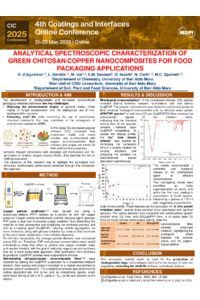
Reducing agrifood waste has become an important goal, considering that up to 50% of total production is lost due to contamination by harmful microorganisms. In this context, controlling the interface between food products and the external environment can be a powerful tool to prevent waste. The aim of this study was to produce a bio-based and biodegradable food packaging material loaded with copper particles, which act as a reservoir of cupric ions.
METHODS
A green one-pot approach was used to synthesize copper particles using poly(N-vinylpyrrolidone) (PVP) as a capping agent (Cu@PVP), preventing aggregation through steric hindrance and eliminating the need for an inert atmosphere. The influence of PVP and reductant concentrations, as well as reaction time, on the oxidation state of copper phase, synthesis kinetics, and particle size was investigated by varying each of these parameters individually. Optimal conditions were identified to obtain an average particle diameter above 200 nm, while minimizing reagent and time consumption, to prevent nano-cytotoxicity effects. After a purification step, the Cu@PVP particles were suspended in ethanol and embedded in a chitosan (CS) polymeric matrix.
RESULTS
Composite films were obtained by solvent casting. The polymer solution concentration was adjusted to maintain good rheological properties even in the presence of inorganic particles. Torsional rheology and water uptake measurements were performed to assess the mechanical behavior of the self-standing films obtained after solvent evaporation. The antimicrobial capabilities were demonstrated by ionic Cu2+ release kinetics, and in vitro by growth inhibition of three different model fungi responsible for agrifood spoilage.
CONCLUSIONS
This innovative material could be used for the production of biodegradable bags and envelopes destined for the storage of fruits and vegetables, extending the shelf-life of these horticultural products.
Keywords
Thin film
Food packaging
Chitosan
Copper particles
Agrifood spoilage
Poster
sciforum-114080.pdf
Recent Advances in Tool Coatings and Materials for Superior Performance in Machining Nickel-Based Alloys
Monitoring the evolution of optical coatings during thermal annealing with in situ spectroscopic ellipsometry