Event submissions
Published
This submission belongs to the session S5. Novel Methods/Techniques for Coating Deposition and Characterization of the event 4th Coatings and Interfaces Online Conference
Published date
16 May, 2025
Academic Editor
'%3e%3cpath%20d='M12.6657%2010.9104C12.4185%2010.325%2012.0599%209.79327%2011.6097%209.34482C11.1609%208.89508%2010.6293%208.5365%2010.0442%208.28888C10.0389%208.28626%2010.0337%208.28495%2010.0285%208.28233C10.8446%207.69279%2011.3752%206.73249%2011.3752%205.64904C11.3752%203.8542%209.92103%202.39999%208.1262%202.39999C6.33136%202.39999%204.87715%203.8542%204.87715%205.64904C4.87715%206.73249%205.40774%207.69279%206.22393%208.28364C6.21869%208.28626%206.21345%208.28757%206.20821%208.29019C5.62129%208.5378%205.09463%208.89284%204.64265%209.34613C4.1929%209.79493%203.83432%2010.3266%203.58671%2010.9117C3.34345%2011.4845%203.21226%2012.0987%203.20023%2012.7209C3.19988%2012.7349%203.20233%2012.7488%203.20744%2012.7619C3.21255%2012.7749%203.22022%2012.7867%203.22998%2012.7968C3.23975%2012.8068%203.25142%2012.8147%203.26431%2012.8202C3.2772%2012.8256%203.29105%2012.8284%203.30504%2012.8284H4.09109C4.14874%2012.8284%204.19459%2012.7825%204.1959%2012.7262C4.2221%2011.7148%204.62823%2010.7676%205.34617%2010.0497C6.08899%209.30683%207.0755%208.89808%208.1262%208.89808C9.17689%208.89808%2010.1634%209.30683%2010.9062%2010.0497C11.6242%2010.7676%2012.0303%2011.7148%2012.0565%2012.7262C12.0578%2012.7838%2012.1037%2012.8284%2012.1613%2012.8284H12.9474C12.9613%2012.8284%2012.9752%2012.8256%2012.9881%2012.8202C13.001%2012.8147%2013.0126%2012.8068%2013.0224%2012.7968C13.0322%2012.7867%2013.0398%2012.7749%2013.0449%2012.7619C13.0501%2012.7488%2013.0525%2012.7349%2013.0522%2012.7209C13.0391%2012.0947%2012.9094%2011.4855%2012.6657%2010.9104ZM8.1262%207.9024C7.52486%207.9024%206.9589%207.6679%206.53312%207.24211C6.10733%206.81633%205.87283%206.25037%205.87283%205.64904C5.87283%205.0477%206.10733%204.48174%206.53312%204.05596C6.9589%203.63018%207.52486%203.39567%208.1262%203.39567C8.72753%203.39567%209.29349%203.63018%209.71927%204.05596C10.1451%204.48174%2010.3796%205.0477%2010.3796%205.64904C10.3796%206.25037%2010.1451%206.81633%209.71927%207.24211C9.29349%207.6679%208.72753%207.9024%208.1262%207.9024Z'%20fill='%235D1EE1'/%3e%3c/g%3e%3c/svg%3e) Heping Li
Heping LiCitation
José Monteiro, Nathalia Hammes, Iran Rocha Segundo, Helena Prado Felgueiras, Maria Manuela Silva, Manuel Filipe Costa, Joaquim Carneiro, Optical and thermal behavior of Phase-Change Fibers for enhancing thermal comfort, in Proceedings of 4th Coatings and Interfaces Online Conference, 21 May–23 May 2025, MDPI: Basel, Switzerland
Share
Email
Facebook
Twitter
LinkedIn
Optical and thermal behavior of Phase-Change Fibers for enhancing thermal comfort
'%3e%3cpath%20d='M12.6647%2010.9104C12.4176%2010.325%2012.0589%209.7933%2011.6088%209.34485C11.16%208.89511%2010.6283%208.53653%2010.0432%208.28891C10.038%208.28629%2010.0327%208.28498%2010.0275%208.28236C10.8437%207.69282%2011.3743%206.73252%2011.3743%205.64907C11.3743%203.85423%209.92005%202.40002%208.12522%202.40002C6.33038%202.40002%204.87618%203.85423%204.87618%205.64907C4.87618%206.73252%205.40677%207.69282%206.22296%208.28367C6.21772%208.28629%206.21248%208.2876%206.20724%208.29022C5.62031%208.53783%205.09365%208.89287%204.64167%209.34616C4.19192%209.79496%203.83334%2010.3266%203.58573%2010.9117C3.34247%2011.4846%203.21128%2012.0987%203.19925%2012.721C3.1989%2012.735%203.20135%2012.7489%203.20646%2012.7619C3.21157%2012.7749%203.21924%2012.7868%203.22901%2012.7968C3.23877%2012.8068%203.25045%2012.8148%203.26334%2012.8202C3.27623%2012.8256%203.29007%2012.8284%203.30406%2012.8284H4.09012C4.14776%2012.8284%204.19362%2012.7825%204.19493%2012.7262C4.22113%2011.7148%204.62726%2010.7676%205.34519%2010.0497C6.08802%209.30686%207.07452%208.89811%208.12522%208.89811C9.17592%208.89811%2010.1624%209.30686%2010.9052%2010.0497C11.6232%2010.7676%2012.0293%2011.7148%2012.0555%2012.7262C12.0568%2012.7839%2012.1027%2012.8284%2012.1603%2012.8284H12.9464C12.9604%2012.8284%2012.9742%2012.8256%2012.9871%2012.8202C13%2012.8148%2013.0117%2012.8068%2013.0214%2012.7968C13.0312%2012.7868%2013.0389%2012.7749%2013.044%2012.7619C13.0491%2012.7489%2013.0515%2012.735%2013.0512%2012.721C13.0381%2012.0947%2012.9084%2011.4856%2012.6647%2010.9104ZM8.12522%207.90243C7.52388%207.90243%206.95792%207.66793%206.53214%207.24215C6.10636%206.81636%205.87185%206.2504%205.87185%205.64907C5.87185%205.04773%206.10636%204.48177%206.53214%204.05599C6.95792%203.63021%207.52388%203.3957%208.12522%203.3957C8.72655%203.3957%209.29252%203.63021%209.7183%204.05599C10.1441%204.48177%2010.3786%205.04773%2010.3786%205.64907C10.3786%206.2504%2010.1441%206.81636%209.7183%207.24215C9.29252%207.66793%208.72655%207.90243%208.12522%207.90243Z'%20fill='%235D1EE1'/%3e%3c/g%3e%3c/svg%3e)
José Monteiro 1
Nathalia Hammes 2,3

Iran Rocha Segundo 2

Helena Prado Felgueiras 3

Maria Manuela Silva 4

Manuel Filipe Costa 5

Joaquim Carneiro 2
1. Earth Sciences Department of the University of Minho, Gualtar Campus, University of Minho, R. da Universidade, 4710-057 Braga, Portugal
2. Centre of Physics of Minho and Porto Universities (CF-UM-UP), Azurém Campus, University of Minho, Av. da Universidade, 4800-058 Guimarães, Portugal
3. Centre for Textile Science and Technology (2C2T-UMinho), Azurém Campus, University of Minho, Av. da Universidade, 4800-058 Guimarães, Portugal
4. Centre of Chemistry of University of Minho (CQ-UMinho), Gualtar Campus, University of Minho, R. da Universidade, 4710-057 Braga, Portugal
5. Centre of Physics of Minho and Porto Universities (CF-UM-UP), Gualtar Campus, University of Minho, R. da Universidade, 4710-057 Braga, Portugal
Abstract
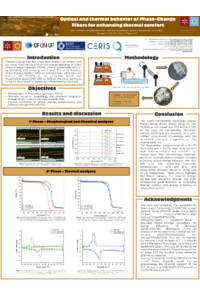
Over the years, climate change has been intensifying global temperature fluctuations, bringing significant heatwaves to certain parts of the planet and vastly contributing to the Urban Heat Island (UHI) effect, while other parts of the world have experienced extreme cold spells. These global changes have impacted cities, leading to significant thermal discomfort and rising energy demands in heating and cooling. Developing sustainable solutions for these rising challenges has become crucial for enhancing urban living conditions and achieving good energy efficiency while keeping the population comfortable. One of the most promising solutions that has arisen in the last couple of years has been the incorporation of Phase-Change Materials (PCMs) into Civil Engineering materials. These materials can be encapsulated into Phase-Change Fibers (PCFs), which represent a novel technology in the literature. These PCFs utilize the latent heat principle, absorbing or releasing energy during phase transitions to maintain a stable temperature. In this context, this study produced PCFs via wet-spinning with commercial Cellulose Acetate (Mn 30,000) and polyethylene glycol (PEG 400 and 600). The fibers’ structures were optically evaluated using Bright-Field microscopy and Attenuated Total Reflectance–Fourier Transform Infrared Spectroscopy (ATR-FTIR). The first test confirmed the PCFs' coaxial morphology and the proper PEG encapsulation within the CA sheath. Through ATR-FTIR, it was possible to confirm the key functional groups of the virgin materials and their successful integration during the production of the fibers. Thermal testing was conducted through Differential Scanning Calorimetry (DSC) and Thermogravimetric Analysis (TGA). PCFs incorporating PEG 400 and PEG 600 demonstrated phase-change temperatures of around -4 °C and 12 °C and an enthalpy of 26 J/g and 29J/g, respectively, showing great potential applications for different climates. The degradation temperatures were 234 °C and 300 °C, ensuring their resilience for integration into construction materials such as cementitious materials.
Keywords
Thermal Comfort
Phase Change Fibers
Wet-Spinning
Cool Building Materials
Optical Characterization
Poster
Poster_2025_Coatings_JM_CORRIGIDO_2formatado.pdf
Monitoring the evolution of optical coatings during thermal annealing with in situ spectroscopic ellipsometry
ALUMINUM-BASED ELECTROSPARK ALLOYED COATINGS