Event submissions
Published
This submission belongs to the session S8. Artificial Intelligence Strategies to Tackle Antibiotic Resistance of the event The 4th International Electronic Conference on Antibiotics
Published date
16 May, 2025
Academic Editor
'%3e%3cpath%20d='M12.6657%2010.9104C12.4185%2010.325%2012.0599%209.79327%2011.6097%209.34482C11.1609%208.89508%2010.6293%208.5365%2010.0442%208.28888C10.0389%208.28626%2010.0337%208.28495%2010.0285%208.28233C10.8446%207.69279%2011.3752%206.73249%2011.3752%205.64904C11.3752%203.8542%209.92103%202.39999%208.1262%202.39999C6.33136%202.39999%204.87715%203.8542%204.87715%205.64904C4.87715%206.73249%205.40774%207.69279%206.22393%208.28364C6.21869%208.28626%206.21345%208.28757%206.20821%208.29019C5.62129%208.5378%205.09463%208.89284%204.64265%209.34613C4.1929%209.79493%203.83432%2010.3266%203.58671%2010.9117C3.34345%2011.4845%203.21226%2012.0987%203.20023%2012.7209C3.19988%2012.7349%203.20233%2012.7488%203.20744%2012.7619C3.21255%2012.7749%203.22022%2012.7867%203.22998%2012.7968C3.23975%2012.8068%203.25142%2012.8147%203.26431%2012.8202C3.2772%2012.8256%203.29105%2012.8284%203.30504%2012.8284H4.09109C4.14874%2012.8284%204.19459%2012.7825%204.1959%2012.7262C4.2221%2011.7148%204.62823%2010.7676%205.34617%2010.0497C6.08899%209.30683%207.0755%208.89808%208.1262%208.89808C9.17689%208.89808%2010.1634%209.30683%2010.9062%2010.0497C11.6242%2010.7676%2012.0303%2011.7148%2012.0565%2012.7262C12.0578%2012.7838%2012.1037%2012.8284%2012.1613%2012.8284H12.9474C12.9613%2012.8284%2012.9752%2012.8256%2012.9881%2012.8202C13.001%2012.8147%2013.0126%2012.8068%2013.0224%2012.7968C13.0322%2012.7867%2013.0398%2012.7749%2013.0449%2012.7619C13.0501%2012.7488%2013.0525%2012.7349%2013.0522%2012.7209C13.0391%2012.0947%2012.9094%2011.4855%2012.6657%2010.9104ZM8.1262%207.9024C7.52486%207.9024%206.9589%207.6679%206.53312%207.24211C6.10733%206.81633%205.87283%206.25037%205.87283%205.64904C5.87283%205.0477%206.10733%204.48174%206.53312%204.05596C6.9589%203.63018%207.52486%203.39567%208.1262%203.39567C8.72753%203.39567%209.29349%203.63018%209.71927%204.05596C10.1451%204.48174%2010.3796%205.0477%2010.3796%205.64904C10.3796%206.25037%2010.1451%206.81633%209.71927%207.24211C9.29349%207.6679%208.72753%207.9024%208.1262%207.9024Z'%20fill='%235D1EE1'/%3e%3c/g%3e%3c/svg%3e) Manuel Simões
Manuel SimõesCitation
Alexis Reinbold, Octávio L Franco, Fabiano C. Fernandes, Olga Iranzo, Marc Maresca, Use of Rational Design and Artificial Intelligence to Improve the Therapeutic Potential of Antimicrobial Peptides, in Proceedings of The 4th International Electronic Conference on Antibiotics, 21 May–23 May 2025, MDPI: Basel, Switzerland
Share
Email
Facebook
Twitter
LinkedIn
Use of Rational Design and Artificial Intelligence to Improve the Therapeutic Potential of Antimicrobial Peptides
'%3e%3cpath%20d='M12.6647%2010.9104C12.4176%2010.325%2012.0589%209.7933%2011.6088%209.34485C11.16%208.89511%2010.6283%208.53653%2010.0432%208.28891C10.038%208.28629%2010.0327%208.28498%2010.0275%208.28236C10.8437%207.69282%2011.3743%206.73252%2011.3743%205.64907C11.3743%203.85423%209.92005%202.40002%208.12522%202.40002C6.33038%202.40002%204.87618%203.85423%204.87618%205.64907C4.87618%206.73252%205.40677%207.69282%206.22296%208.28367C6.21772%208.28629%206.21248%208.2876%206.20724%208.29022C5.62031%208.53783%205.09365%208.89287%204.64167%209.34616C4.19192%209.79496%203.83334%2010.3266%203.58573%2010.9117C3.34247%2011.4846%203.21128%2012.0987%203.19925%2012.721C3.1989%2012.735%203.20135%2012.7489%203.20646%2012.7619C3.21157%2012.7749%203.21924%2012.7868%203.22901%2012.7968C3.23877%2012.8068%203.25045%2012.8148%203.26334%2012.8202C3.27623%2012.8256%203.29007%2012.8284%203.30406%2012.8284H4.09012C4.14776%2012.8284%204.19362%2012.7825%204.19493%2012.7262C4.22113%2011.7148%204.62726%2010.7676%205.34519%2010.0497C6.08802%209.30686%207.07452%208.89811%208.12522%208.89811C9.17592%208.89811%2010.1624%209.30686%2010.9052%2010.0497C11.6232%2010.7676%2012.0293%2011.7148%2012.0555%2012.7262C12.0568%2012.7839%2012.1027%2012.8284%2012.1603%2012.8284H12.9464C12.9604%2012.8284%2012.9742%2012.8256%2012.9871%2012.8202C13%2012.8148%2013.0117%2012.8068%2013.0214%2012.7968C13.0312%2012.7868%2013.0389%2012.7749%2013.044%2012.7619C13.0491%2012.7489%2013.0515%2012.735%2013.0512%2012.721C13.0381%2012.0947%2012.9084%2011.4856%2012.6647%2010.9104ZM8.12522%207.90243C7.52388%207.90243%206.95792%207.66793%206.53214%207.24215C6.10636%206.81636%205.87185%206.2504%205.87185%205.64907C5.87185%205.04773%206.10636%204.48177%206.53214%204.05599C6.95792%203.63021%207.52388%203.3957%208.12522%203.3957C8.72655%203.3957%209.29252%203.63021%209.7183%204.05599C10.1441%204.48177%2010.3786%205.04773%2010.3786%205.64907C10.3786%206.2504%2010.1441%206.81636%209.7183%207.24215C9.29252%207.66793%208.72655%207.90243%208.12522%207.90243Z'%20fill='%235D1EE1'/%3e%3c/g%3e%3c/svg%3e)
Alexis Reinbold 1
Octávio L Franco 2
Fabiano C. Fernandes 3
Olga Iranzo 1

Marc Maresca 1
1. Aix Marseille Univ, CNRS, Centrale Med, ISM2, Marseille, France
2. Universidade Católica Dom Bosco (UCDB) Catholic University of Brasília, Brazil
3. Departamento de Ciência da Computação, Instituto Federal de Brasília, Campus Taguatinga, Brasília, Brazil
Abstract
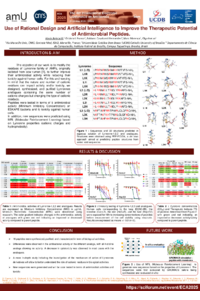
Antimicrobial peptides (AMPs) have emerged as promising alternatives to conventional antibiotics, addressing the growing concern of antibiotic resistance. Their efficacy primarily relies on two key properties: amphiphilicity and cationic charge, which promote targeted action on bacterial membranes. The Lynronne family, identified in the bovine rumen through metagenomic screening, already exhibits notable antimicrobial activity and low toxicity, making it a strong candidate for further development [1]. Our goal is to enhance the therapeutic potential of these AMPs using conventional and innovative strategies. Traditional approaches include substitutions with cationic amino acids and D/L enantiomeric modifications.
In parallel, we employed artificial intelligence techniques using the MRL (Molecular Reinforcement Learning) model for AMP design, based on the biophysical properties of the Lynronne family (cationic charge, hydrophobicity). The activity and toxicity of the designed peptides were first evaluated in silico using various prediction tools (MIC predictors and toxicity/hemolysis predictor). Their antimicrobial activity against diverse pathogens and their cytotoxicity on human cells were then measured, allowing comparison between predicted and measured activities. Their mechanism of action was studied via biophysical techniques, membrane permeabilization assays, and molecular dynamics simulations (GROMACS), confirming specific interactions with bacterial membranes and membranolytic effects. This study highlights how combining rational design strategies and AI can optimize Lynronne peptides, reinforcing their potential as alternatives to conventional antibiotics.
Keywords
Artificial Intelligence (AI) in AMP Design
Molecular Dynamics Simulations
Rational Design of AMPs
Antibiotic Alternatives
Poster
Poster Econf Alexis Reinbold.pdf
Antibacterial Activity of Detarium Senegalense Stem Bark Against Selected Pathogenic Bacteria