Event submissions
Published
This submission belongs to the session S2. Laser-Coating Technology: Deposition, Structuring and Cladding of the event 4th Coatings and Interfaces Online Conference
Published date
16 May, 2025
Academic Editor
'%3e%3cpath%20d='M12.6657%2010.9104C12.4185%2010.325%2012.0599%209.79327%2011.6097%209.34482C11.1609%208.89508%2010.6293%208.5365%2010.0442%208.28888C10.0389%208.28626%2010.0337%208.28495%2010.0285%208.28233C10.8446%207.69279%2011.3752%206.73249%2011.3752%205.64904C11.3752%203.8542%209.92103%202.39999%208.1262%202.39999C6.33136%202.39999%204.87715%203.8542%204.87715%205.64904C4.87715%206.73249%205.40774%207.69279%206.22393%208.28364C6.21869%208.28626%206.21345%208.28757%206.20821%208.29019C5.62129%208.5378%205.09463%208.89284%204.64265%209.34613C4.1929%209.79493%203.83432%2010.3266%203.58671%2010.9117C3.34345%2011.4845%203.21226%2012.0987%203.20023%2012.7209C3.19988%2012.7349%203.20233%2012.7488%203.20744%2012.7619C3.21255%2012.7749%203.22022%2012.7867%203.22998%2012.7968C3.23975%2012.8068%203.25142%2012.8147%203.26431%2012.8202C3.2772%2012.8256%203.29105%2012.8284%203.30504%2012.8284H4.09109C4.14874%2012.8284%204.19459%2012.7825%204.1959%2012.7262C4.2221%2011.7148%204.62823%2010.7676%205.34617%2010.0497C6.08899%209.30683%207.0755%208.89808%208.1262%208.89808C9.17689%208.89808%2010.1634%209.30683%2010.9062%2010.0497C11.6242%2010.7676%2012.0303%2011.7148%2012.0565%2012.7262C12.0578%2012.7838%2012.1037%2012.8284%2012.1613%2012.8284H12.9474C12.9613%2012.8284%2012.9752%2012.8256%2012.9881%2012.8202C13.001%2012.8147%2013.0126%2012.8068%2013.0224%2012.7968C13.0322%2012.7867%2013.0398%2012.7749%2013.0449%2012.7619C13.0501%2012.7488%2013.0525%2012.7349%2013.0522%2012.7209C13.0391%2012.0947%2012.9094%2011.4855%2012.6657%2010.9104ZM8.1262%207.9024C7.52486%207.9024%206.9589%207.6679%206.53312%207.24211C6.10733%206.81633%205.87283%206.25037%205.87283%205.64904C5.87283%205.0477%206.10733%204.48174%206.53312%204.05596C6.9589%203.63018%207.52486%203.39567%208.1262%203.39567C8.72753%203.39567%209.29349%203.63018%209.71927%204.05596C10.1451%204.48174%2010.3796%205.0477%2010.3796%205.64904C10.3796%206.25037%2010.1451%206.81633%209.71927%207.24211C9.29349%207.6679%208.72753%207.9024%208.1262%207.9024Z'%20fill='%235D1EE1'/%3e%3c/g%3e%3c/svg%3e) Rafael Comesaña
Rafael ComesañaCitation
Nina Kovač, Matic Može, Barbara Kapun, Iztok Golobič, Ingrid Milošev, Peter Rodič, Superhydrophobic Aluminium Surface Obtained via Laser Structuring and Stearic Acid Grafting with Corrosion Protection and Anti-Icing Abilities, in Proceedings of 4th Coatings and Interfaces Online Conference, 21 May–23 May 2025, MDPI: Basel, Switzerland
Share
Email
Facebook
Twitter
LinkedIn
Superhydrophobic Aluminium Surface Obtained via Laser Structuring and Stearic Acid Grafting with Corrosion Protection and Anti-Icing Abilities
'%3e%3cpath%20d='M12.6647%2010.9104C12.4176%2010.325%2012.0589%209.7933%2011.6088%209.34485C11.16%208.89511%2010.6283%208.53653%2010.0432%208.28891C10.038%208.28629%2010.0327%208.28498%2010.0275%208.28236C10.8437%207.69282%2011.3743%206.73252%2011.3743%205.64907C11.3743%203.85423%209.92005%202.40002%208.12522%202.40002C6.33038%202.40002%204.87618%203.85423%204.87618%205.64907C4.87618%206.73252%205.40677%207.69282%206.22296%208.28367C6.21772%208.28629%206.21248%208.2876%206.20724%208.29022C5.62031%208.53783%205.09365%208.89287%204.64167%209.34616C4.19192%209.79496%203.83334%2010.3266%203.58573%2010.9117C3.34247%2011.4846%203.21128%2012.0987%203.19925%2012.721C3.1989%2012.735%203.20135%2012.7489%203.20646%2012.7619C3.21157%2012.7749%203.21924%2012.7868%203.22901%2012.7968C3.23877%2012.8068%203.25045%2012.8148%203.26334%2012.8202C3.27623%2012.8256%203.29007%2012.8284%203.30406%2012.8284H4.09012C4.14776%2012.8284%204.19362%2012.7825%204.19493%2012.7262C4.22113%2011.7148%204.62726%2010.7676%205.34519%2010.0497C6.08802%209.30686%207.07452%208.89811%208.12522%208.89811C9.17592%208.89811%2010.1624%209.30686%2010.9052%2010.0497C11.6232%2010.7676%2012.0293%2011.7148%2012.0555%2012.7262C12.0568%2012.7839%2012.1027%2012.8284%2012.1603%2012.8284H12.9464C12.9604%2012.8284%2012.9742%2012.8256%2012.9871%2012.8202C13%2012.8148%2013.0117%2012.8068%2013.0214%2012.7968C13.0312%2012.7868%2013.0389%2012.7749%2013.044%2012.7619C13.0491%2012.7489%2013.0515%2012.735%2013.0512%2012.721C13.0381%2012.0947%2012.9084%2011.4856%2012.6647%2010.9104ZM8.12522%207.90243C7.52388%207.90243%206.95792%207.66793%206.53214%207.24215C6.10636%206.81636%205.87185%206.2504%205.87185%205.64907C5.87185%205.04773%206.10636%204.48177%206.53214%204.05599C6.95792%203.63021%207.52388%203.3957%208.12522%203.3957C8.72655%203.3957%209.29252%203.63021%209.7183%204.05599C10.1441%204.48177%2010.3786%205.04773%2010.3786%205.64907C10.3786%206.2504%2010.1441%206.81636%209.7183%207.24215C9.29252%207.66793%208.72655%207.90243%208.12522%207.90243Z'%20fill='%235D1EE1'/%3e%3c/g%3e%3c/svg%3e)
Nina Kovač 1,2

Matic Može 3
Barbara Kapun 1

Iztok Golobič 3

Ingrid Milošev 1
Peter Rodič 1
1. Jožef Stefan Institute, Department of Physical and Organic Chemistry, Jamova c. 39, 1000 Ljubljana, Slovenia
2. Jožef Stefan International Postgraduate School, 1000 Ljubljana, Jamova c. 39, Slovenia
3. University of Ljubljana, Faculty of Mechanical Engineering, Aškerčeva c. 6, 1000 Ljubljana, Slovenia
Abstract
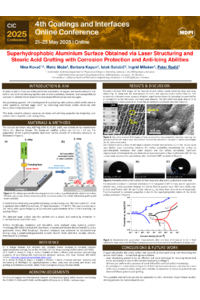
Aluminium and its alloys are widely used in the automotive, aerospace, and marine industries due to their excellent mechanical properties and corrosion resistance. However, their susceptibility to corrosion in chloride-rich environments necessitates effective protection strategies. One promising approach is the development of superhydrophobic surfaces, which exhibit extreme water repellency (contact angle >150°) by combining hierarchical surface structures with low-surface-energy materials.[1,2]
This study aimed to enhance corrosion resistance and anti-icing properties by integrating laser surface structuring with stearic acid grafting. Different laser structuring parameters (selected scanning line spacings) were explored to optimize surface roughness before applying a stearic acid coating. Surface morphology, wettability, and roughness were analyzed using scanning electron microscopy, a contact profilometer, and a goniometer. Corrosion resistance was evaluated via electrochemical testing in 0.1 M NaCl, while the anti-icing effect and droplet-bouncing behaviour were assessed.
Results demonstrated that the optimal laser parameter (scanning line spacing) combined with stearic acid grafting significantly improved corrosion resistance and water repellency. This method offers a cost-effective, scalable approach for enhancing aluminium surfaces, making it suitable for applications requiring improved durability and anti-icing performance.
References:
[1] A. Bahgat Radwan, A.M. Abdullah, N.A. Alnuaimi, Recent advances in corrosion resistant superhydrophobic coatings, Corros. Rev. 36 (2018) 127–153. https://doi.org/10.1515/corrrev-2017-0012.
[2] P. Rodič, N. Kovač, S. Kralj, S. Jereb, I. Golobič, M. Može, I. Milošev, Anti-corrosion and anti-icing properties of superhydrophobic laser-textured aluminum surfaces, Surf. Coat. Technol. 494 (2024) 131325. https://doi.org/10.1016/j.surfcoat.2024.131325
Acknowledgements: The financial support from the Slovenian Research and Innovation Agency (ARIS) research core funding No. P2-0393, P1-0134, and P2-0223, and through the ARIS project, L2-60141, is acknowledged.
Keywords
Laser structuring
superhydrophobicity
aluminium
corrosion resistance
anti-icing
Poster
sciforum-117374.pdf
Deposition, processing and functionalization of vertical graphene nanowalls and their application on energy harvesting and storage
Illuminating Surfaces: Emerging Trends in Laser Surface Texturing Applications