Event submissions
Published
This submission belongs to the session S2. Laser-Coating Technology: Deposition, Structuring and Cladding of the event 4th Coatings and Interfaces Online Conference
Published date
16 May, 2025
Academic Editor
'%3e%3cpath%20d='M12.6657%2010.9104C12.4185%2010.325%2012.0599%209.79327%2011.6097%209.34482C11.1609%208.89508%2010.6293%208.5365%2010.0442%208.28888C10.0389%208.28626%2010.0337%208.28495%2010.0285%208.28233C10.8446%207.69279%2011.3752%206.73249%2011.3752%205.64904C11.3752%203.8542%209.92103%202.39999%208.1262%202.39999C6.33136%202.39999%204.87715%203.8542%204.87715%205.64904C4.87715%206.73249%205.40774%207.69279%206.22393%208.28364C6.21869%208.28626%206.21345%208.28757%206.20821%208.29019C5.62129%208.5378%205.09463%208.89284%204.64265%209.34613C4.1929%209.79493%203.83432%2010.3266%203.58671%2010.9117C3.34345%2011.4845%203.21226%2012.0987%203.20023%2012.7209C3.19988%2012.7349%203.20233%2012.7488%203.20744%2012.7619C3.21255%2012.7749%203.22022%2012.7867%203.22998%2012.7968C3.23975%2012.8068%203.25142%2012.8147%203.26431%2012.8202C3.2772%2012.8256%203.29105%2012.8284%203.30504%2012.8284H4.09109C4.14874%2012.8284%204.19459%2012.7825%204.1959%2012.7262C4.2221%2011.7148%204.62823%2010.7676%205.34617%2010.0497C6.08899%209.30683%207.0755%208.89808%208.1262%208.89808C9.17689%208.89808%2010.1634%209.30683%2010.9062%2010.0497C11.6242%2010.7676%2012.0303%2011.7148%2012.0565%2012.7262C12.0578%2012.7838%2012.1037%2012.8284%2012.1613%2012.8284H12.9474C12.9613%2012.8284%2012.9752%2012.8256%2012.9881%2012.8202C13.001%2012.8147%2013.0126%2012.8068%2013.0224%2012.7968C13.0322%2012.7867%2013.0398%2012.7749%2013.0449%2012.7619C13.0501%2012.7488%2013.0525%2012.7349%2013.0522%2012.7209C13.0391%2012.0947%2012.9094%2011.4855%2012.6657%2010.9104ZM8.1262%207.9024C7.52486%207.9024%206.9589%207.6679%206.53312%207.24211C6.10733%206.81633%205.87283%206.25037%205.87283%205.64904C5.87283%205.0477%206.10733%204.48174%206.53312%204.05596C6.9589%203.63018%207.52486%203.39567%208.1262%203.39567C8.72753%203.39567%209.29349%203.63018%209.71927%204.05596C10.1451%204.48174%2010.3796%205.0477%2010.3796%205.64904C10.3796%206.25037%2010.1451%206.81633%209.71927%207.24211C9.29349%207.6679%208.72753%207.9024%208.1262%207.9024Z'%20fill='%235D1EE1'/%3e%3c/g%3e%3c/svg%3e) Rafael Comesaña
Rafael ComesañaCitation
Niclas Hanisch, Philipp Steinert, Thomas Lindner, Hendrik Liborius, Andreas Schubert, Thomas Lampke, Considering Scaling Aspects in Interface Design for Adhesion-Promoting Laser Structures in Polymer–Metal Hybrids, in Proceedings of 4th Coatings and Interfaces Online Conference, 21 May–23 May 2025, MDPI: Basel, Switzerland
Share
Email
Facebook
Twitter
LinkedIn
Considering Scaling Aspects in Interface Design for Adhesion-Promoting Laser Structures in Polymer–Metal Hybrids
'%3e%3cpath%20d='M12.6647%2010.9104C12.4176%2010.325%2012.0589%209.7933%2011.6088%209.34485C11.16%208.89511%2010.6283%208.53653%2010.0432%208.28891C10.038%208.28629%2010.0327%208.28498%2010.0275%208.28236C10.8437%207.69282%2011.3743%206.73252%2011.3743%205.64907C11.3743%203.85423%209.92005%202.40002%208.12522%202.40002C6.33038%202.40002%204.87618%203.85423%204.87618%205.64907C4.87618%206.73252%205.40677%207.69282%206.22296%208.28367C6.21772%208.28629%206.21248%208.2876%206.20724%208.29022C5.62031%208.53783%205.09365%208.89287%204.64167%209.34616C4.19192%209.79496%203.83334%2010.3266%203.58573%2010.9117C3.34247%2011.4846%203.21128%2012.0987%203.19925%2012.721C3.1989%2012.735%203.20135%2012.7489%203.20646%2012.7619C3.21157%2012.7749%203.21924%2012.7868%203.22901%2012.7968C3.23877%2012.8068%203.25045%2012.8148%203.26334%2012.8202C3.27623%2012.8256%203.29007%2012.8284%203.30406%2012.8284H4.09012C4.14776%2012.8284%204.19362%2012.7825%204.19493%2012.7262C4.22113%2011.7148%204.62726%2010.7676%205.34519%2010.0497C6.08802%209.30686%207.07452%208.89811%208.12522%208.89811C9.17592%208.89811%2010.1624%209.30686%2010.9052%2010.0497C11.6232%2010.7676%2012.0293%2011.7148%2012.0555%2012.7262C12.0568%2012.7839%2012.1027%2012.8284%2012.1603%2012.8284H12.9464C12.9604%2012.8284%2012.9742%2012.8256%2012.9871%2012.8202C13%2012.8148%2013.0117%2012.8068%2013.0214%2012.7968C13.0312%2012.7868%2013.0389%2012.7749%2013.044%2012.7619C13.0491%2012.7489%2013.0515%2012.735%2013.0512%2012.721C13.0381%2012.0947%2012.9084%2011.4856%2012.6647%2010.9104ZM8.12522%207.90243C7.52388%207.90243%206.95792%207.66793%206.53214%207.24215C6.10636%206.81636%205.87185%206.2504%205.87185%205.64907C5.87185%205.04773%206.10636%204.48177%206.53214%204.05599C6.95792%203.63021%207.52388%203.3957%208.12522%203.3957C8.72655%203.3957%209.29252%203.63021%209.7183%204.05599C10.1441%204.48177%2010.3786%205.04773%2010.3786%205.64907C10.3786%206.2504%2010.1441%206.81636%209.7183%207.24215C9.29252%207.66793%208.72655%207.90243%208.12522%207.90243Z'%20fill='%235D1EE1'/%3e%3c/g%3e%3c/svg%3e)
Niclas Hanisch 1
Philipp Steinert 2

Thomas Lindner 1
Hendrik Liborius 2
Andreas Schubert 2

Thomas Lampke 1
1. Materials and Surface Engineering Group, Institute of Materials Science and Engineering, Chemnitz University of Technology, 09107 Chemnitz, Germany
2. Micromanufacturing Technology Group, Institute for Machine Tools and Production Processes, Chemnitz University of Technology, 09107 Chemnitz, Germany
Abstract
When combining materials with divergent property profiles, such as polymers and metals, adhesion is mainly determined by mechanical interlocking—for example, in thermal joining or thermal spraying. For this, surface structuring is necessary in order to form undercuts and other adhesion-promoting profile elements. In this respect, laser-beam machining enables the production of complex structures, e.g., cone-like protrusions, grooves, or pins. However, despite a high flexibility in interface design, the influence of the scaling of profile elements has not been investigated so far. Although, understanding the effect of altering the initial surfaces on the functional properties, in particular the adhesion strength, offers potential for optimizing processing time or cost as well as overall adhesion performance. Therefore, the fractal dimension, a unitless measure of the structured interface, has been introduced previously, as it correlates quantitatively to the bonding shear strength. In this study, hence, the influence of structure scaling and the suitability of the fractal dimension as a strength prognosis criterion have been investigated on laser-beam-machined groove structures on aluminum 6082 prior to joining to polyamide 6. In parallel, modelled, virtual groove structures were considered for comparison. Finally, the fractal dimension served as a scale-independent measure, yielding similar values for constant aspect ratios for structures differing in their respective scale for both the model and experiment. Moreover, the adhesion strength in lap shear tests, ranging from 3.5–18.5 MPa, appeared independent of the scaling of profile elements for similar structure densities. So, a quantitative correlation of the fractal dimension of the interface to the adhesion strength could be confirmed and the influence of scaling could be excluded.
Keywords
Adhesion
Fractal Dimension
Interface Design
Laser Structuring
Surface Characterization
Poster
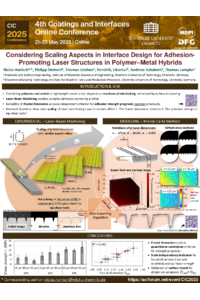
CIC2025_Hanisch_Poster.pdf
Illuminating Surfaces: Emerging Trends in Laser Surface Texturing Applications
Laser-Induced Copper Oxidation for Improved Performance in Anode-Free Lithium Metal Batteries